FIRE stands for Financial Independence, Retire Early. It describes a movement of people who prioritize saving and investing aggressively in order to achieve financial independence — the point at which investment returns can sustain their lifestyle without earned income — earlier than traditional retirement age.
The FIRE community has grown significantly over the past decade, driven partly by disillusionment with traditional 40-year careers and partly by a recognition that the standard "save 10% and retire at 65" model does not work well for everyone. But FIRE is not a single strategy. It encompasses a wide range of approaches, from extreme austerity to relatively modest adjustments to standard financial planning.
The Mathematical Foundation: The 4% Rule
FIRE planning rests on a research finding called the 4% rule (or the "safe withdrawal rate"). Derived from the Trinity Study — a 1998 analysis of historical market data by three finance professors — the 4% rule states that a retiree who withdraws 4% of their portfolio in year one, then adjusts for inflation each subsequent year, has historically had approximately a 95% chance of not running out of money over a 30-year retirement period.
The implication for FIRE: to determine how much you need to retire, multiply your annual spending by 25. If you spend $50,000 per year, you need a $1.25 million portfolio. If you spend $40,000, you need $1 million. This gives you your "FIRE number."
Important caveats: The original Trinity Study covered 30-year retirements. FIRE adherents who retire at 40 or 45 face 40–50 year retirements, which increases the risk that a 4% withdrawal rate eventually depletes the portfolio. Some FIRE practitioners use a 3–3.5% withdrawal rate for longer retirements, which implies a higher portfolio multiple (28–33x annual expenses).
Lean FIRE
Lean FIRE means achieving financial independence with a lean, frugal lifestyle — typically targeting $25,000–$40,000 per year in expenses. Your FIRE number might be $625,000 to $1 million. The advantage is that you can reach FIRE faster because both the target portfolio is smaller and the aggressive saving required produces a higher savings rate. The trade-off is living on less — often in lower cost-of-living areas, with minimal discretionary spending.
Lean FIRE works best for people who genuinely prefer a simple lifestyle, not those who are forcing frugality they will grow to resent. It also requires careful planning for healthcare costs (a major consideration before Medicare eligibility at 65), sequence-of-returns risk in early retirement, and lifestyle flexibility.
Fat FIRE
Fat FIRE targets financial independence with a comfortable, relatively generous lifestyle — often $80,000 to $150,000 or more per year in spending. Your FIRE number might be $2 million to $4 million or higher. The portfolio required is substantially larger, and the timeline to reach it is longer. But Fat FIRE provides considerably more lifestyle flexibility and a larger buffer against unexpected costs, healthcare expenses, and market downturns.
Fat FIRE is more achievable for high-income professionals — doctors, engineers, lawyers, finance professionals — who can maintain high savings rates despite higher spending. A person earning $250,000 and saving 40% can potentially reach a Fat FIRE number in 15–20 years.
Coast FIRE
Coast FIRE is a different concept from Lean or Fat FIRE. Instead of reaching a portfolio that fully supports your lifestyle, Coast FIRE asks: how much do I need invested today so that, with no additional contributions, compound growth will deliver my full retirement portfolio by traditional retirement age (65 or 67)?
The core insight is that compounding does the heavy lifting if you have enough time. If you have 25 years until retirement and assume 7% annual returns, a dollar invested today grows to approximately $5.43. You need far less saved today if you leave decades for compounding to work.
Example: You want $1.5 million at age 65. At a 7% real return, the Coast FIRE number at age 40 is approximately $276,000 — because $276,000 compounding at 7% for 25 years grows to roughly $1.5 million without any additional contributions. Once you have hit your Coast FIRE number, you theoretically need only earn enough to cover your current expenses — you do not need to save additionally for retirement.
Coast FIRE is particularly appealing for people who want to reduce career pressure without fully retiring. After hitting their Coast number, they might switch to part-time work, a less stressful job, or self-employment with lower income — confident that retirement is already handled.
Barista FIRE and Semi-Retirement
Many FIRE practitioners land somewhere in between — working part-time or in a low-stress job that covers basic expenses while their investment portfolio grows or partially funds the gap. This "Barista FIRE" or semi-retirement model allows them to leave demanding careers much earlier without needing a complete FIRE portfolio.
The Practical Path to FIRE
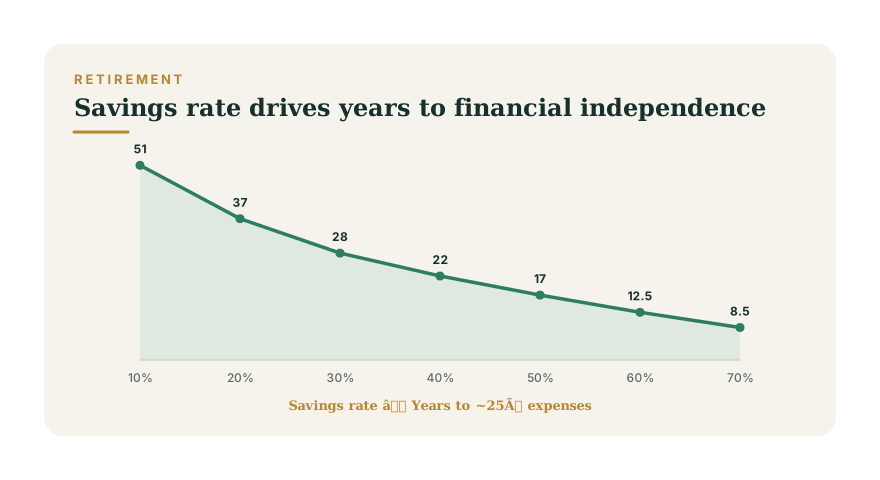
FIRE is essentially an extreme application of standard personal finance principles: spend less than you earn, invest the difference, repeat. The distinguishing factor is the savings rate. Traditional advice says save 10–15% of income. FIRE adherents typically save 25–50%, with some saving over 70%.
The relationship between savings rate and years to financial independence is dramatic:
- Savings rate 10%: approximately 42 years to FIRE
- Savings rate 25%: approximately 32 years to FIRE
- Savings rate 50%: approximately 17 years to FIRE
- Savings rate 75%: approximately 7 years to FIRE
(These assume a 5% real return and 4% withdrawal rate.)
The most actionable FIRE insight is not that you should retire at 35 — it is that every increase in savings rate dramatically shortens the time to financial independence. Whether you plan to fully retire early or simply want the option to work on your own terms, building toward FIRE creates the financial security to make better life choices at any age.