The Roth IRA and Traditional IRA both offer powerful tax advantages for retirement savings. The 2025 contribution limit is the same for both: $7,000 per year ($8,000 if you are 50 or older). Both grow tax-deferred. The fundamental difference is when you pay taxes — and that single question determines which is better for you.
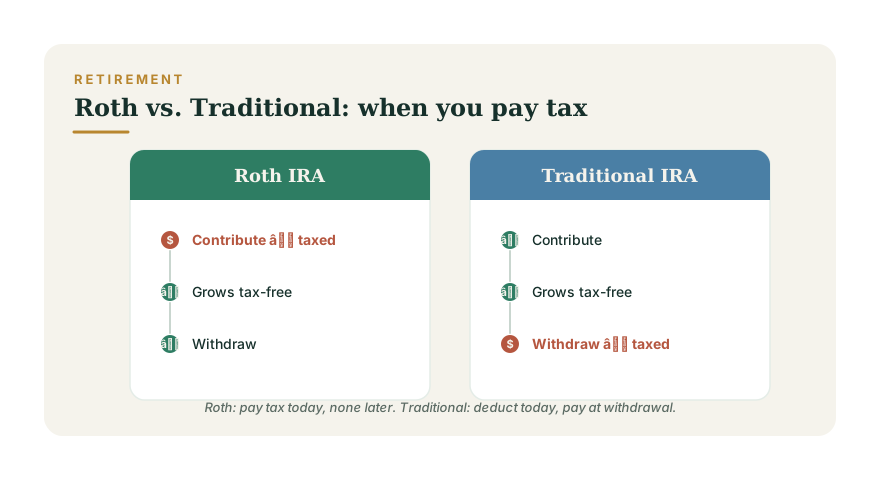
How Each Account Works
Traditional IRA: Contributions may be tax-deductible, reducing your taxable income in the year you contribute. Your money grows tax-deferred until withdrawal. In retirement, withdrawals are taxed as ordinary income. You are required to begin taking minimum distributions (RMDs) at age 73. The logic: you defer taxes now, when presumably you are in a higher bracket, and pay them later at a lower retirement income tax rate.
Roth IRA: Contributions are made with after-tax dollars — no deduction today. Your money grows tax-free. Withdrawals in retirement (after age 59½ and at least 5 years after the first contribution) are completely tax-free. No required minimum distributions during your lifetime. The logic: you pay taxes now, at your current rate, and never pay taxes on that money again — regardless of how much it grows.
The Key Question: Future Tax Rate
If your tax rate in retirement will be higher than your current rate, Roth wins — it is better to pay taxes at today's lower rate. If your tax rate in retirement will be lower than your current rate, Traditional wins — defer taxes until you are in a lower bracket.
The problem is that neither you nor your tax advisor can predict future tax rates with certainty. Tax laws change. Your income will change. The answer requires making educated guesses about both your future income and the future of the US tax code.
When Roth IRA Is Usually Better
Early career and lower current income. If you are in the 12% or 22% federal tax bracket today, paying taxes now is likely advantageous. Your income — and tax rate — will almost certainly be higher at peak career. Locking in today's low rate via Roth contributions is one of the most valuable things a young earner can do.
When you expect high retirement income. If you will have significant Social Security income, a pension, rental income, or other sources in retirement, your effective retirement tax rate may not be lower than your working rate. Roth contributions provide tax-free withdrawals on top of those other taxable sources.
When you want flexibility. Roth IRAs have no required minimum distributions during your lifetime. This makes them useful for estate planning (you can pass them to heirs who inherit tax-free) and for managing retirement income in a tax-efficient way. You can let a Roth grow untouched for decades while drawing from other accounts first.
When you might need access before retirement. Roth IRA contributions (not earnings, just what you put in) can be withdrawn at any time without penalty. This provides an emergency-fund-adjacent function that Traditional IRAs do not offer without penalty. This should not be your primary reason to choose Roth — but it is a meaningful advantage.
When Traditional IRA Is Usually Better
Peak earning years. If you are in the 32%, 35%, or 37% federal tax bracket, the immediate deduction from a Traditional contribution is substantial. Deferring tax at today's high rate to pay it later at a presumably lower retirement rate makes mathematical sense.
When current cash flow is tight. If money is genuinely tight, the immediate tax reduction from a Traditional IRA contribution frees up cash today. Reducing your tax bill by $1,500–$2,000 now may be worth more in your current situation than the future tax-free benefit of Roth.
When retirement income will be genuinely lower. Some people genuinely expect a simpler, lower-cost retirement lifestyle. If your retirement income — Social Security, part-time work, modest withdrawals — keeps you in the 12% or lower bracket, paying 22–24% taxes today to avoid 12% later is the wrong trade.
The Income Limits
Roth IRA contributions are limited for higher earners. In 2025:
- Single filers: phase-out begins at $150,000, eliminated at $165,000
- Married filing jointly: phase-out begins at $236,000, eliminated at $246,000
If your income exceeds these limits, you cannot contribute directly to a Roth IRA. However, the "backdoor Roth" strategy — contributing to a non-deductible Traditional IRA and then converting to Roth — is a legal workaround available to high earners. Consult a tax professional before executing this if you have existing Traditional IRA balances.
Traditional IRA deductibility also phases out if you (or your spouse) are covered by a workplace retirement plan and your income exceeds certain thresholds.
The Practical Answer for Most People
For people in their 20s and 30s who are not yet at peak income, default to Roth. The certainty of tax-free growth and withdrawals is valuable enough that the potential downside of paying taxes now (rather than later at a lower rate) is worth accepting. You can always convert traditional contributions to Roth later through a Roth conversion if rates and circumstances change.
For people in their 40s and 50s at peak income, the Traditional IRA or 401(k) deduction becomes more attractive. The immediate tax savings at high marginal rates are real and significant.
Many people end up with both Roth and Traditional balances, which is actually a useful position — it gives you the ability to manage your tax situation in retirement by choosing which account to draw from in any given year, keeping your taxable income in the most advantageous bracket.