Almost all retirement advice is about the climb: save more, invest cheaply, capture the match. Far less is said about the descent, which is where the real damage gets done. Spending your money down over a multi-decade retirement is genuinely harder than building it, because now taxes, withdrawal order, required distributions, and Social Security timing all collide at once. Get the sequence right and your money can last years longer; get it wrong and you can hand a fortune to the IRS and still risk running short late in life, exactly when you have the fewest options.
The honest truth: the order you spend matters as much as how much
Most retirees hold money in three tax buckets, and they are taxed completely differently:
- Taxable accounts (brokerage, savings): you owe tax only on gains and dividends, often at lower long-term capital-gains rates.
- Tax-deferred accounts (traditional 401(k) and IRA): every dollar you withdraw is taxed as ordinary income.
- Roth accounts (Roth IRA and Roth 401(k)): qualified withdrawals are completely tax-free and have no required distributions during your lifetime.
Because each bucket is taxed differently, the order you drain them in changes your lifetime tax bill, and over 30 years that difference compounds into a very large number.
The general withdrawal order
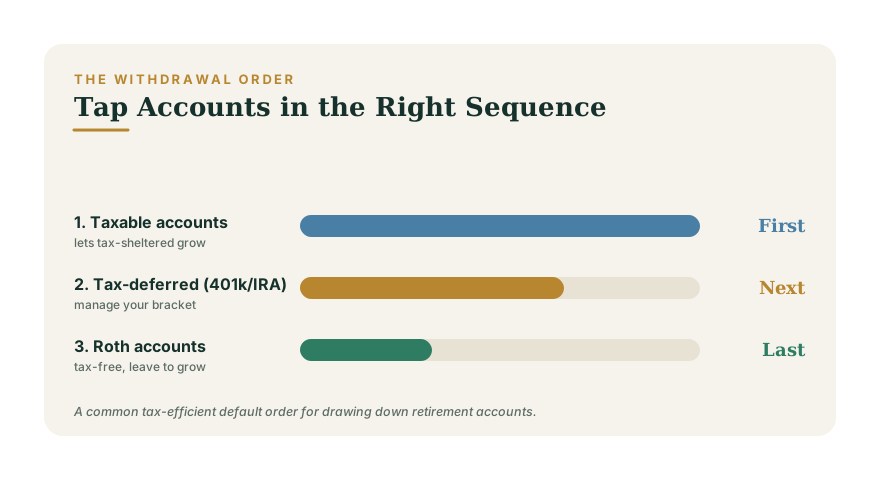
A common, sensible default is to spend in this sequence:
- Taxable accounts first. Spending these early generates relatively little tax and lets your tax-sheltered accounts keep compounding untouched for longer.
- Tax-deferred accounts next. Draw down the 401(k) and traditional IRA in the middle years, deliberately, watching your tax bracket as you go.
- Roth accounts last. Roth dollars grow tax-free, have no required distributions, and make an ideal inheritance, so you want them to keep compounding as long as possible.
This is a starting framework, not a rigid rule. The smarter version blends the buckets in any given year to control your taxable income, rather than fully emptying one before touching the next.
Manage your tax brackets every year
The real skill is bracket management. In a year where your income is low, you may have room to pull extra from tax-deferred accounts while still staying inside a low bracket, voluntarily paying tax now at a cheap rate to avoid being forced to pay it later at a high one. The reverse is also true: in a high-income year, lean on taxable or Roth dollars to avoid spilling into a higher bracket. The goal is to smooth your taxable income across retirement rather than letting it spike, because a smooth income line almost always pays less total tax than a lumpy one.
Use the gap years for Roth conversions
The window between retiring and the start of Social Security and required distributions, often your sixties, is frequently your lowest-income, lowest-tax stretch of life. These "gap years" are prime time for Roth conversions: moving money from a traditional IRA into a Roth, paying tax on it now at today's low rate. Done deliberately, this shrinks the future tax-deferred balance that would otherwise trigger large taxable required distributions, and it builds up tax-free Roth money for later. Convert just enough each year to fill up a low bracket without spilling into the next one.
Plan around RMDs
At the required age (currently in the mid-seventies, depending on your birth year), the government forces you to start taking required minimum distributions from tax-deferred accounts whether you need the money or not, and each one is taxed as ordinary income. If you let a traditional 401(k) or IRA grow untouched until then, the forced withdrawals can be large enough to push you into a higher bracket and raise other costs in retirement. Drawing down tax-deferred accounts thoughtfully in your sixties, and converting some to Roth, is largely about defusing this RMD bomb before it goes off.
Coordinate with Social Security
Drawdown and Social Security timing are two halves of the same plan. Delaying Social Security to 70 maximizes that inflation-protected check, but it means you need other money to live on in the meantime, which is exactly what makes the gap years so useful for spending down tax-deferred accounts and running Roth conversions. The two decisions reinforce each other: living off your portfolio early lets your Social Security grow, and a thoughtful drawdown gives you the room to wait.
The bucket strategy and guardrails
To manage sequence-of-returns risk (the danger of selling investments during a downturn), many retirees use a bucket strategy: keep one to two years of spending in cash, a few more years in bonds, and the rest in stocks. When markets fall, you spend from the cash bucket instead of selling stocks at a loss, then refill it when markets recover. Pairing that with spending guardrails (trimming withdrawals a little in bad years, allowing a bit more in good ones) keeps a long retirement from being derailed by a single bad stretch.
Your drawdown checklist
- Set a default order: taxable first, tax-deferred next, Roth last, then blend to manage brackets.
- Smooth your taxable income year to year instead of letting it spike.
- Use the low-income gap years for Roth conversions, filling up cheap brackets.
- Defuse RMDs by drawing down or converting tax-deferred money before the required age.
- Coordinate with Social Security so delaying it and spending the portfolio work together.
- Hold a cash and bond buffer and use guardrails to survive market downturns.
The honest recommendation
Build a written withdrawal order before you retire, then revisit it every year, because the optimal move changes with markets, tax law, and your own income. The biggest, most common mistake is hoarding tax-deferred accounts untouched until RMDs force a tax avalanche; the second is selling stocks in a crash because you had no cash buffer. A deliberate order, active bracket management, gap-year Roth conversions, and a cash cushion together can make the same nest egg last meaningfully longer. This is one area where, given the stakes, professional help can genuinely pay for itself, provided it comes from an unbiased, fee-only source.
Map out your own withdrawal order and see how different sequences affect how long your money lasts using the wealth simulator, fold it into your full plan, or check where your retirement readiness stands on your scores. Spending it down wisely is the part of retirement nobody trains you for, and it is the part that decides whether the money outlives you or you outlive it.