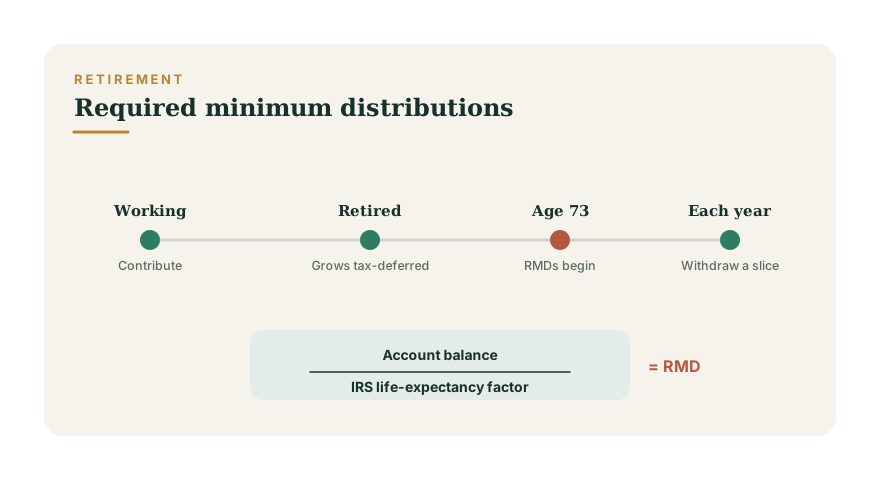
A Required Minimum Distribution (RMD) is a mandatory annual withdrawal from pre-tax retirement accounts that the IRS requires you to begin taking at age 73 (or 75 for those born in 1960 or later, under SECURE Act 2.0). The rule exists because the government gave you a tax deduction when you contributed to Traditional IRAs and 401(k)s, and it eventually wants that deferred tax revenue.
For many retirees, RMDs are a non-event — they need the money to live on anyway. But for those who have accumulated large pre-tax balances or have other income sources in retirement, RMDs can create significant, preventable tax problems. Understanding the rules and planning around them early can save tens or hundreds of thousands of dollars over a long retirement.
Which Accounts Have RMDs?
RMDs apply to all pre-tax retirement accounts:
- Traditional IRA
- Traditional 401(k), 403(b), 457(b)
- SEP-IRA
- SIMPLE IRA
- Inherited IRAs (different rules apply — see below)
RMDs do not apply to Roth IRAs during your lifetime. This is one of the most significant advantages of Roth accounts: your money can continue growing tax-free without ever being forced out. (Inherited Roth IRAs do have RMD rules for non-spouse beneficiaries.)
How RMD Amounts Are Calculated
Your RMD for each year is calculated by dividing your account balance as of December 31 of the prior year by a life expectancy factor from the IRS Uniform Lifetime Table. The factor decreases each year as you age, which means the percentage you must withdraw increases over time.
At age 73, the factor is 26.5 — meaning you must withdraw approximately 3.77% of your balance. At 80, the factor is 20.2 — approximately 4.95%. At 90, it reaches 12.2 — approximately 8.2%.
Example: If you have $1 million in Traditional IRA accounts at age 73, your RMD is $1,000,000 ÷ 26.5 = approximately $37,736. That $37,736 is added to your other taxable income for the year.
If you have multiple IRAs, you can calculate the total RMD across all IRAs and take it from any combination of those accounts. For 401(k)s and other employer plans, you must calculate and take the RMD separately for each plan.
The Tax Impact: Why Large RMDs Are a Problem
RMD amounts are taxed as ordinary income. Large RMDs can push you into higher tax brackets, trigger the Medicare Income-Related Monthly Adjustment Amount (IRMAA — a surcharge on Medicare premiums for higher earners), cause more of your Social Security benefits to be taxable, and increase your Medicare Part B and D premiums with a two-year lag.
This "RMD time bomb" is a real planning risk for people who have accumulated large pre-tax balances. If you reach 73 with $2–$3 million in Traditional IRAs and defer taking any distributions before that, your RMDs in your 70s and 80s may force more taxable income per year than you actually need to live on — and at higher rates than you might have paid through careful early withdrawals.
Strategies to Manage RMD Tax Impact
Roth conversions before RMDs begin. If you retire before 73, the window between retirement and RMD start age is an opportunity to convert Traditional IRA funds to Roth at potentially lower tax rates. Each dollar converted is taxable income in the conversion year, but it reduces future RMDs and creates a tax-free Roth balance. For many retirees, strategically converting $20,000–$50,000 per year in their late 60s and early 70s significantly reduces the RMD tax bomb.
Qualified Charitable Distributions (QCDs). If you are 70½ or older and charitably inclined, you can donate up to $105,000 per year (2025 limit) directly from your IRA to a qualified charity. This transfer counts toward your RMD but is excluded from your taxable income — a better outcome than taking the RMD, paying tax, and then donating the after-tax amount. For charitably inclined retirees, QCDs are among the most tax-efficient giving strategies available.
Working past 73. If you are still employed at 73 and participating in your current employer's 401(k), you can generally delay RMDs from that specific plan until you retire (provided you do not own more than 5% of the company). This does not affect IRAs or old employer plans, which are still subject to RMDs at 73.
Spending from Traditional accounts first. Some retirees instinctively preserve their Roth accounts and spend pre-tax accounts first. This approach reduces the balance subject to RMDs and may make sense when your current tax rate is lower than you expect it to be after RMDs begin.
The Penalty for Missing RMDs
The penalty for failing to take a required RMD is steep: 25% of the amount that should have been withdrawn (reduced to 10% if corrected within two years). For context, if your RMD was $40,000 and you missed it entirely, you owe a $10,000 penalty on top of the ordinary income tax on the eventual distribution.
The IRS does offer a process to request a waiver for reasonable errors. But the better approach is to automate RMD withdrawals through your brokerage. Most major custodians will calculate and distribute your RMD automatically if you ask them to, eliminating the risk of accidentally missing a distribution.
Inherited IRAs
If you inherit an IRA from someone other than a spouse, the SECURE Act (2019) eliminated the popular "stretch IRA" strategy for most non-spouse beneficiaries. You are now generally required to fully distribute the inherited IRA within 10 years of the original owner's death. Annual RMDs may or may not be required within that 10-year window depending on whether the original owner had already started RMDs. This is a complex area where the rules have changed recently and professional tax guidance is worthwhile.
The key takeaway for most people: if you have significant pre-tax retirement savings, begin planning your RMD strategy at least 5–10 years before age 73. The decisions you make in your early-to-mid retirement years — particularly around Roth conversions — have an enormous impact on your tax burden in your 80s.