Social Security is the largest single source of retirement income for most Americans, yet most people make their claiming decision without running the numbers. The difference between claiming at 62 and waiting until 70 can exceed $200,000 in lifetime benefits for the average recipient. Understanding the tradeoffs — and the strategies that make the most of them — is one of the highest-value things you can do for your retirement.
How Social Security Benefits Are Calculated
Your Social Security benefit is based on your 35 highest-earning years. The Social Security Administration (SSA) adjusts these earnings for wage inflation and calculates your Primary Insurance Amount (PIA) — the monthly benefit you receive if you claim at your Full Retirement Age (FRA).
FRA is 67 for everyone born in 1960 or later. For those born before 1960, FRA is between 65 and 67 depending on birth year.
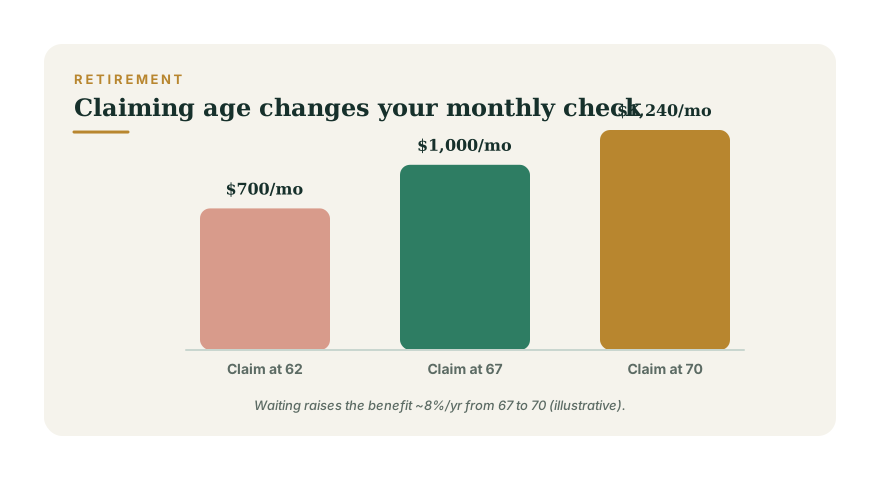
You can claim as early as 62 or as late as 70. Your benefit adjusts based on when you claim relative to your FRA:
- Claim at 62: benefit reduced by approximately 25–30% below PIA
- Claim at FRA (67): receive 100% of PIA
- Claim at 70: benefit increased by approximately 24–32% above PIA (8% per year from FRA to 70)
There is no financial benefit to claiming after 70 — the delayed credits stop at that age.
The Break-Even Analysis
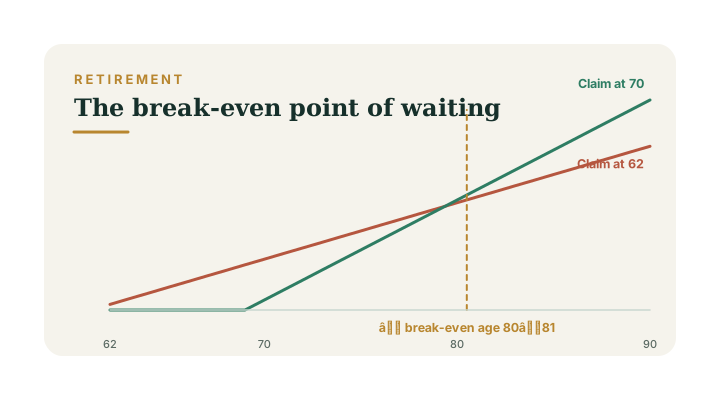
The core question in Social Security timing is: does the higher monthly payment from waiting justify the months of payments you missed?
Suppose your benefit at FRA (67) is $2,000/month. If you claim at 62, you receive approximately $1,400/month. If you wait until 70, you receive approximately $2,480/month.
Claiming at 62 vs FRA: You receive $1,400/month for 5 years before your FRA peer starts. By the time you both reach 67, you have collected approximately $84,000 more. But from age 67 forward, the FRA claimant receives $600/month more. The break-even is around age 78. If you live past 78, waiting until 67 was better.
Claiming at 62 vs 70: The person who waited until 70 receives $1,080/month more than the early claimer. But the early claimer collected for 8 extra years before age 70, accumulating a substantial head start. The break-even is around age 80–82. If you live past 80, waiting until 70 was better.
The average life expectancy for a healthy 65-year-old is approximately 85 for women and 83 for men — above the break-even point for waiting. If your health is good and your family history suggests longevity, waiting typically pays off.
When Claiming Early Makes Sense
Poor health or reduced life expectancy. If you have a serious medical condition or family history of short lifespan, claiming at 62 captures more total lifetime benefits. The break-even math does not work in your favor if you are unlikely to live into your 80s.
Immediate financial need. If you have no other income source and must retire at 62 for financial reasons, claiming is the right choice. A reduced benefit is better than no income.
Lower-earning spouse in a dual-income household. In some spousal benefit strategies, it makes sense for the lower earner to claim early while the higher earner delays. The lower earner's reduced benefit is more than offset by the higher earner's delayed credits, which also increases the survivor benefit.
When Waiting Until 70 Makes Sense
Good health and family longevity. If you are healthy at 62 and your parents and grandparents lived into their late 80s or 90s, the probability strongly favors waiting. The higher monthly benefit for a longer retirement creates substantially more lifetime income.
Higher earner in a married couple. Social Security pays a survivor benefit equal to the higher earner's benefit upon their death. By maximizing the higher earner's benefit (by waiting until 70), you are also maximizing the survivor benefit that the lower-earning spouse will receive if the higher earner dies first. This is particularly important because women statistically outlive men.
Working or have other income. If you continue working past 62, claiming Social Security early reduces your benefit through the earnings test: if you earn above a threshold (about $22,320 in 2025), SSA withholds $1 for every $2 you earn above the limit. (These withheld benefits are later added back when you reach FRA, but the interaction creates complexity.) If you are still working, delaying Social Security is usually simpler and financially superior.
Spousal and Survivor Benefits
Married couples have more strategic options than single individuals.
A spouse who earned significantly less (or did not work) can claim a spousal benefit equal to up to 50% of the higher earner's PIA — but only if the higher earner has already claimed. This affects the sequencing of claiming decisions for couples.
Upon a spouse's death, the survivor receives the higher of their own benefit or the deceased spouse's benefit. If the higher earner waited until 70, the survivor receives that higher-70 benefit for the rest of their life. This makes the higher earner's claiming decision essentially a life insurance decision for the surviving spouse.
Checking Your Estimated Benefit
Create an account at SSA.gov to see your earnings record and projected benefit at different claiming ages. The estimates are based on your actual earnings history and are far more accurate than general rules of thumb. Review it annually to catch any errors in your earnings record — which are more common than most people realize and can affect your benefit if not corrected.
For most people in good health, waiting at least until FRA — and ideally until 70 if finances allow — is the mathematically sound choice. Run your numbers before making a decision you cannot reverse.