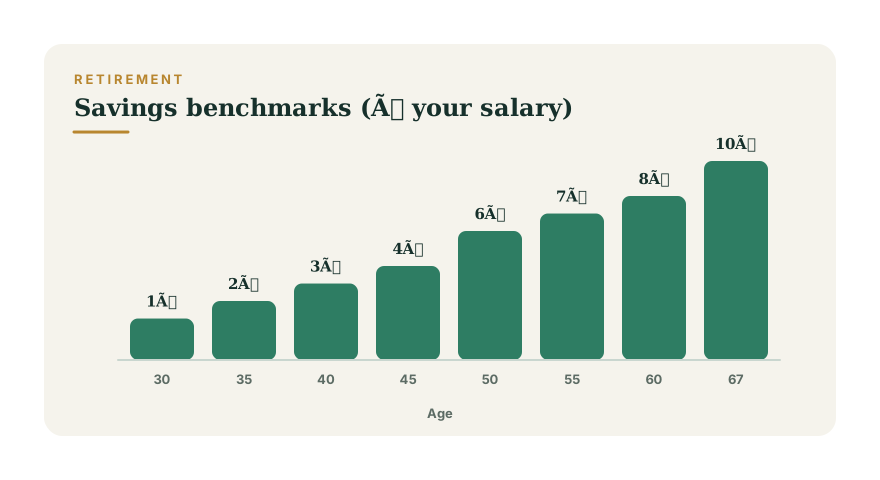
Retirement savings benchmarks circulate widely in personal finance — you may have heard that you should have 1x your salary saved by 30, 3x by 40, 6x by 50, and so on. These numbers come from reasonable assumptions about savings rates and investment returns, and they provide a useful reality check. But they can also be deeply misleading if you do not understand what they are actually measuring.
The Standard Benchmarks — and Their Assumptions
The most commonly cited benchmarks suggest the following targets:
- By age 30: 1x your annual salary
- By age 35: 2x your annual salary
- By age 40: 3x your annual salary
- By age 45: 4x your annual salary
- By age 50: 6x your annual salary
- By age 55: 7x your annual salary
- By age 60: 8x your annual salary
- By age 67: 10x your annual salary
These benchmarks assume you will need to replace about 75–85% of your pre-retirement income in retirement, that Social Security will cover roughly 30–40% of that (at average income levels), that you will retire at 67, and that your portfolio will sustain a 4–4.5% annual withdrawal rate.
Change any of these assumptions and the targets change significantly.
Why Salary-Multiple Benchmarks Are Imperfect
High earners need less. If you earn $300,000 per year and currently save 40% of your income, you are not actually spending the full $300,000 — you are spending roughly $180,000. You do not need to replace $300,000 in retirement; you need to replace $180,000 (minus taxes). A 10x salary target of $3 million is probably more than you need.
Low earners have more support. Social Security replaces a higher percentage of income for people who earned less during their careers. A person earning $50,000 per year might have Social Security replace 40–50% of their pre-retirement income. For them, the portfolio burden is lower, and a 10x salary target may be conservative.
Retirement age matters enormously. The benchmarks above assume retirement at 67. If you plan to retire at 55, you need a much larger portfolio — both because withdrawals start earlier and because you are not eligible for Social Security until 62 (and receive reduced benefits before full retirement age). If you plan to work until 70, a smaller portfolio may suffice.
A Better Framework: Your Personal Retirement Number
Instead of using salary-multiple benchmarks, calculate your own retirement number based on what you actually plan to spend.
Step 1: Estimate your annual retirement spending. Think about what your lifestyle will cost in retirement. Many retirees spend less on commuting, work clothes, and childcare. But they spend more on healthcare, travel, and hobbies. A reasonable rule of thumb is 75–85% of current spending — but be specific if you can.
Step 2: Subtract guaranteed income. Estimate your Social Security benefit (available at SSA.gov or through the Social Security Optimizer tool). If you have a pension, include that. Deduct this guaranteed income from your annual spending estimate. The remainder is what your portfolio must cover.
Step 3: Apply the 4% rule. Multiply the portfolio-funded portion of your annual spending by 25. This is the portfolio size needed to support a 4% annual withdrawal rate — the rate that historical research suggests is sustainable over a 30-year retirement with a reasonable asset allocation. If you plan a longer retirement (35+ years) or are very conservative, multiply by 28–33 instead.
Example: You expect to spend $80,000 per year in retirement. Social Security will cover $28,000. Your portfolio needs to fund $52,000 per year. $52,000 × 25 = $1.3 million — your retirement number.
Are You Behind? What to Do
The benchmarks suggest you are behind if your current savings are significantly below the salary-multiple targets for your age. If that is the case, the most effective levers are:
Increase savings rate. Every percentage point increase in savings rate shortens the time to retirement and/or increases the portfolio you accumulate. Going from a 10% to a 20% savings rate has a more significant impact than most market return improvements.
Increase earnings. A promotion, job change, or side income stream that increases take-home pay gives you more to save. If your savings rate stays constant, higher income translates directly to faster accumulation.
Delay retirement by a few years. Working until 68 instead of 65 gives three more years of accumulation, three fewer years of withdrawals, and typically higher Social Security benefits. The impact on required portfolio size is substantial.
Reduce expected retirement spending. If you plan to pay off your mortgage before retirement, your monthly expenses drop significantly. Geographic arbitrage — retiring to a lower cost-of-living area — can dramatically reduce the portfolio needed.
If You Are Starting Late
The most important thing to know about starting late is that the situation is rarely as dire as the benchmarks suggest — especially if you are willing to make a few adjustments.
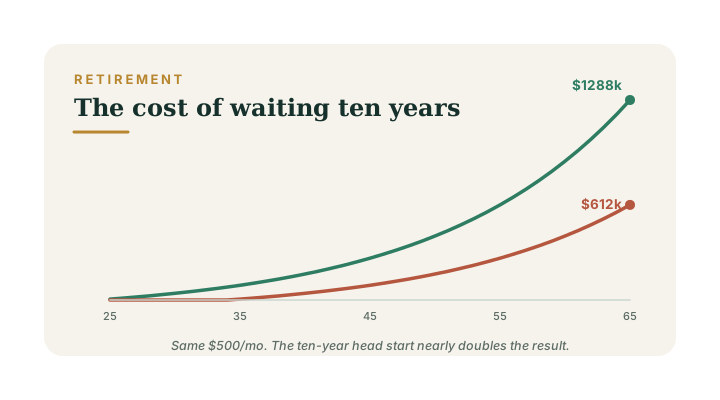
People who start investing in their 40s and maintain a high savings rate can still accumulate meaningful portfolios. The compounding period is shorter, which means the required savings rate is higher, but the math is not hopeless. Use the retirement planning calculator to model your specific situation before concluding you cannot catch up.
Retirement planning is not a pass/fail test. Every additional dollar saved and every additional year of work improves the outcome. The worst thing to do is nothing because the benchmarks feel too far away.