Albert Einstein may or may not have called compound interest the eighth wonder of the world — the attribution is probably apocryphal. But whoever said it was onto something important. Compound interest is not a financial trick or a marketing slogan. It is a mathematical principle that governs how money grows over time, and understanding it changes the way you think about every financial decision you make.
Simple Interest vs Compound Interest
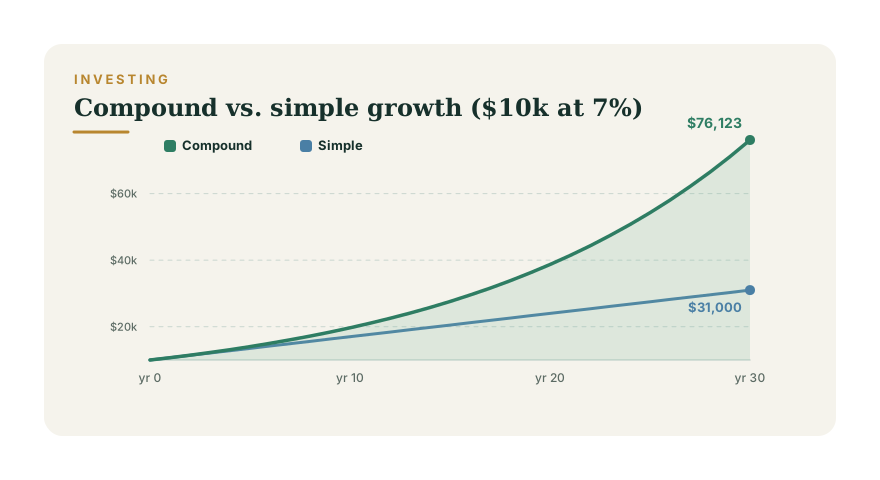
Simple interest pays a return only on the original principal. If you invest $10,000 at 7% simple interest, you earn $700 each year — always $700, no matter how long you hold the investment.
Compound interest pays a return on both the principal and the accumulated interest. In year one, you earn $700. In year two, you earn 7% on $10,700, which is $749. In year three, you earn 7% on $11,449, which is $801. The interest earns interest. The growth accelerates.
After 10 years, $10,000 at 7% simple interest grows to $17,000. At 7% compound interest, it grows to $19,672. After 30 years, simple interest yields $31,000. Compound interest yields $76,123. The gap between the two is not linear — it widens dramatically over time.
The Rule of 72
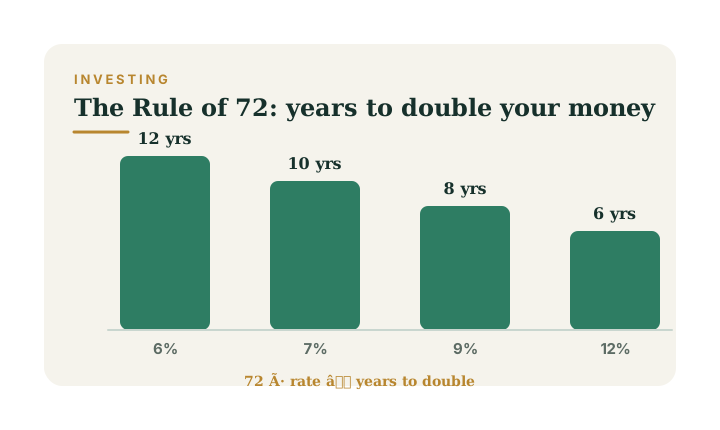
The Rule of 72 is a shortcut for calculating how long it takes your money to double at a given interest rate. Divide 72 by the annual interest rate to get the approximate number of years to double.
- At 6%: 72 ÷ 6 = 12 years to double
- At 7%: 72 ÷ 7 ≈ 10 years to double
- At 9%: 72 ÷ 9 = 8 years to double
- At 12%: 72 ÷ 12 = 6 years to double
The Rule of 72 also works in reverse. Credit card debt at 24% APR doubles every 3 years. A balance of $5,000 becomes $10,000 in 3 years, $20,000 in 6 years, if left unpaid.
Why Time Matters More Than Amount
The most counterintuitive thing about compound interest is that time is a more powerful variable than the amount you invest. Consider two investors:
Investor A contributes $5,000 per year from age 25 to 35 (10 years, total invested: $50,000), then stops contributing and lets the money grow until age 65.
Investor B starts at age 35 and contributes $5,000 per year all the way to age 65 (30 years, total invested: $150,000).
Assuming a 7% annual return, Investor A ends up with approximately $602,000 at age 65. Investor B ends up with approximately $472,000 — despite contributing three times as much money.
Investor A wins because their money had 40 years to compound; Investor B's money had at most 30 years. The 10-year head start is worth more than 20 additional years of contributions. This is the most important implication of compound interest for young investors: starting early is more powerful than contributing more later.
Compounding Frequency
Compounding frequency refers to how often interest is calculated and added to the principal. Common frequencies include annually, quarterly, monthly, and daily. The more frequently interest compounds, the faster growth occurs.
In practice, the difference between monthly and daily compounding is small. The difference between monthly compounding (most investment accounts) and annual compounding is more meaningful over long periods. When evaluating savings accounts and CDs, look for the APY (Annual Percentage Yield) rather than the APR — APY already accounts for the effect of compounding frequency, making different products directly comparable.
Compounding Working Against You: Debt
Compound interest is the engine of wealth creation when you are the lender (investor). It is the engine of wealth destruction when you are the borrower.
Credit card interest compounds daily on most cards. A $5,000 balance at 22% APR costs approximately $1,100 in interest in the first year — but that interest is added to the balance, so the next year's interest is calculated on $6,100. If you make only minimum payments, the balance grows faster than you can pay it down.
This is why paying off high-interest debt is mathematically equivalent to earning a guaranteed return equal to the interest rate. Paying off a 22% credit card balance is a guaranteed 22% return on that money — no market risk, no volatility. No investment reliably matches it.
Making Compounding Work for You
The practical implications of compound interest point toward a few clear actions:
Start investing as early as possible, even in small amounts. Increase contributions when your income grows. Minimize investment fees — a 1% annual fee does not seem large, but it reduces your compound growth rate and costs significantly more over 30 years than the fee itself suggests. Avoid dipping into investments early, which resets the compounding clock. And eliminate high-interest debt, which is compounding against you.
You do not need to understand the mathematics of compound interest in detail to benefit from it. You just need to start early, stay consistent, and let time do the work.