Most investing advice focuses on what to buy. But decades of research point to a quieter, costlier problem: the gap between what an investment returns and what the average investor actually earns from it. That gap is not caused by bad funds. It is caused by human behavior — the predictable mental shortcuts that push us to buy high, sell low, and trade too much.
Understanding these biases will not make them disappear; even professionals feel them. But naming them, and building a few rules that make the right choice the automatic one, is the most reliable edge a regular investor has.
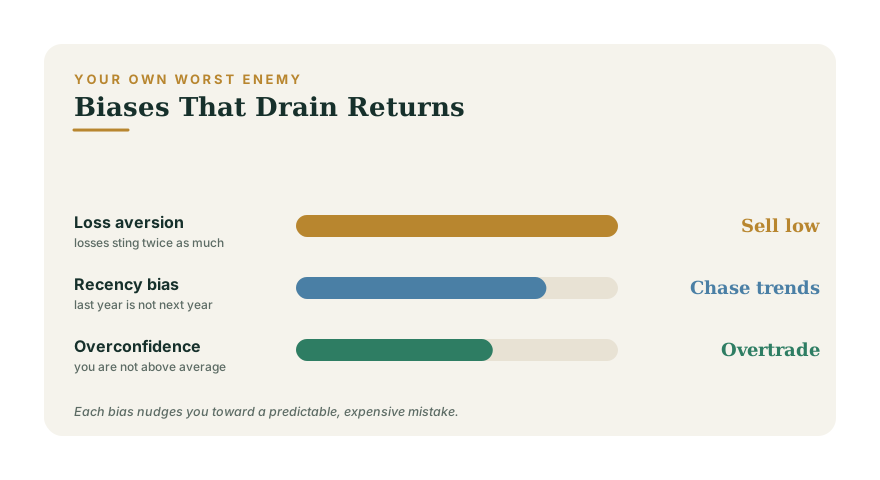
Loss aversion: losses hurt about twice as much as gains feel good
Loss aversion is the best-documented bias in finance. The pain of losing $1,000 is psychologically about twice the pleasure of gaining $1,000. That imbalance drives the single most expensive investor mistake: selling during a downturn to make the bad feeling stop, then sitting in cash through the recovery. It also shows up as holding a losing stock far too long because selling would "lock in" the loss and make it real.
The fix is to take the in-the-moment decision out of your hands. If your plan is automatic and your allocation is set in advance, a scary week is just a week — not a prompt to act. This is one big reason why trying to time the market doesn't work: the urge to flee almost always peaks at exactly the wrong moment.
Recency bias: assuming the recent past will continue
Recency bias is the tendency to weight what just happened far more than the long-term record. After a hot year, you assume the streak continues, so you pile into last year's winner. After a crash, you assume the pain continues, so you stay out. Both lead to buying high and selling low — the exact opposite of what works.
You see recency bias whenever someone picks a fund off a "top performers" list. Past performance is a poor predictor of future returns, and chasing it is a documented way to underperform. We unpack that trap in how fund managers trick you with performance numbers.
Herd behavior: comfort in the crowd
Herd behavior is the pull to do what everyone else is doing. When a stock, sector, or coin is all over the news and your neighbor is bragging about gains, the social pressure to join is enormous — and it feels safer than standing apart. But by the time an asset is a crowd favorite, the easy gains are usually gone and the risk is highest. Herding is how bubbles inflate and how ordinary people end up buying at the top.
The antidote is a written plan you made when you were calm. If an investment is not in your strategy, "everyone's doing it" is not a reason to add it.
Overconfidence: believing you are the exception
Overconfidence convinces us we can pick winners, time entries, and beat the average — even though, by definition, most people can't. Its most measurable cost is overtrading: studies consistently find that the more frequently investors trade, the worse they do, after costs and taxes. Confidence also makes us under-diversify, betting too much on a single stock or our own employer.
If even professional stock pickers mostly fail to beat the index over time, humility is the realistic stance. A low-cost, broadly diversified portfolio is an admission that you can't predict the future — and that admission is what wins.
Anchoring: fixating on an irrelevant number
Anchoring is latching onto a reference point — usually the price you paid — and judging decisions against it instead of the facts now. "I'll sell once it gets back to what I paid" is anchoring; the market does not know or care what you paid. Anchoring keeps people in bad investments waiting for a number that may never return, and out of good ones that have "already gone up."
The fixes that actually work: rules and automation
You can't think your way out of a bias in the moment, because the bias is the thinking. So design choices that remove the moment:
- Automate contributions. Set a fixed amount to invest on payday. This is dollar-cost averaging in practice — you buy on schedule regardless of headlines, which neutralizes recency bias and herding.
- Write an investment policy. One page: your target asset allocation, why you chose it, and the rule that you only change it on a set schedule. When fear hits, you follow the page, not the feeling.
- Rebalance on a calendar, not on emotion. Rebalancing once or twice a year mechanically forces you to sell what's high and buy what's low — the opposite of every bias above. See how rebalancing works.
- Look less often. Checking constantly amplifies loss aversion; we cover the damage in why checking your portfolio every day hurts returns.
The investor who automates, diversifies broadly, and reviews on a schedule isn't smarter than everyone else — they've just built a system their own brain can't sabotage. To see where your instincts might be steering you, the Investor Profile assessment is a useful, honest starting point.