When a fund company shows you a chart that beats the market, your instinct is to assume the manager is skilled. The more useful question is: which fund is this, and what happened to all the others the same company launched? Because the single most powerful trick in fund marketing is not lying about a number. It is choosing which numbers you get to see at all.
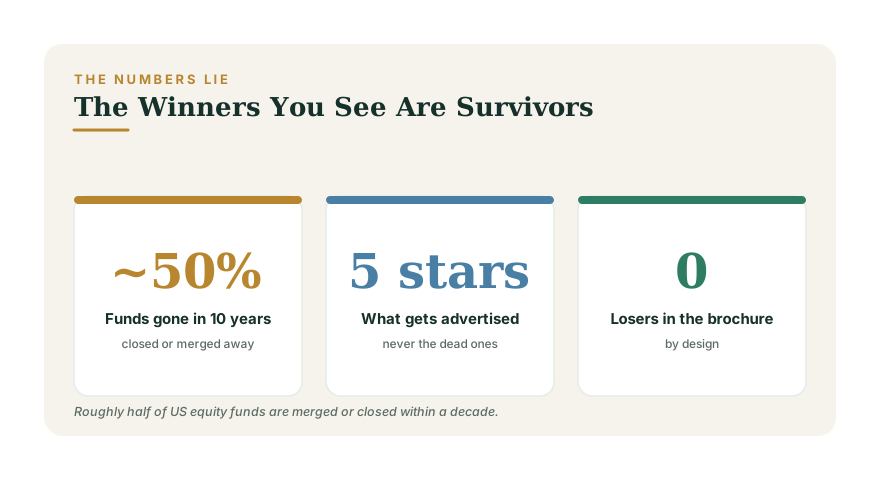
The honest truth: you are seeing the survivors
Roughly half of US stock funds are closed or merged out of existence over any given ten-year stretch. When a fund performs badly, the company does not keep advertising it. It quietly folds it into another fund, the bad track record vanishes, and the average performance of the funds that remain magically looks better. This is survivorship bias, and it is baked into almost every "the average fund returned X" statistic you will ever see. You are looking at a graveyard with the headstones removed.
Follow the money
A large fund family does not place one bet. It places dozens. Here is the playbook:
- Incubation. The company launches several small, private funds with seed money. It does not advertise any of them yet. A few will get lucky, a few will flop. Then it shuts down the flops, opens the lucky one to the public, and markets its "track record since inception" as if that winner was the plan all along. It was not the plan. It was a coin-flipping tournament, and you only meet the finalist.
- Cherry-picking the date. Performance is quoted from whatever start date makes the chart look best. Start the clock right after a crash and almost anything looks like genius.
- Cherry-picking the benchmark. A fund that owns risky small companies will compare itself to a calm large-company index it was never trying to match, so its extra risk reads as extra skill.
None of this is illegal. It is the standard way the industry converts random luck into a marketable story, because gathering assets is how the company gets paid, and a great-looking chart gathers assets.
The math of the coin-flip factory
Imagine a fund company launches 16 incubated funds. In any given year, suppose each has a 50% chance of beating the market by luck alone. After one year, about 8 are ahead. After two years, about 4 have beaten the market both years. After three years, about 2. After four years, about 1 fund has beaten the market four years running, purely by chance.
That one fund now gets a five-star rating, a glossy brochure, and a "four consecutive years of outperformance" headline. The other 15 are quietly shut down. You never hear about them, so you cannot tell the difference between a genuinely skilled manager and the inevitable winner of a coin-flipping contest. The track record looks like skill. The math says it is mostly noise.
This is why "past performance does not guarantee future results" is not legal boilerplate to skim past. It is the single truest sentence in the entire document, and the company is required to print it because it knows the chart above it is misleading.
There is one more sleight of hand worth naming: the comparison group. When a fund advertises that it "beat 90% of its peers," ask who is left in that peer group. The badly performing peers have been closed and erased, so the surviving field the fund is beating is itself a survivor pool. The fund is winning a race after most of the slow runners were quietly removed from the results. Stacked on top of incubation and date selection, it means a "top decile" ranking can describe a perfectly ordinary fund that simply outlasted its stablemates.
How to protect yourself
- Judge the whole fund family, not the one fund. Ask how many funds they have launched and closed. A firm with a wall of five-star funds and a trail of dead ones is running the coin-flip factory.
- Distrust any track record under ten years. Short records are mostly luck. Even ten years is barely enough to separate skill from chance.
- Check the benchmark. If a fund beats "the market" but the market it chose is suspiciously easy to beat, the outperformance is borrowed risk, not skill.
- Ignore star ratings as a buy signal. They are backward-looking and do not predict future returns. High past returns often just mean high past risk that will eventually bite.
- Look at the fee first. The one number that does predict future net returns is the expense ratio, and it is the one thing the brochure plays down.
The honest recommendation
You cannot reliably pick next decade's winning manager, because the very evidence you would use to pick them, the track record, has been pre-filtered to hide the failures. So stop trying to second-guess managers and own the entire market instead. A total-market or S&P 500 index fund does not need a five-star story, because it is not trying to beat the market, it is trying to be the market at the lowest possible cost. There is no survivorship trick to fall for, no incubation game, and no manager whose luck can run out, because there is no bet on a manager at all.
Before you believe any performance chart, ask what got left out of it. Then run a plain, total-market plan through the wealth simulator, check it against your own goals in scores, and read more on how fees and active management quietly drain returns in our articles. The boring fund with no story is usually the one that wins.