Market timing sounds like the smart move: get out before the crash, get back in before the rebound. The reason almost nobody pulls it off is not a lack of discipline or intelligence. It is the structure of the market itself. The best days and the worst days sit right next to each other, often in the same week, so the only way to dodge the crash is to be on the sidelines for the recovery that follows it. You cannot have one without the other, and that single fact quietly wrecks more returns than any crash ever did.
The honest truth: the best days hide inside the worst ones
Big up days do not arrive when things feel calm. They arrive in the middle of panics, right after the scary down days, when the headlines are at their darkest. The single best days in market history are clustered around the single worst ones. So the investor who sells to "wait for things to settle down" is almost guaranteed to be in cash on the exact days that do most of the heavy lifting for a decade's worth of returns. Settling down is the trap, because by the time it feels safe, the rebound has already happened without you.
Follow the money
Ask who benefits from the idea that you should be moving your money around. Brokers earn on transactions. Active fund managers and "tactical" strategies justify their fees by promising to get you out before the trouble. Financial media needs you anxious and clicking, so every wobble becomes a reason to do something. The entire ecosystem profits when you trade, and you carry every cost: commissions where they exist, bid-ask spreads, and the big one, taxes. Selling a winning position in a taxable account triggers a capital gains bill that a buy-and-hold investor simply never pays. The churn enriches the people around your money. It rarely enriches you.
Now the math
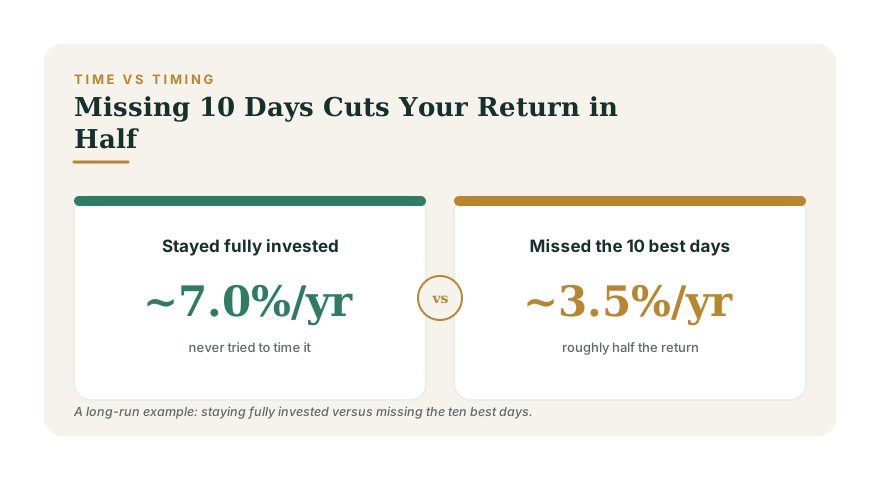
Here is the stat that ends most timing arguments. Take a broad US stock index over a multi-decade stretch where staying fully invested earned roughly 7% a year after inflation. Now remove just the ten single best days from that entire period, a few dozen years, and the return falls to somewhere around 3.5% a year. Ten days. Out of thousands. Cutting your long-run return roughly in half.
Put real numbers on it. Invest 100,000 dollars and leave it alone for 30 years at 7%, and it grows to about 760,000 dollars. The same 100,000 dollars compounding at 3.5% for 30 years grows to only about 281,000 dollars. The difference, almost half a million dollars, was created entirely by being present for a tiny number of unpredictable days. Miss the best thirty days instead of ten and the result can drop below your starting point in real terms.
The cruel part is that nobody can identify those ten days in advance. They are scattered, unannounced, and most often glued to the worst days. To catch them you have to be invested through the discomfort. To dodge a crash you have to be out, which means you are statistically very likely to be out for the rebound too. Timing asks you to be right twice, on the way out and the way back in, and to be right on the hardest days to act, again and again, for decades.
It is worth being clear about why sector rotation, the cousin of market timing, fails for the same reason. Instead of guessing when to be in or out of stocks, sector rotation guesses which slice, technology, energy, healthcare, will lead next. The catch is identical: leadership changes abruptly, the hot sector of last year is often the laggard of this one, and the rotations that matter happen too fast and too unpredictably to chase. Every time you sell one sector to buy another you pay spreads and, in a taxable account, taxes, while making two correct guesses in a row that the professionals who do this full time mostly get wrong. The broad index already owns every sector, so it captures whichever one wins without you having to predict it.
There is also a quieter cost that never shows up on a statement: the emotional toll. Every time you sit in cash watching the market climb, or jump back in just before a dip, the stress pushes you toward the next bad decision. Timing does not just lose you money. It keeps you anxious, glued to the news, and primed to act at exactly the wrong moments, which is how a single mistimed move turns into a habit of them.
How to protect yourself
The fix is almost insultingly simple, which is exactly why it works. You remove the decision instead of trying to win it.
- Automate your contributions so money goes in on a schedule no matter how the market feels that week. This is dollar-cost averaging, and it converts volatility into an advantage.
- Pick a diversified, low-cost allocation you can hold through a 40% drop without flinching, then leave it alone.
- Turn off the urge to react. Rebalance on a calendar, once or twice a year, not on the news.
- Keep an emergency fund in cash so you are never forced to sell stocks at the bottom to pay a bill.
- Measure your plan in decades. The daily and monthly noise is the thing timing tries to exploit, so stop watching it.
The honest recommendation
Time in the market beats timing the market, and it is not close. The boring strategy, buy broad index funds, contribute automatically, and stay invested through every scary headline, beats the clever strategy precisely because it guarantees you are present for the best days. You give up the fantasy of dodging crashes. In exchange you keep the rebounds, the dividends, and the compounding, which is where nearly all of the long-run reward actually comes from.
If you are tempted to wait for a "better entry point," run both paths first: model staying fully invested against trying to time it using the wealth simulator, set up your allocation in your plan, and check where your portfolio stands with scores. The most profitable thing you can do with a market forecast is almost always nothing.