The hardest part of investing is not picking the right stock or timing the market — it is starting. The financial industry has done an impressive job of making investing seem complicated enough to require professional guidance, but the truth is that most people need a simple system, not a sophisticated one. The simpler your investment approach, the better your results are likely to be.
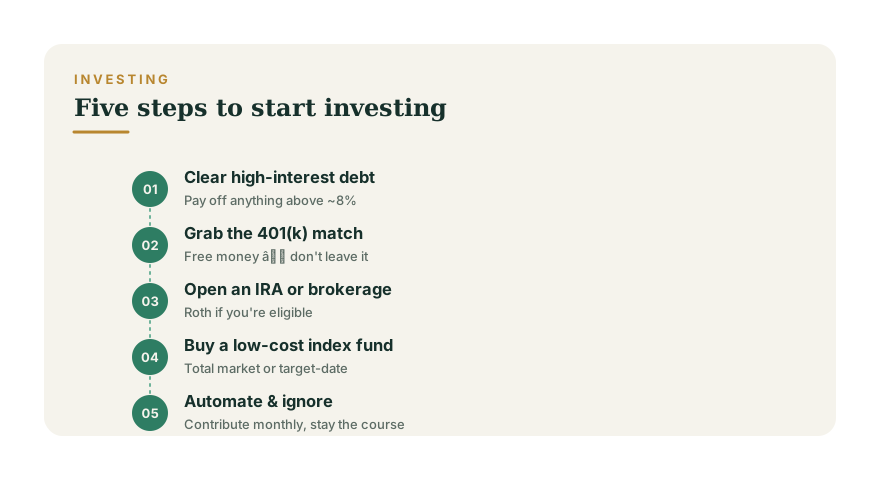
Here is the order of operations that most financial planners quietly agree on, even when they do not say it publicly.
Step 1: Build Your Emergency Fund First
Before you invest a single dollar, you need three to six months of living expenses in a high-yield savings account. This is not a formality. It is the financial foundation that prevents you from selling investments at the wrong time.
Imagine you invest $10,000 in an index fund and the market drops 30% — a normal occurrence that happens every few years. If you have an emergency fund, you sit on your hands and wait for the market to recover. If you do not have an emergency fund and you lose your job in that same month, you are forced to sell those investments at a 30% loss to cover rent. That is a permanent, unrecoverable mistake caused entirely by the lack of a cash buffer.
Step 2: Capture Every Dollar of Employer 401(k) Match
If your employer matches your 401(k) contributions — for example, 50 cents on every dollar up to 6% of your salary — contribute at least enough to capture the full match before doing anything else. An employer match is an immediate 50–100% return on your money. No investment in the world reliably delivers that.
A common example: if you earn $80,000 and your employer matches 50% of contributions up to 6% of salary, contributing 6% ($4,800/year) generates a $2,400 match. That is free money. Choosing not to contribute to the match is equivalent to turning down a $2,400 pay raise.
Step 3: Pay Off High-Interest Debt
Any debt charging more than 7–8% interest should be paid off before you invest beyond the employer match. Credit cards at 20–25% APR, personal loans at 15%, and high-rate auto loans fall into this category.
The logic is straightforward: paying off a 22% credit card balance is a guaranteed 22% return on that money. The stock market has historically returned about 7–10% annually — but that is an average with significant volatility. Paying off high-interest debt always beats the expected return on most investments.
Student loans at 4–6% are a judgment call. Many financial planners suggest investing while making normal student loan payments at these rates, since long-term investment returns are likely to exceed the interest cost. Loans above 7% lean toward paying off first.
Step 4: Max Your IRA
A Roth IRA (or Traditional IRA, depending on your tax situation) is the next best account after capturing the employer match. The 2025 contribution limit is $7,000 ($8,000 if you are 50 or older).
A Roth IRA lets your investments grow tax-free and you withdraw the money tax-free in retirement. This is an extraordinary benefit that most people do not fully appreciate until they see the math: $7,000 contributed at age 30, growing at 7% for 35 years, becomes approximately $75,000 — and you pay zero taxes on any of that growth or the withdrawals.
If your income exceeds Roth IRA limits (in 2025: $161,000 for single filers, $240,000 for married filing jointly), use a Traditional IRA instead and consider a "backdoor Roth" conversion — a legal strategy worth discussing with a tax professional.
Step 5: Return to Your 401(k) Up to the Annual Maximum
After maxing your IRA, go back to your 401(k) and increase contributions toward the annual maximum ($23,500 in 2025, or $31,000 if you are 50+). Even if your plan has limited fund choices or higher expense ratios than an IRA, the tax advantages make it worthwhile.
Step 6: Taxable Brokerage Account
If you have maxed your 401(k) and IRA and still have money to invest, open a taxable brokerage account. Unlike retirement accounts, there are no contribution limits, no withdrawal restrictions, and no required distributions. The tradeoff is that investment gains are taxed — but long-term capital gains rates (0%, 15%, or 20% depending on your income) are still much lower than ordinary income tax rates.
What to Actually Invest In
Once you have the right accounts, the investment decision is simpler than the financial media suggests. For most people, a portfolio of low-cost index funds — funds that track broad market indexes like the S&P 500 — beats the performance of actively managed funds over any 10+ year period, after accounting for fees.
A simple three-fund portfolio that covers most needs:
- US total stock market index fund
- International stock market index fund
- US bond market index fund
The exact allocation between these three depends on your age, risk tolerance, and time horizon. For a deeper look at allocation, see our article on asset allocation by age.
The Most Important Investment Decision You Make
It is not which fund to buy. It is whether to start today or wait until conditions feel right. The cost of waiting is enormous.
$500 per month invested from age 25 to 65 at 7% grows to approximately $1.2 million. The same $500 per month starting at age 35 grows to only $590,000. The 10-year delay costs more than $600,000 — not because the market performed differently, but simply because of lost time for compounding to work.
You do not need to understand everything about investing to start. You need an emergency fund, an account, a low-cost index fund, and a recurring contribution. The rest is refinement over time.