For decades, the standard advice on portfolio allocation was a single sentence: subtract your age from 100, and that is the percentage you should hold in stocks. A 30-year-old would hold 70% stocks and 30% bonds. A 60-year-old would hold 40% stocks and 60% bonds. It was simple, memorable, and — given today's longer lifespans and lower bond yields — increasingly inadequate.
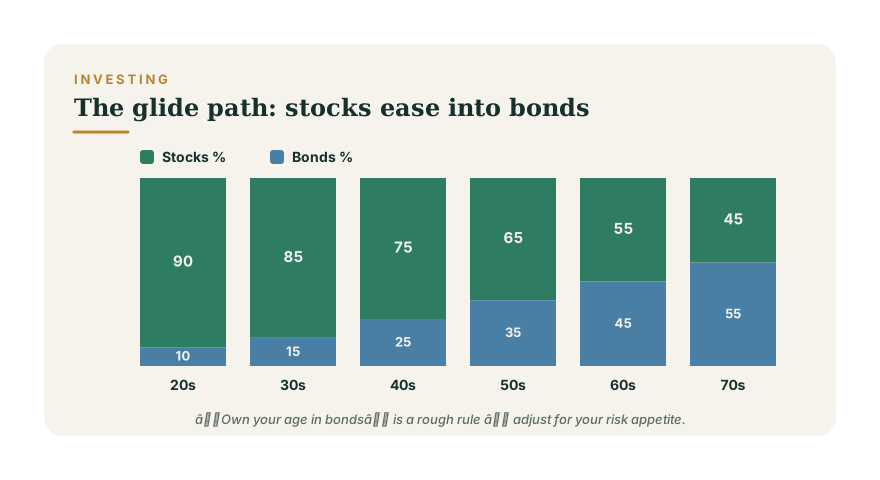
The core insight behind age-based allocation is correct: younger investors have more time to recover from market downturns and can therefore tolerate more volatility. Older investors approaching or in retirement need more stability. But the specific numbers, and the linear glide path from stocks to bonds, deserve more nuance than the rule provides.
What Asset Allocation Actually Means
Asset allocation is the decision about how to divide your investment portfolio among different asset classes — primarily stocks (equities), bonds (fixed income), and cash. Each behaves differently in different market environments:
Stocks represent ownership in companies. They offer higher expected returns over long periods but with substantial short-term volatility. Stocks can drop 30–50% in a bear market and take years to recover.
Bonds are loans to governments or corporations that pay regular interest. They tend to be less volatile than stocks and sometimes move in the opposite direction (though not always), providing stability in a mixed portfolio.
Cash and cash equivalents (high-yield savings, money market funds, short-term CDs) provide stability and liquidity but minimal long-term growth after inflation.
The goal of asset allocation is not to maximize returns — it is to match your portfolio's risk level to your personal circumstances so you can stay invested through market downturns without panic-selling.
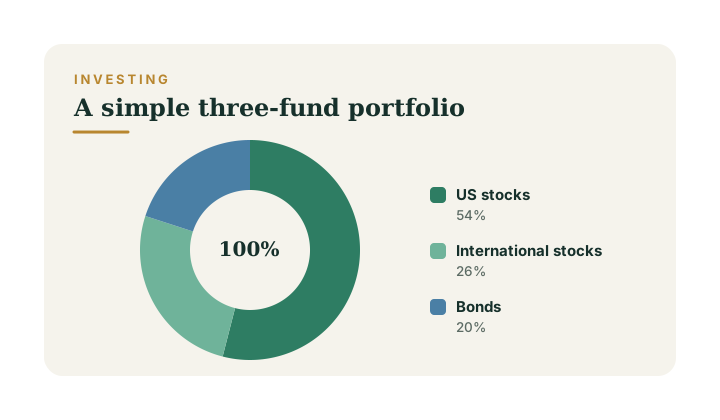
A More Modern Framework
Rather than subtracting your age from a fixed number, consider three factors that actually drive the right allocation:
1. Time horizon — How many years until you need this money? A 35-year-old investing for retirement at 65 has a 30-year horizon. A 55-year-old does not have just a 10-year horizon — they may live to 90, meaning their portfolio needs to last 35 more years. Time horizon is not just "years until retirement." It is "years until you need this specific money."
2. Risk capacity — Can you financially absorb a major market loss? A person with a stable government pension, Social Security, and no debt has high risk capacity — a 40% market drop does not threaten their lifestyle. A person with significant fixed expenses, no other income sources, and high debt has low risk capacity regardless of their age.
3. Risk tolerance — How much volatility can you emotionally handle without making poor decisions? This is distinct from risk capacity. An investor who will panic-sell everything when the market drops 25% should hold more bonds than their financial situation alone suggests — because panic-selling at market lows is the single most destructive thing an investor can do.
Suggested Allocation Ranges by Stage
These are starting points, not prescriptions. Adjust based on your specific circumstances.
Early career (20s–early 30s): 85–100% stocks, 0–15% bonds. With 30+ years until retirement, short-term volatility is irrelevant. An aggressive allocation captures the full benefit of long-term compounding. Many target-date funds for 2060+ hold 90% equities.
Mid-career (mid-30s–late 40s): 75–90% stocks, 10–25% bonds. You have enough assets now that a 40% market drop would be genuinely uncomfortable, even if financially survivable. Adding some bonds reduces the psychological and financial stress of a bad year without significantly reducing long-term returns.
Pre-retirement (50s–early 60s): 60–75% stocks, 25–40% bonds. You are within 15 years of retirement. A severe bear market early in this period can meaningfully reduce what you have available. Gradually shifting toward bonds reduces sequence-of-returns risk — the danger of a bad market at the wrong time.
Retirement (60s+): 40–60% stocks, 40–60% bonds. Even in retirement, you likely have a 20–30 year horizon. Too little in stocks increases the risk that inflation erodes your purchasing power. The traditional advice of moving heavily into bonds at retirement leads many retirees to run out of money.
The Bucket Strategy for Retirees
Many financial planners recommend a "bucket" approach for retirees rather than a single blended allocation. The idea is to separate money by time horizon:
- Bucket 1 (0–2 years of expenses): Cash and short-term bonds. This covers near-term living expenses without needing to sell stocks during a market downturn.
- Bucket 2 (years 3–10): Intermediate-term bonds, dividend stocks, balanced funds. More growth potential than Bucket 1, less volatility than Bucket 3.
- Bucket 3 (10+ years out): Equities, growth-oriented investments. This money will not be touched for at least a decade, so it can ride out market cycles.
The bucket strategy is more behavioral than mathematical — it makes it psychologically easier to hold stocks during a downturn by ensuring near-term needs are covered in safe assets.
The Danger of Being Too Conservative
The risk most people focus on is market loss. The risk most people underestimate is inflation — the gradual erosion of purchasing power that happens when your investments fail to outpace rising prices.
A portfolio of 80% bonds and 20% stocks for a 70-year-old retiree sounds safe. But at 3% annual inflation, prices double every 24 years. A portfolio growing at 2–3% annually does not keep pace. The retiree who was comfortable at 70 may struggle at 90. A portfolio with meaningful stock exposure — even in retirement — historically provides better inflation protection over the long run.
Asset allocation is not a set-it-and-forget-it decision. Review it every three to five years and whenever your circumstances change significantly. The goal is a portfolio you can hold through good markets and bad ones without making decisions you will later regret.