It feels responsible to open the app and check your portfolio every morning. You are paying attention, staying informed, being a serious investor. In reality, frequent checking is one of the most reliable ways to harm your own returns — not because watching is wrong, but because of what watching does to your decisions.
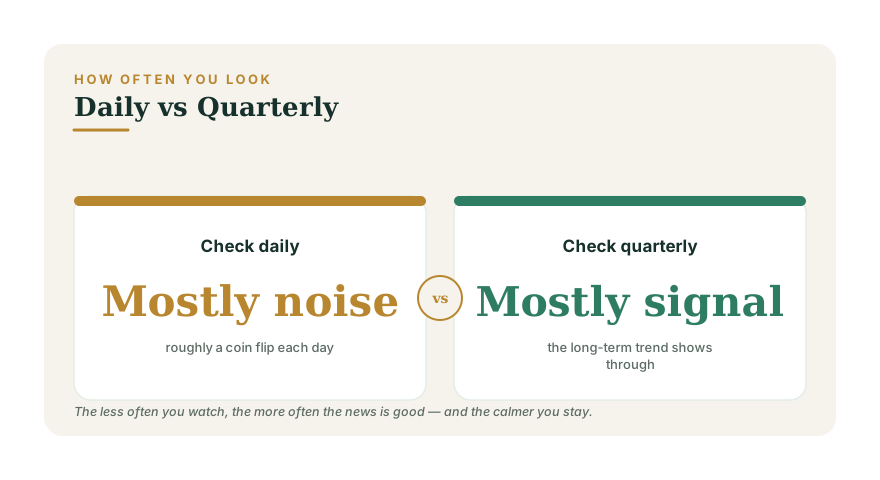
The market is mostly noise in the short run and mostly signal in the long run. The more often you look, the more noise you absorb, and the harder it becomes to leave a good plan alone.
Myopic loss aversion: the math of looking too often
We know that losses hurt roughly twice as much as equivalent gains feel good. Now combine that with how often you look. On any single day, the stock market is close to a coin flip — it rises a little more than half the time and falls the rest. So if you check daily, you experience a near-even mix of small gains and small losses, and because the losses sting twice as hard, the net emotional experience is negative even in a year your portfolio rises.
Researchers call this myopic loss aversion: the more frequently you evaluate a long-term investment, the riskier and more painful it feels, and the more tempted you are to flee to safety. Stretch the window out and the picture flips. Over a full year, stocks are up far more often than down; over longer horizons, up the large majority of the time. The investment didn't change — your sampling frequency did.
Action bias: the itch to do something
Frequent checking feeds action bias — the deep human urge to do something in the face of discomfort, even when doing nothing is the better move. Watch a red number long enough and "just trim a little" or "move to cash until this blows over" starts to feel prudent rather than panicky.
But for a diversified long-term portfolio, the correct action during normal volatility is almost always nothing. As we cover in the behavioral biases that cost investors, the trades that feel most urgent are usually the most expensive. Activity feels like control; it mostly just adds costs, taxes, and timing errors.
How noise tricks you into bad trades
A typical sequence: you check, see a drop, read a scary headline that seems to explain it, feel the loss twice over, and conclude you should act. So you sell — and then you face a second, harder decision the market never makes easy: when to get back in. People who sell in fear tend to re-enter only after prices have already recovered, locking in the loss and missing the rebound. A handful of the market's best days often cluster right after the worst ones, which is exactly why market timing doesn't work. Daily checking simply gives you more chances to make that mistake.
Volatility is the price, not a problem
Drops are not malfunctions; they are the normal, recurring cost of the higher long-term returns stocks provide. Treating every dip as an emergency is like panicking about turbulence on a flight that is on course. Understanding this turns frightening days into expected ones — we lay out the full picture in understanding market volatility.
The right review cadence
You should not ignore your money forever — you should review on a schedule that matches your time horizon, not the market's mood:
- Contributions: automate them so investing happens every payday without a decision.
- Full review: once or twice a year. Check that your savings rate, goals, and risk level still fit your life.
- Rebalancing: on that same calendar, nudge your mix back to target. See how to rebalance your portfolio.
- Big life changes: a new job, a baby, retirement nearing — trigger an off-cycle review.
Between those reviews, the best thing you can do is close the app. If you want a structured once-a-year look that doesn't tempt you into tinkering, the Annual Financial Checkup is built for exactly that cadence — a deliberate review, not a daily reflex.