Imagine you set up a portfolio of 80% stocks and 20% bonds in January. By December, after a strong year in equities, your portfolio might be sitting at 87% stocks and 13% bonds. Your portfolio has drifted from your target allocation — and without intervention, it will continue to drift with every market movement.
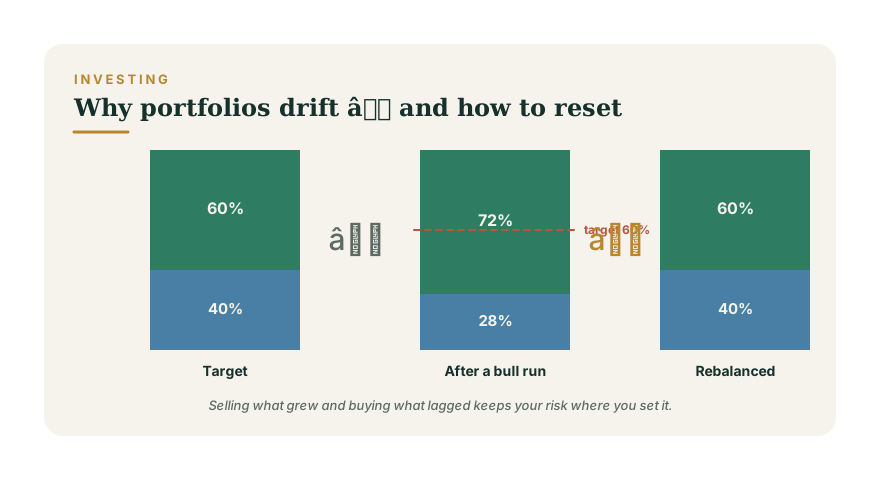
Rebalancing is the practice of periodically adjusting your portfolio back to its target allocation. It is one of the few investment activities that is both actionable and evidence-based — studies consistently show that systematic rebalancing improves risk-adjusted returns compared to drift portfolios over time.
Why Portfolios Drift
Different asset classes perform differently in any given period. In a strong bull market, stocks grow faster than bonds, increasing their proportion of the portfolio. In a bond rally or equity downturn, bonds may grow while stocks shrink. Over months and years, these performance differences compound, and your actual allocation can diverge significantly from your intended one.
This matters because your target allocation reflects your risk tolerance and time horizon. A drift toward 87% stocks means you are now carrying more equity risk than you intended — which is fine when markets are rising, but painful when they fall.
Two Approaches to Rebalancing
Calendar rebalancing means checking and adjusting your portfolio on a fixed schedule — once a year, or twice a year. This is simple to implement and requires minimal monitoring. Annual rebalancing is sufficient for most long-term investors. More frequent rebalancing generates more transaction costs and tax events without meaningful additional benefit.
Threshold rebalancing means rebalancing whenever an asset class drifts beyond a set band — for example, when stocks drift more than 5 percentage points above or below target. This approach is more responsive to large market moves but requires more monitoring. Research suggests a 5% threshold strikes a reasonable balance between keeping allocation on target and avoiding excessive trading.
A hybrid approach works well for many investors: check annually, and rebalance only if any asset class has drifted more than 5% from its target. If you are within 5%, leave it alone.
How to Rebalance
The mechanical steps are straightforward. First, calculate your current allocation by asset class. Then compare it to your target allocation. Finally, determine what to sell and what to buy to return to target.
Example: Target is 70% US stocks, 20% international stocks, 10% bonds. After a year of strong US equity performance, your actual allocation is 78% US stocks, 17% international, 5% bonds. To rebalance, you would sell some US stocks and use the proceeds to buy international stocks and bonds until each returns to target.
In practice, you have several options for executing the rebalance:
Redirect contributions. If you are still adding money to your portfolio, direct new contributions toward underweighted assets rather than selling overweighted ones. This achieves rebalancing without triggering taxable events and without transaction costs. It is the preferred method whenever contribution amounts are large enough to close the gap.
Reinvest dividends. If your broker automatically reinvests dividends, redirect them to underweighted funds rather than the fund that paid them.
Sell and buy. When contributions and dividends are insufficient, sell overweighted assets and buy underweighted ones directly. In a tax-advantaged account (401k, IRA), there are no tax consequences. In a taxable account, selling appreciated assets generates capital gains, so do this thoughtfully.
The Tax Dimension
In tax-advantaged accounts (traditional or Roth IRA, 401k), rebalancing has no immediate tax cost. Buy and sell freely. Prioritize rebalancing in these accounts.
In taxable brokerage accounts, selling appreciated assets realizes capital gains. A few strategies minimize the tax impact:
- Rebalance primarily with new contributions and dividend reinvestment before selling anything.
- When selling is necessary, prioritize selling assets held more than a year (long-term capital gains rates are lower).
- Offset gains by harvesting losses in underperforming positions if available (tax-loss harvesting).
- Consider your overall income for the year — if you are in a 0% long-term capital gains bracket, rebalancing is essentially free from a tax standpoint.
What Rebalancing Is Not
Rebalancing is not market timing. You are not rebalancing because you think stocks are overvalued or bonds are about to rally. You are rebalancing because your portfolio has drifted from the risk level you intended, regardless of any market prediction.
Rebalancing is also not a performance maximization strategy. In a sustained bull market, a portfolio that drifts to 90% stocks will outperform one that rebalances back to 70% stocks. Rebalancing costs you upside in trending markets. Its value comes from risk control — and from the discipline of systematically selling high and buying low, which is precisely what most investors fail to do emotionally.
Annual rebalancing, consistently applied, requires about 30 minutes per year. It is among the highest-value investment activities available to a long-term investor.