It is tempting to believe that somewhere out there is a brilliant manager who can consistently beat the market, and that the only problem is finding them. The uncomfortable evidence is that even the people most likely to be that manager, the ones with the best research, the fastest data, and billions in resources, mostly fail to beat a plain index fund over time. And the most famous investor alive has spent years telling you to stop looking and just buy the index.
The honest truth: it is math, not stupidity
Active managers are not failing because they are unintelligent. They are failing because of a structural fact about markets. The market return is simply the average of all investors, weighted by how much they own. For every investor who beats the market by a dollar, another must trail it by a dollar, because together they are the market. Before costs, active investing is a near zero-sum game. The winners' gains come out of the losers' pockets.
Now add costs. Active funds charge high fees, trade constantly (racking up transaction costs), and trigger taxable gains. So after fees, active management is not zero-sum. It is negative-sum. The average active dollar must, by arithmetic, underperform the average index dollar by roughly the difference in costs. This is not an opinion about any manager. It holds no matter how skilled the field is.
What the scoreboard actually shows
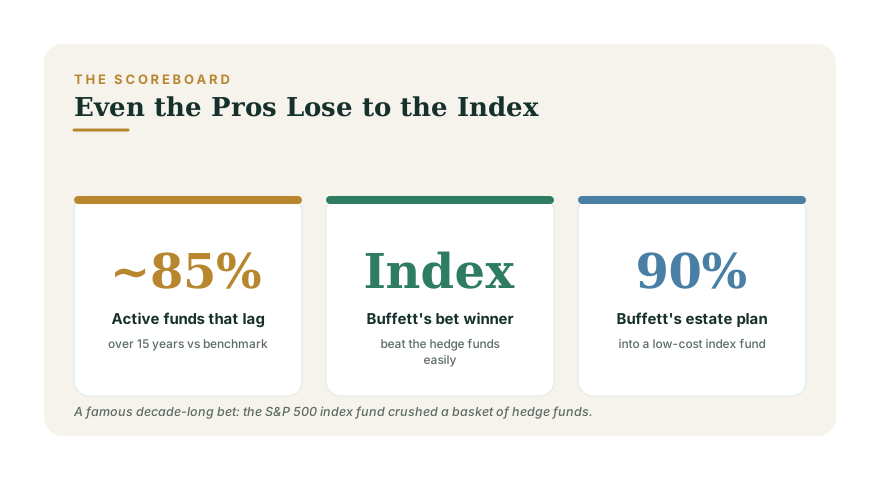
The long-running studies that track active funds against their benchmarks find the same thing year after year: over a 15-year horizon, around 85% to 90% of actively managed US stock funds underperform their benchmark. The longer the period, the worse it gets, because fees and the odd bad year compound. And the rare funds that win in one period are mostly not the ones that win in the next, which is exactly what you would expect if outperformance were largely luck rather than durable skill.
Buffett's bet, in his own actions
Warren Buffett, a stock picker who built one of the great fortunes of all time, is blunt about this for everyone who is not running his particular operation.
- The ten-year bet. In 2007 Buffett publicly bet 1 million dollars that a simple low-cost S&P 500 index fund would beat a hand-selected basket of hedge funds over ten years. He won decisively. The index fund returned roughly 7%-plus per year while the funds-of-funds limped in far behind, dragged down by their layers of fees. The professionals had every advantage and still lost to the cheapest, simplest option available to any ordinary investor.
- His estate. Buffett has said the instructions for the money he leaves his family are to put about 90% into a very low-cost S&P 500 index fund and 10% into short-term government bonds. The greatest stock picker of the era is directing his own heirs into an index fund, not into stock picking.
When the person most qualified to pick stocks tells you not to bother, that is worth more than any glossy track record. Buffett's point is not that skill is impossible. It is that the costs of trying to buy skill, the fees, the trading, the taxes, and the risk of picking the wrong manager, almost always swamp whatever edge a manager might have, so the expected outcome for an ordinary investor is worse, not better.
The math on your own money
Say you invest 100,000 dollars for 30 years at a 7% market return. An index fund at 0.05% keeps roughly 6.95%, growing to about 750,000 dollars. An active fund that merely matches the market gross but charges 1% nets 6%, growing to about 574,000 dollars. To merely tie the index after fees, the manager has to beat the market by a full percentage point every year for three decades, and the data says almost none do. You are paying a premium for the privilege of probably losing.
How to protect yourself
- Stop hunting for the winning manager. Past outperformance does not predict future outperformance, and the search itself usually leads you into high-fee products.
- Own the whole market. A total-market or S&P 500 index fund guarantees you the market return minus a tiny fee, which the evidence says beats most professionals over time.
- Treat low cost as your edge. Cost is the one factor you control and the best predictor of net return. Aim for expense ratios under 0.10%.
- Ignore the noise. Hot funds, market forecasts, and "this time it is different" pitches are how the negative-sum game keeps recruiting players.
- Stay the course. The biggest threat to index returns is not the strategy, it is you selling in a panic. Decide your allocation and leave it alone.
The honest recommendation
You do not need to be smarter than the professionals. You need to refuse to play their losing game. By owning a broad, low-cost index fund, you accept the market's return and skip the fees, the turnover, and the long-odds bet that you or your fund manager can outguess millions of other smart, motivated investors. That is not settling for average. Because of fees, the market return quietly beats the large majority of active investors over a lifetime. It is winning by not trying to win.
If you are still holding active funds, compare their long-run net returns against a simple index in the wealth simulator, then sanity-check your overall mix with the tools and your scores. The boring choice is the one even Buffett picked for the people he loves most.