Most investors spend their energy on asset allocation — how much to hold in stocks versus bonds. Far fewer think about asset location: which of those holdings goes into which account. Yet for someone who holds investments across a 401(k), an IRA, a Roth, and a regular brokerage account, smart placement can add a meaningful slice of after-tax return every year without changing the underlying portfolio at all. It is one of the rare free lunches in investing.
The idea is simple. Different accounts are taxed in different ways, and different investments throw off different amounts of taxable income. When you match the most heavily taxed holdings to the most shielded accounts, less of your return leaks out to the IRS each year.
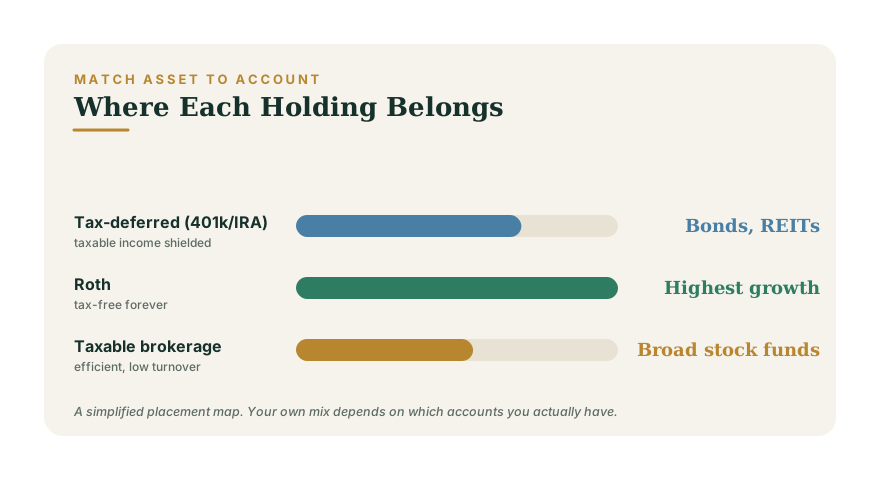
The three account types, and how each is taxed
- Tax-deferred (traditional 401(k), traditional IRA) — you contribute pre-tax dollars, the money grows untaxed, and you pay ordinary income tax on every dollar you withdraw in retirement. Interest and distributions inside the account are invisible to the IRS until you take money out.
- Tax-free (Roth IRA, Roth 401(k)) — you contribute after-tax dollars, and qualified withdrawals — growth included — come out entirely tax-free. Whatever grows in here is never taxed again.
- Taxable brokerage — no contribution limits and full flexibility, but you owe tax each year on dividends and on realized gains. Long-term gains and qualified dividends get favorable rates; interest and short-term gains are taxed as ordinary income.
The placement logic
Once you see how each account is taxed, the placement rules fall out naturally.
- Hold tax-inefficient assets in tax-deferred accounts. Bonds and bond funds spin off interest taxed at your ordinary rate, and REITs distribute income that mostly does not qualify for the lower dividend rate. Tucked inside a 401(k) or traditional IRA, that yearly income is shielded until withdrawal.
- Hold your highest-growth assets in the Roth. Because Roth growth is never taxed, you want the holdings with the greatest long-run expected return — typically your most aggressive stock funds — to do their compounding there. A dollar that becomes ten in a Roth is ten tax-free dollars.
- Hold broad, tax-efficient stock funds in the taxable account. Total-market index funds and ETFs have low turnover and generate little in the way of taxable distributions, so they sit comfortably in a brokerage account. They also qualify for favorable long-term capital gains rates when you eventually sell.
Why this raises after-tax returns
Two portfolios can hold the identical funds in the identical proportions and still deliver different after-tax results purely because of where each fund lives. Every year a bond fund sits in a taxable account, its interest is taxed away at your full marginal rate; the same fund inside an IRA keeps that money compounding. Move the tax drag to where it can be deferred or erased, and your money grows faster. Over decades, that difference compounds into real money — see how compounding works for why small annual edges matter so much.
Think across all accounts as one portfolio
The mental shift asset location requires is to stop viewing each account as its own little portfolio and start treating all of them as one. Your overall stock/bond split should match your target — see asset allocation by age — but you achieve that split by deciding which specific holdings land in which account. Your 401(k) might be all bonds and your Roth all stocks, yet together they hit your intended mix.
When location matters most — and least
This strategy only pays off if you hold assets in both taxable and tax-advantaged accounts. If everything you own sits inside a single IRA, there is nothing to optimize. Location starts to matter once your taxable brokerage account grows large alongside your retirement accounts, and it matters more the higher your tax bracket. It is an advanced refinement, not a starting point — get your allocation and your low-cost funds right first.
A few practical cautions
Do not let the tax tail wag the investment dog. Never sell a holding in a taxable account and trigger a big gain just to relocate it; let new contributions and rebalancing nudge things into place over time. And remember that rebalancing inside tax-advantaged accounts is painless because trades there are not taxable events.
If you want to see how placement and account mix shape your long-run outcome, the model portfolios tool can help you map holdings to accounts, and the Tax Health assessment will flag whether your current setup is leaving easy after-tax return on the table.