Retirement accounts come with generous tax breaks, but they also come with limits: annual contribution caps and rules about when you can touch the money. Once you have funded those accounts, the taxable brokerage account is where the rest of your investing happens. It is the most flexible account you can own, and used thoughtfully, it earns its keep.
The trade-off is in the name: you owe tax along the way. But the taxable account has real advantages that retirement accounts cannot match, and a handful of habits keep its tax cost low.
The big advantages: no limits, no strings
A taxable account has no contribution limit. You can invest ten thousand dollars or a million; there is no cap and no income phase-out. It also has no early-withdrawal penalty — the money is yours to access at any age for any reason, which makes it the natural home for goals that arrive before retirement, like a house down payment or a bridge to early retirement. For followers of the FIRE movement, the taxable account is what funds the years before retirement-account access opens up.
Where it fits in the order of operations
For most people the priority order runs: capture the full employer 401(k) match first, then fund tax-advantaged accounts like an HSA and IRA, then return to max the 401(k). Only after those are full does the taxable account take center stage. How to start investing walks through this sequence. The taxable account is not a consolation prize — it is simply where money goes once the tax-sheltered buckets are full.
Long-term capital gains: the core advantage
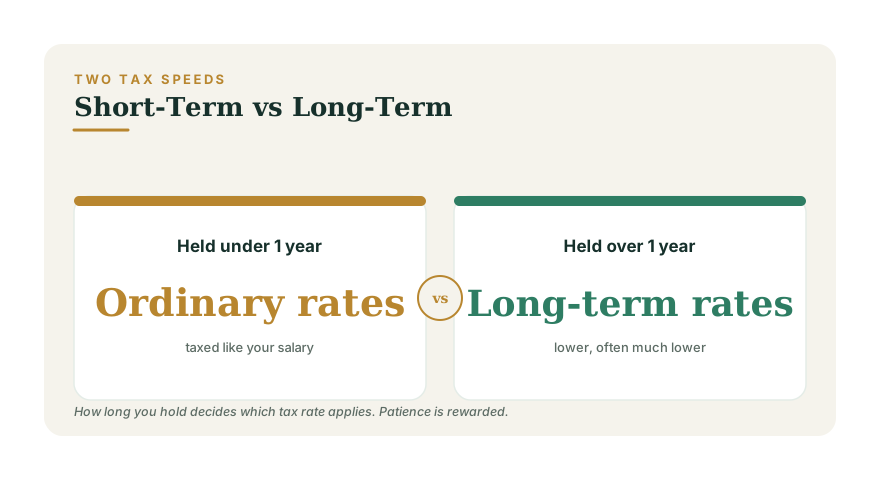
The single most important rule in a taxable account is the holding period. Sell an investment you have owned for one year or less, and the profit is a short-term gain taxed at your ordinary income rate — the same rate as your salary. Hold for more than a year, and it becomes a long-term gain taxed at preferential rates that are meaningfully lower for most investors. Qualified dividends get the same favorable treatment. The full mechanics are in the capital gains tax guide. The practical lesson: in a taxable account, patience is not just a virtue, it is a tax strategy.
Choose tax-efficient funds
Not all funds are equally friendly to a taxable account. The goal is to minimize the taxable income the fund throws off each year.
- Broad index funds and ETFs have low turnover, so they rarely realize gains internally. ETFs in particular are structured to avoid passing capital gains on to shareholders — a key reason they shine in taxable accounts.
- Actively managed funds trade frequently and often distribute taxable gains every year whether you sell or not. That yearly drag makes them a poor fit here; they tend to underperform anyway.
- High-yield bond funds and REITs generate income taxed at ordinary rates and generally belong in a tax-sheltered account instead — the logic behind asset location.
Habits that keep the tax bill down
- Hold for the long term to convert short-term gains into long-term ones.
- Harvest losses in down markets to offset gains and a little ordinary income; see tax-loss harvesting.
- Track your cost basis and use specific-lot selling so you can choose which shares to sell — more in cost basis explained.
- Avoid unnecessary trading. Every sale is a potential taxable event; a buy-and-hold approach is naturally tax-efficient.
A quiet bonus: the step-up at death
Assets passed to heirs receive a step-up in basis — the cost basis resets to the value on the date of death, wiping out the embedded capital gain. This makes long-held, highly appreciated taxable holdings a surprisingly tax-smart thing to leave behind, a wrinkle that does not exist in retirement accounts.
To see how a taxable account fits alongside your sheltered accounts and how the tax drag affects your long-run total, run the numbers through the capital gains calculator and check your overall picture with the investor profile assessment.