A Treasury security is a loan you make to the U.S. federal government. In exchange for your money, the Treasury promises to pay you back on a set date and, in most cases, to pay interest along the way. Because that promise is backed by the full faith and credit of the United States, Treasuries are widely treated as the closest thing to a risk-free investment available to ordinary savers.
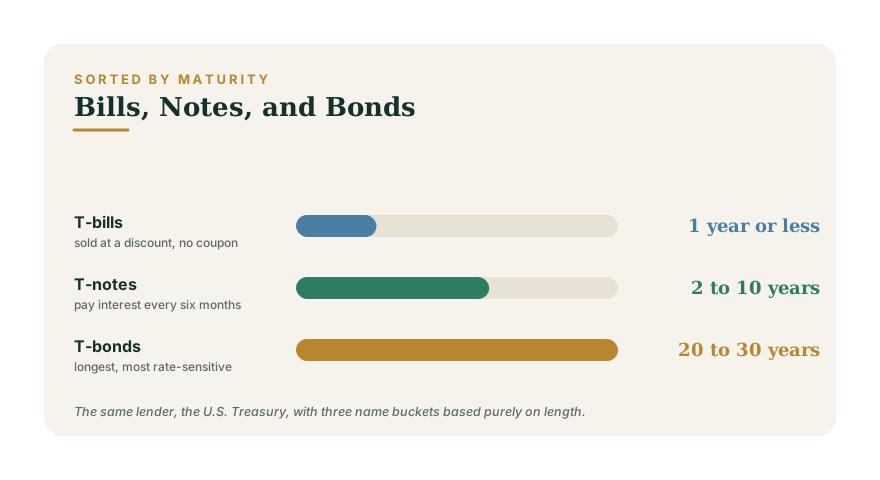
The confusing part is the three names — bills, notes, and bonds. They are not different products in any deep sense. They are the same kind of loan sorted into buckets by one thing: how long until you get your money back.
The only real difference is maturity
Maturity is just the date the loan ends and you get your principal back. The Treasury uses three labels:
- Treasury bills (T-bills) mature in one year or less — common terms are 4, 8, 13, 17, 26, and 52 weeks. They are the short end.
- Treasury notes (T-notes) mature in 2 to 10 years and pay interest every six months. The widely watched 10-year note lives here.
- Treasury bonds (T-bonds) are the long end, maturing in 20 or 30 years and also paying interest twice a year.
Longer maturities generally pay more to compensate you for tying up money longer, but they also swing more in price when interest rates move. That sensitivity is called duration, and it is worth understanding before you buy anything long — see Understanding Bond Yields and Duration.
Why T-bills are "sold at a discount"
T-bills work differently from their longer cousins. They do not pay a separate interest coupon. Instead, you buy them for less than their face value and get the full face value at maturity. The difference is your interest.
Suppose a one-year bill has a face value of 1,000 dollars and you buy it for 950 dollars. A year later the Treasury pays you 1,000 dollars. Your 50-dollar gain is the interest, and on a 950-dollar outlay that works out to roughly a 5.3% return. There is no check arriving every quarter — the entire payoff is baked into the discounted price you paid up front. This is why short Treasuries are such a clean place to park money you will need within a year, alongside options covered in savings accounts, money markets, and CDs.
How to actually buy them
You have two main routes.
Directly, through TreasuryDirect. TreasuryDirect is the federal government's own website, where you can buy newly issued Treasuries at auction with no fee and no middleman. You can place a "non-competitive" bid, which simply means you accept whatever yield the auction sets — the right choice for nearly every individual. The trade-off is a dated interface and the fact that selling before maturity is awkward; the system is built for buy-and-hold.
Indirectly, through a brokerage or a fund. Inside a regular brokerage account, you can buy individual Treasuries on the secondary market or, more simply, buy a Treasury mutual fund or ETF. A fund spreads your money across many maturities, reinvests automatically, and is easy to sell any day the market is open. The cost is a small expense ratio and slightly less control over exact maturity dates. For most people building a portfolio, a low-cost Treasury or total-bond fund is the more practical choice.
The state-tax advantage people overlook
Here is the feature that makes Treasuries genuinely special: the interest is exempt from state and local income tax. It is still subject to federal income tax, but if you live in a high-tax state, that exemption can make a Treasury meaningfully more attractive than a bank CD or corporate bond paying the same headline rate.
To compare fairly, you have to think in after-tax terms — the same logic used to evaluate municipal bonds, which dodge federal tax instead. A Treasury yielding slightly less than a CD can still leave more in your pocket once your state tax is factored in. You can pressure-test how fixed income fits your overall mix using the Portfolio Builder.
Where Treasuries fit
Treasuries are not about getting rich; they are about safety, predictable income, and a ballast that tends to hold steady when stocks fall. Short bills are excellent for an emergency reserve or a near-term goal, while notes and bonds anchor the conservative side of a long-term portfolio. To see how much of your money belongs in bonds at your age and risk level, start with the Model Portfolios tool and the broader asset allocation by age guide.