A certificate of deposit is a simple deal: you lock up money for a set term, and the bank pays you a fixed rate that is usually higher than a regular savings account. What trips people up is discovering there are two ways to buy one — straight from a bank, or through a brokerage account as a "brokered CD." They are the same underlying product, but the buying and selling mechanics differ in ways that matter.
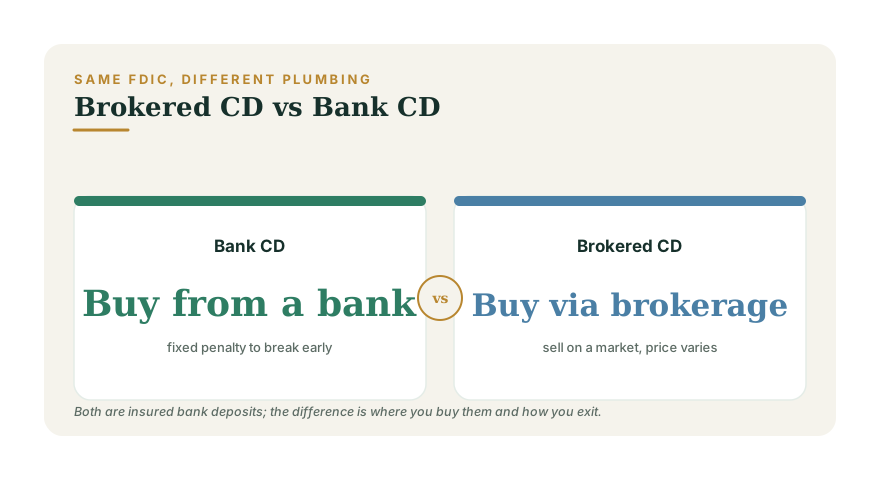
What a brokered CD actually is
A brokered CD is a CD issued by a bank but sold to you through a brokerage firm rather than at the bank's branch. The brokerage acts as a marketplace, gathering CDs from many different banks and listing their rates side by side. You buy from your brokerage account, and the CD shows up alongside your stocks and bonds. The money is still on deposit at the issuing bank, and it is still FDIC-insured — the brokerage is just the storefront.
How they trade — the key difference
This is where brokered and bank CDs diverge most.
A traditional bank CD has a fixed early-withdrawal penalty. Need your money before maturity? You pay a set number of months of interest and get the rest back. Painful, but predictable.
A brokered CD usually has no early-withdrawal penalty at all — because there is no early withdrawal. To get out early, you must sell it on the secondary market through your broker. And here is the catch: its price floats with interest rates, just like a bond. If rates have risen since you bought, your CD is worth less, and you could sell for less than you paid. If rates have fallen, you might sell for a gain. Hold to maturity and you get full face value back, but exit early and you are exposed to market price — a trade-off explained more fully in Understanding Bond Yields and Duration.
FDIC coverage across many banks
FDIC insurance protects deposits up to 250,000 dollars per depositor, per insured bank. With a single bank's CDs, going above that limit means going uninsured. Brokered CDs offer a clever workaround: because your brokerage sources CDs from many different banks, you can spread a large sum across several issuers from one account and keep every dollar within the per-bank limit.
Someone with 750,000 dollars to lock up could, in theory, buy CDs from three different banks through one brokerage and stay fully insured across all of it. One important check: make sure you do not already hold deposits at an issuing bank elsewhere, since the 250,000-dollar limit aggregates across all your accounts at that same bank.
Call features to watch
Some brokered CDs are callable, meaning the issuing bank can redeem them early — typically when rates drop and it would rather stop paying you the higher rate. You get your principal and earned interest back, but you are then forced to reinvest at the lower prevailing rate, exactly when you would prefer not to. A callable CD often advertises a tempting yield precisely because of this disadvantage to you. Always read whether a CD is callable and, if so, on what dates. For a simple ladder, non-callable CDs keep your maturity schedule predictable.
Yield versus convenience
So which should you choose?
- Brokered CDs often offer higher yields and let you comparison-shop dozens of banks in one place, manage everything in one account, and insure large balances easily. The cost is complexity: market-price risk if you sell early, and call risk to watch for.
- Bank CDs are simpler and more predictable. You know the exact penalty to break one, the rate is locked, and there is no market price to track. For a modest amount you plan to hold to maturity, this simplicity is often worth a slightly lower rate.
For most savers building a CD ladder, the strategy itself matters more than the wrapper — see High-Yield Savings, CDs, and How to Build a CD Ladder. And do not forget the alternative: short Treasury bills sometimes out-yield CDs after tax, since their interest is exempt from state income tax. Compare your safe-money options and how they fit your goals with the Emergency Fund Calculator before locking anything up.