A municipal bond — a "muni" — is a loan to a state or local government, or to an entity like a school district, water authority, or transit agency. They use the money to build roads, schools, and hospitals, and they pay you interest in return. What makes munis distinctive is the tax treatment: the interest is generally exempt from federal income tax.
That single feature reshapes how you have to evaluate them. A muni paying a lower headline rate than a taxable bond can still be the better deal, but only if you do the comparison correctly.
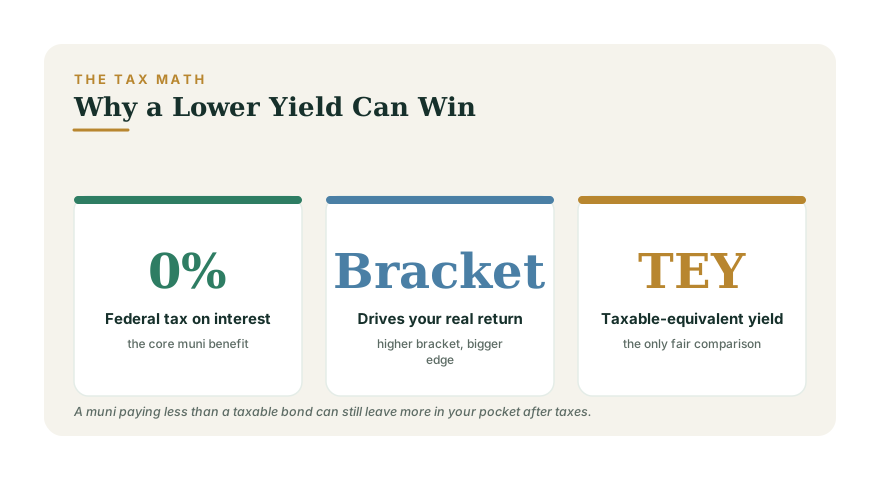
The tax break, and the "double exemption"
Interest from most munis is free of federal income tax. On top of that, if you buy a bond issued in the state where you live, the interest is often free of state tax too — a "double exemption" that is especially valuable in high-tax states like California or New York. A few caveats apply: certain bonds can trigger the alternative minimum tax, and muni interest can affect how much of your Social Security is taxed. But for the core coupon, the federal exemption is the headline event.
The taxable-equivalent yield: the only fair comparison
Because muni interest skips federal tax, comparing a muni's stated yield to a taxable bond's stated yield is apples to oranges. The fix is the taxable-equivalent yield (TEY) — the pretax yield a taxable bond would need to match the muni after taxes.
The math is simple: divide the muni yield by (1 minus your federal tax rate). Say a muni yields 3.5% and you are in the 32% federal bracket. Dividing 3.5% by (1 − 0.32) gives about 5.1%. So that 3.5% muni puts as much in your pocket as a 5.1% taxable bond. If a comparable taxable bond yields less than 5.1%, the muni wins.
Notice what drives the result: your tax bracket. The higher your bracket, the bigger the muni advantage. If you are unsure which bracket you are in, How Tax Brackets Really Work clears it up.
Who actually benefits
Munis are not for everyone. The tax exemption is only worth something if you would otherwise be paying meaningful tax on bond interest.
- ✅ High earners in a taxable account. If you are in a top federal bracket and especially if you live in a high-tax state, munis can genuinely beat taxable bonds after tax.
- ❌ Low-bracket investors. If your tax rate is modest, you give up yield for an exemption you barely needed. A plain Treasury or corporate bond often leaves you better off.
- ❌ Inside a 401(k), IRA, or HSA. These accounts are already tax-sheltered, so buying a tax-free bond inside them wastes the benefit. This is the idea behind tax-efficient asset location: hold munis in taxable accounts, not retirement ones.
You can sketch how your bracket changes the answer with the Tax Strategies tool.
The risks the tax break can hide
"Tax-free" makes munis sound safe, but they carry real risks worth respecting.
Credit risk. Unlike Treasuries, munis are not backed by the federal government. A city or agency can run into financial trouble, and defaults, while historically rare among investment-grade issuers, do happen. Pay attention to credit ratings, and remember that general-obligation bonds (backed by taxing power) tend to be sturdier than revenue bonds (backed only by one project's income).
Call risk. Many munis are "callable," meaning the issuer can repay you early — typically when rates fall and it wants to refinance cheaply. That leaves you reinvesting at lower rates right when you would least want to. Always check whether a bond is callable before buying.
Interest-rate risk. Like all bonds, muni prices fall when rates rise, and longer maturities fall further.
How to hold them
Buying individual munis well takes research and diversification across many issuers. For most people, a low-cost muni bond fund or ETF — sometimes a state-specific one for that double exemption — is simpler and spreads credit risk across hundreds of bonds. To decide how much of your fixed income belongs in munis versus taxable bonds, weigh your bracket and run the numbers through the Portfolio Builder before you commit.