Bonds are supposed to be the calm, boring part of a portfolio, so it surprised a lot of people when bond funds posted real losses as interest rates climbed. Nothing broke. The losses came from two ideas that every bond investor should understand: the inverse relationship between price and yield, and a measure called duration. Get these two, and bond behavior stops feeling random.
A bond is a loan with a fixed coupon
When you buy a bond, you are lending money in exchange for fixed interest payments (the coupon) and the return of your principal at maturity. If you buy a brand-new bond and hold it to maturity, the math is simple: you get your coupons and your money back. The complication starts the moment you might sell it before maturity, or buy someone else's older bond, because then it has a market price. For the basics underneath all this, start with Bonds Explained for Beginners.
Why price and yield move opposite
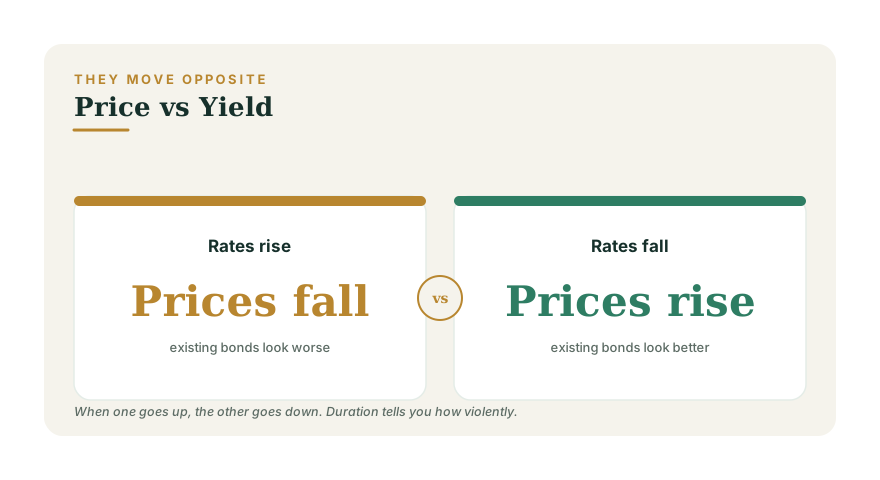
Imagine you own a bond paying a 3% coupon. Then new bonds start being issued at 5% because rates rose. Nobody wants your 3% bond at full price when they can buy a fresh 5% bond instead. To sell yours, you have to drop the price until the buyer's effective return — the yield — matches what new bonds offer. So your bond's price fell precisely because market yields rose. The reverse is also true: when rates fall, your older higher-coupon bond becomes more attractive and its price rises.
This is the inverse relationship in one sentence: rates up, prices down; rates down, prices up. The coupon you receive never changes — what changes is what the bond is worth to someone else today.
What duration actually measures
Duration is the number that tells you how much a bond's price will move when rates change. As a rule of thumb, a bond or bond fund with a duration of 7 will fall roughly 7% in price if interest rates rise by one percentage point, and rise roughly 7% if rates fall by one point. A duration of 2 means only about a 2% move for the same rate change.
Duration is driven mostly by maturity: longer-dated bonds have higher duration and swing more, while short-term bonds barely move. That is the whole story of the bond-fund losses — funds holding long-term bonds had high duration, so when rates rose sharply, their prices dropped sharply. It was not a default or a scandal; it was duration doing exactly what duration does.
Interest-rate risk, and why it is not the same as default risk
Bonds carry two distinct risks worth separating:
- Interest-rate risk — the price swings from changing rates, measured by duration. This is what hurt high-quality bond funds recently. It is a paper loss that recovers if you hold long enough, as maturing bonds get reinvested at the new higher rates.
- Credit (default) risk — the chance the borrower fails to pay you back. A U.S. Treasury has almost no credit risk; a shaky corporate or junk bond has plenty.
A long-term Treasury fund can be very safe on credit yet very sensitive on rates. Knowing which risk you are taking keeps you from being surprised by either one.
Why a bond fund can drop even when you did nothing wrong
A single bond you hold to maturity gives you your money back regardless of price wiggles in between. A bond fund never matures — it continuously holds a rolling basket of bonds, so its share price reflects current market prices every day. When rates spiked, fund share prices fell to reflect the new reality. The flip side is that the fund's yield rose, and over a holding period close to the fund's duration, those higher yields tend to offset the price drop. Patience, not panic, is the response.
Using duration to match bonds to your timeline
The practical takeaway is to match a bond's duration to when you will need the money. For cash you may need in a year or two, short-duration bonds, I Bonds and TIPS, or simply high-yield savings make more sense than a long-term bond fund. For a long horizon, more duration can be acceptable in exchange for higher yield. How much you hold in bonds at all is largely a function of your time horizon — the logic behind asset allocation by age.
Putting it together
Bonds are not broken when their prices fall — they are obeying the price-yield seesaw, and duration is the dial that sets how far the seesaw tips. Decide how much rate sensitivity you are comfortable with, then build a mix that fits your timeline. You can sketch the bond portion of your portfolio inside the Portfolio Builder and see how it fits alongside your stocks.