Once you have cash set aside — an emergency fund, a down-payment fund, money waiting for a goal — a new question appears: where should it actually live? A regular savings account, a money market account, or a certificate of deposit? They look similar, and all three are safe, but they make different trade-offs between how easily you can reach the money and how much it earns. Matching the account to the goal can be worth real money with zero added risk.
The one trade-off behind all three: liquidity vs yield
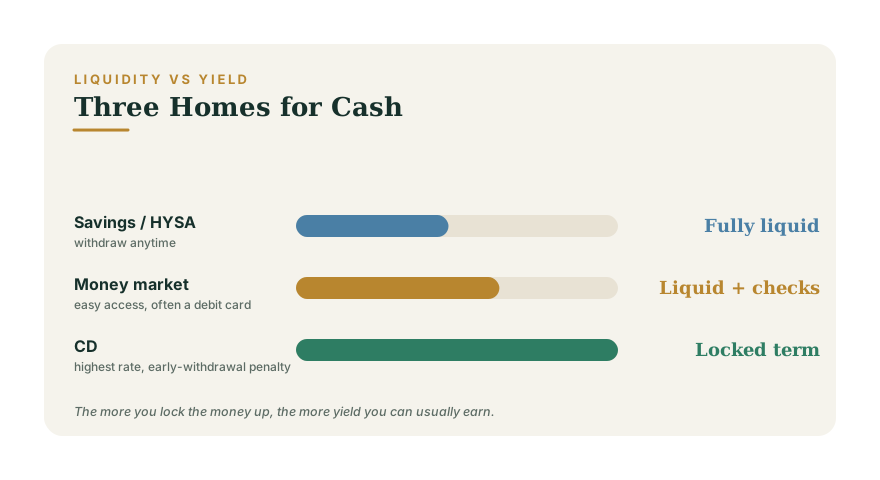
Almost everything that distinguishes these accounts comes down to a single tension. Liquidity is how quickly and freely you can get your money. Yield is how much interest it earns. In cash accounts, the two pull against each other: the more willing you are to lock the money up, the more the bank will generally pay you. Your job is to decide how much access you actually need for a given pot of money, then take the best yield available at that level of access.
High-yield savings accounts: liquid and flexible
A savings account is the default home for cash. The version worth using is a high-yield savings account (HYSA), usually from an online bank, which can pay many times what a big traditional bank pays — sometimes the difference between earning almost nothing and earning a meaningful amount on the same balance. You can withdraw or transfer the money whenever you want, typically within a day or two. The rate is variable, meaning it moves up and down with broader interest rates. For most people, an HYSA is the right home for the emergency fund and everyday savings. The mechanics are covered in High-Yield Savings, CDs, and How to Build a CD Ladder.
Money market accounts: savings with check-writing
A money market account (MMA) is a close cousin of the high-yield savings account. It also pays a competitive variable rate, but it adds more convenient access — often check-writing and sometimes a debit card. Rates and minimum-balance requirements vary, and at any given moment an MMA may pay a little more or a little less than an HYSA. The practical takeaway: an MMA suits cash you may need to spend directly and quickly, while still earning a solid rate. (Do not confuse a money market account, which is a bank deposit, with a money market fund, which is an investment product and is not FDIC-insured.)
Certificates of deposit: lock it up for a higher, fixed rate
A certificate of deposit (CD) is a deposit you agree to leave untouched for a set term — a few months to several years. In exchange, the bank usually pays a higher rate, and crucially that rate is fixed for the whole term, so it cannot fall even if market rates drop. The catch is the lock: pull the money out early and you typically pay an early-withdrawal penalty, often several months of interest. That makes CDs a poor home for your emergency fund but a good fit for money you have a firm date for and will not touch before then.
FDIC insurance: why all three are safe
The reason you can treat these accounts as "safe" is federal deposit insurance. FDIC insurance (or NCUA at credit unions) protects your deposits — standard coverage is $250,000 per depositor, per insured bank, per ownership category — even if the bank itself fails. Savings accounts, money market accounts, and CDs are all covered. Two practical notes: confirm the institution is FDIC- or NCUA-insured before depositing, and if you hold more than the limit at one bank, spread it across institutions or ownership categories so every dollar stays insured.
Match the account to the goal
The right account follows directly from when you need the money:
- Emergency fund — must be instantly available; use an HYSA or MMA, never a CD.
- Spending money you tap directly — an MMA's check-writing can be handy.
- Money with a fixed future date (a tax bill, a known purchase) — a CD timed to that date can lock in a higher rate.
- General savings with no firm date — an HYSA keeps things simple and flexible.
A popular technique for larger balances is a CD ladder — splitting money across CDs that mature at staggered dates, so a portion frees up regularly while the rest keeps earning the higher fixed rate. This same horizon-matching logic for goals is the heart of Where to Park Money for Short-Term Goals.
One more rule worth repeating: none of these accounts is for long-term, decades-away money — that belongs invested for growth, not parked in cash. For cash, decide your timeline, then pick the safe account that pays the most for that level of access. You can size an appropriate cushion with the Emergency Fund Calculator, and check how your overall safety net looks with the Financial Resilience assessment.