Most beginners learn about stocks first and treat bonds as an afterthought, something boring that retirees own. That is a mistake. Bonds are the part of a portfolio that holds steady when stocks fall apart, and they are where a huge share of the world's money actually lives. The reason people avoid them is not that bonds are complicated; it is that nobody explains the handful of terms that make them click. Once you understand four ideas — coupon, yield, duration, and credit risk — bonds stop being mysterious.
At its core, a bond is a loan. Instead of borrowing money from a bank, a government or company borrows from investors by issuing bonds, and you are the lender.
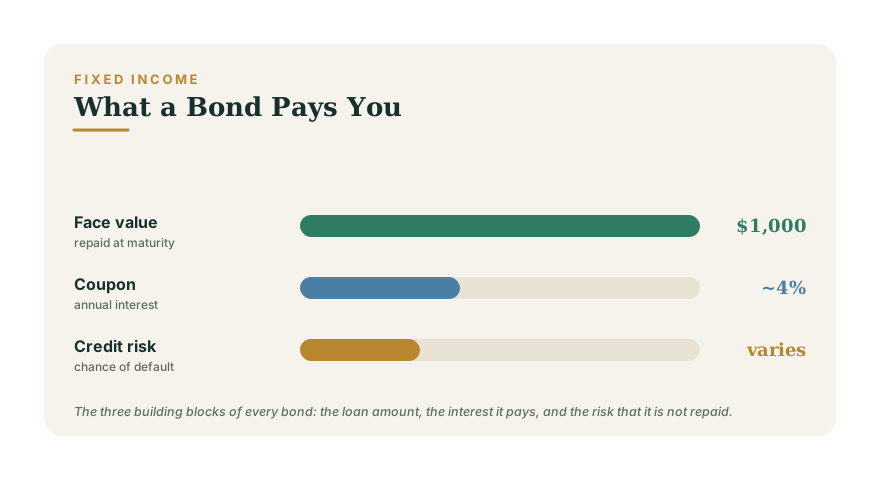
Coupon, face value, and maturity
When a bond is issued it has a face value (also called par), typically 1,000 dollars, which is the amount repaid when the bond matures. It pays a coupon, the annual interest, usually in two installments. A 1,000 dollar bond with a 4 percent coupon pays roughly 40 dollars a year. The maturity is the date the loan ends and you get your face value back. Hold a healthy bond to maturity and the deal is simple: collect interest along the way, get your principal back at the end.
Price and yield move in opposite directions
Here is the single most confusing thing about bonds, and the one worth slowing down for. A bond's price can change after it is issued, because it trades on a market. But the coupon is fixed in dollars. So when prices rise, the effective return — the yield — falls, and when prices fall, yield rises. They move inversely.
- Imagine a bond paying 40 dollars a year. If you pay 1,000 dollars for it, your yield is about 4 percent.
- If new bonds start paying 5 percent, nobody wants your 4 percent bond at full price, so its price drops. A buyer paying, say, 950 dollars now earns a higher yield on that same 40 dollars.
- That is why rising interest rates push existing bond prices down. It feels backward until you remember the coupon never changes.
Duration: how much rates can hurt
Duration measures how sensitive a bond's price is to interest-rate changes, expressed roughly in years. A bond with a duration of 7 will lose about 7 percent of its value if rates rise one percentage point, and gain about that much if rates fall. Longer-maturity bonds have longer durations and swing harder. This is interest-rate risk, and it is the reason a "safe" long-term Treasury fund can drop double digits in a year when rates spike. Short-term bonds barely move; long-term bonds move a lot.
Credit risk and the three big categories
The other danger is credit risk — the chance the borrower cannot pay you back. This is where the type of bond matters:
- Treasuries are loans to the U.S. government, considered the safest, with essentially no default risk. They pay the least because of that safety.
- Corporate bonds are loans to companies. They pay more to compensate for default risk. "Investment grade" is relatively safe; "high yield" (junk) pays a lot more because the risk is real.
- Municipal bonds are loans to states and cities. Their interest is often exempt from federal tax, which makes them attractive for high earners holding them in taxable accounts.
The pattern is consistent: more risk, more yield. There is no free lunch where a bond pays well above Treasuries without carrying extra risk somewhere.
Why you actually need them
Bonds are not in a portfolio to make you rich. They are there to keep you steady. When stocks drop 30 percent in a panic, high-quality bonds tend to hold their value or even rise, which does two things: it cushions the fall so you are less likely to sell at the bottom, and it gives you dry powder to rebalance into cheap stocks. The right mix shifts with your time horizon — younger investors hold few bonds, older investors hold more. For a starting framework on how that balance changes over a lifetime, see Asset Allocation by Age: What the Research Actually Says.