Every year, usually in the fall, the IRS announces new contribution limits for retirement accounts. Some years the numbers rise; some years they hold flat. If you have ever wondered why the ceiling on your 401(k) keeps moving, or how the 401(k) limit relates to the IRA limit, this is the map.
The exact dollar figures change annually, so rather than memorize numbers that will be stale next year, it helps to understand the structure. The current amounts are always published on the IRS retirement plans pages.
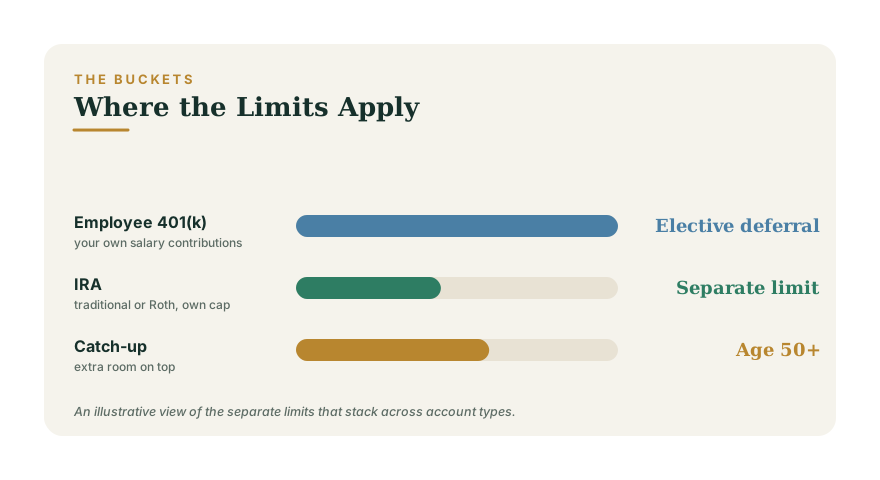
The limits are separate buckets, not one pool
A common misconception is that there is a single number for all retirement saving. There is not. Your 401(k) elective deferral — the money you route from your paycheck — has its own annual limit. Your IRA (traditional or Roth) has a completely separate, smaller limit. You can generally max both in the same year. There is also a much larger overall cap on total 401(k) contributions that includes your employer's match and any after-tax dollars, which is what makes strategies like the mega backdoor Roth possible. A tour of all the account types is in Tax-Advantaged Accounts Overview.
Catch-up contributions add room after 50
Once you reach age 50, you can contribute an extra catch-up amount on top of the standard limit in both your 401(k) and your IRA. It is designed for people who got a late start or want to accelerate in their peak earning years. There is now an even larger catch-up window in the years right before typical retirement age for certain plans. One important recent wrinkle: for higher earners, catch-up contributions to a workplace plan must go into a Roth — covered fully in The New Roth Catch-Up Rule.
Why the limits drift upward
The limits are indexed to inflation. Each year the IRS looks at cost-of-living measures and, when the increase is large enough to cross a rounding threshold, bumps the limits up in set increments. That is why some years jump and others stay flat — the underlying inflation has to accumulate past a step before the number moves. The point of indexing is to keep the real, inflation-adjusted amount you can shelter roughly constant over time, so your ability to save is not quietly eroded by rising prices.
Income limits are a different thing
Do not confuse contribution limits with income limits. A Roth IRA phases out your ability to contribute directly once your income climbs past certain thresholds, and the deductibility of a traditional IRA can phase out too if you are covered by a workplace plan. These thresholds also adjust annually. If your income is too high to contribute to a Roth IRA directly, the workaround is the backdoor Roth. Understanding which income figure the IRS uses is worth a read: AGI and MAGI, Explained.
How to actually use the limits
- Capture your full employer match first — it is the highest-return dollar you can contribute.
- Then work toward maxing your IRA and 401(k) as separate goals, not a single number.
- Check the new limits each January and raise your payroll contribution so you do not leave room unused.
- If you are 50 or older, turn on catch-up contributions.
Make the room count
Contribution limits are one of the few genuinely free advantages the tax code hands ordinary savers — but only if you use them. Set your contributions to hit the new ceiling each year, adjust for catch-ups when you turn 50, and see how it compounds with the Retirement Planner. Confirm you are on pace with the Retirement Readiness assessment, then plan the rest at the planning hub.