Buried in SECURE 2.0 is a change that quietly reshapes how higher earners save in the years right before retirement. If your wages from an employer exceed a set threshold, your catch-up contributions to that workplace plan can no longer be made pre-tax — they must be made as Roth (after-tax) contributions instead. It is a small-sounding rule with real consequences for tax planning.
The rule in one sentence
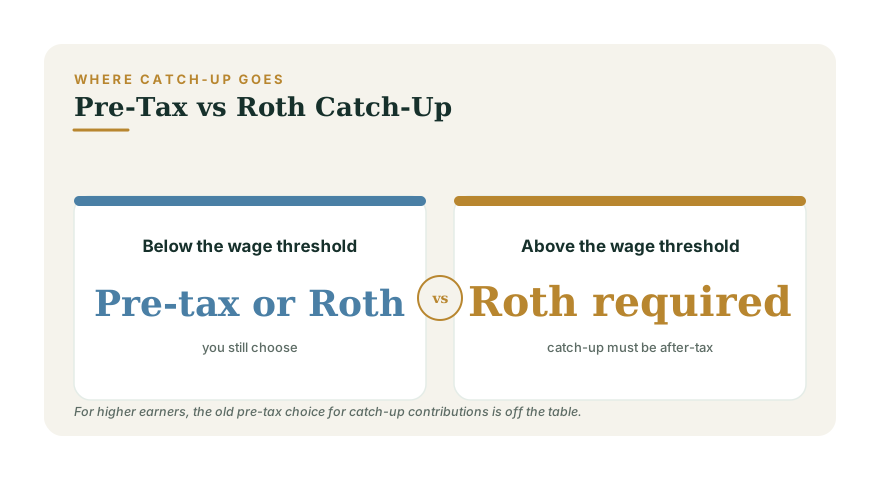
If your prior-year wages from the employer sponsoring your plan exceed an indexed threshold, any age-50 catch-up contributions you make to that plan must be designated Roth. Below the threshold, nothing changes — you can still choose pre-tax or Roth. The regular (non-catch-up) portion of your contributions is unaffected; this rule is only about the extra catch-up amount. The IRS lays out the framework on its retirement plans pages, and the threshold adjusts over time.
Why the government did this
Pre-tax contributions cost the Treasury money now, because they reduce your taxable income today. Roth contributions do not — you pay tax now and withdraw tax-free later. By forcing high earners to route their catch-up dollars into Roth, the government pulls tax revenue forward. For you, it changes the tax timing of a meaningful slice of your late-career saving, whether or not you would have chosen Roth on your own.
What it means for your tax bill
Pre-tax catch-up contributions used to give higher earners an immediate deduction in what are often their peak tax-bracket years. Losing that deduction on the catch-up portion means a slightly higher tax bill today. In exchange, that money grows and comes out tax-free in retirement. Whether that trade helps or hurts depends on your bracket now versus in retirement — the same calculus behind Roth 401(k) vs Traditional 401(k). For many high earners who expected to be in a lower bracket later, forced Roth is a mild negative; for those who expect high income in retirement, it can be a gift. Understand how brackets work in How Tax Brackets Really Work.
The plan-availability catch
There is a practical wrinkle: the rule only works if your employer's plan actually offers a Roth option for catch-up contributions. If a plan does not, affected employees may not be able to make catch-up contributions at all until the plan adds the feature. If you are a high earner counting on catch-ups, confirm with your plan administrator that Roth catch-up is available before you rely on it.
How to respond
- Check whether your prior-year wages put you above the threshold — if not, this rule does not touch you.
- If you are above it, confirm your plan supports Roth catch-up contributions.
- Recalculate your expected retirement tax bracket; forced Roth may nudge your broader mix of pre-tax and Roth saving.
- Remember the extra tax paid today buys tax-free growth — it is not lost, just shifted.
Fold it into the bigger picture
This rule is a reminder that where you put a dollar matters as much as how much you save. Revisit your split between pre-tax and Roth in light of it, model the outcomes with the Roth vs Traditional Calculator, and pressure-test your overall tax posture with the Tax Health assessment. Bring it all together at the planning hub.