The Roth IRA is one of the best deals in the tax code — tax-free growth, tax-free withdrawals in retirement, and no required distributions. But there is a catch: once your income climbs above a certain threshold, you are not allowed to contribute to a Roth IRA directly. The "backdoor" Roth is a completely legal two-step maneuver that gets high earners in anyway, and the IRS has long acknowledged it works.
Who actually needs this
You only need the backdoor if your modified adjusted gross income is above the Roth IRA contribution limit for your filing status (the IRS adjusts these thresholds each year). Below that line, just contribute to a Roth directly — there is no backdoor needed and no reason to add complexity. If you are unsure whether Roth or traditional is even right for you, start with Roth vs Traditional IRA: Which One Wins.
The backdoor exists because of a quirk: while income limits cap who can contribute to a Roth, there is no income limit on who can convert a traditional IRA to a Roth. The strategy simply walks through that open door.
The two steps
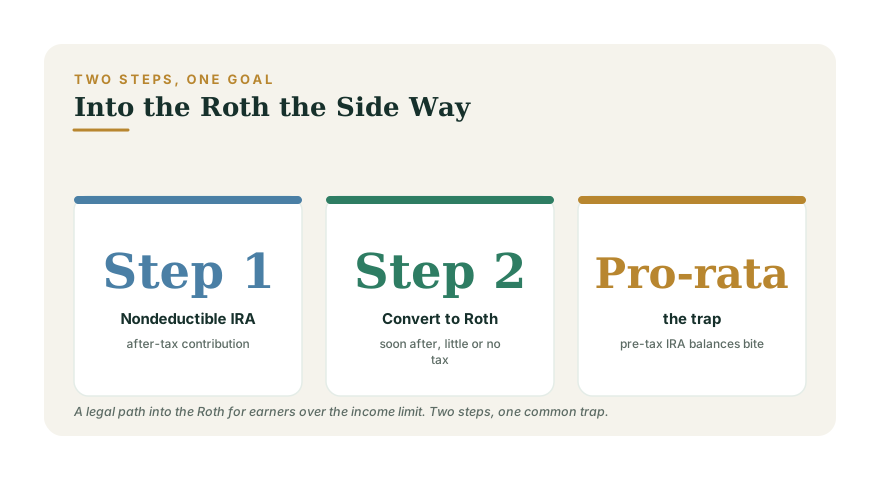
- Step 1 — Make a nondeductible contribution to a traditional IRA. Anyone with earned income can contribute to a traditional IRA; high earners just cannot deduct it. So you contribute after-tax money, claiming no deduction. You file Form 8606 to report this nondeductible contribution — this is the paperwork that establishes your after-tax "basis."
- Step 2 — Convert that traditional IRA to a Roth IRA. Shortly after, you convert the balance to a Roth. Because you already paid tax on the money (it was nondeductible) and it has barely grown, the conversion triggers little or no additional tax. The money is now in the Roth, growing tax-free forever.
Most brokerages let you do both steps online in a few days. The conversion is reported on the same Form 8606, so the IRS can see your basis was already taxed and you are not taxed twice.
The pro-rata rule: the trap that ruins backdoors
Here is where people get hurt. The IRS does not let you cherry-pick which dollars you convert. When you convert, it treats all your traditional, SEP, and SIMPLE IRA money as one big pot and calculates what fraction is pre-tax versus after-tax. You are taxed on the pre-tax fraction of any conversion — this is the pro-rata rule.
An example: if you have $93,000 of pre-tax money sitting in a rollover IRA and add a $7,000 nondeductible contribution, only 7% of any conversion counts as your tax-free after-tax money. Convert $7,000 and roughly 93% of it is taxable. The clean backdoor you imagined becomes a surprise tax bill.
Important: the rule looks only at IRAs, not at 401(k)s. So the common fix is to roll any existing pre-tax IRA balances into your current employer's 401(k) before doing the backdoor, leaving your IRA empty of pre-tax money. With a zero pre-tax IRA balance, the conversion is essentially tax-free.
Common mistakes to avoid
- ❌ Forgetting Form 8606 — without it, the IRS may tax your contribution again at conversion.
- ❌ Ignoring pre-tax IRA balances and getting blindsided by pro-rata tax.
- ❌ Investing the contribution and letting it grow a lot before converting — gains between the two steps are taxable.
- ✅ Keeping the steps close together and your IRA clean of pre-tax money.
The bigger picture
The backdoor Roth is one of several conversion strategies; if you already have large traditional balances, a planned multi-year conversion may matter more — see The Roth Conversion Strategy Guide and how it fits the wider tax-advantaged account lineup. To estimate the tax on any conversion before you pull the trigger, run the numbers through the Roth Conversion Calculator. Because the pro-rata rule and Form 8606 are easy to get wrong, this is one strategy where a quick check with a tax professional often pays for itself.