Most people know a 401(k) has one contribution limit: the amount you can defer from your paycheck each year. That is the number that gets all the attention. But the IRS actually sets a much higher ceiling on the total that can land in your 401(k) annually, counting your contributions, your employer's match, and a third category almost nobody uses. The mega backdoor Roth is the strategy that fills that gap with Roth money, and for the right person it can move tens of thousands of extra dollars into a tax-free account every single year.
It is not for everyone, and it is not even available to most people. But if your plan supports it and you have cash to spare, it is one of the most powerful tax shelters in the entire system.
The two limits that make this possible
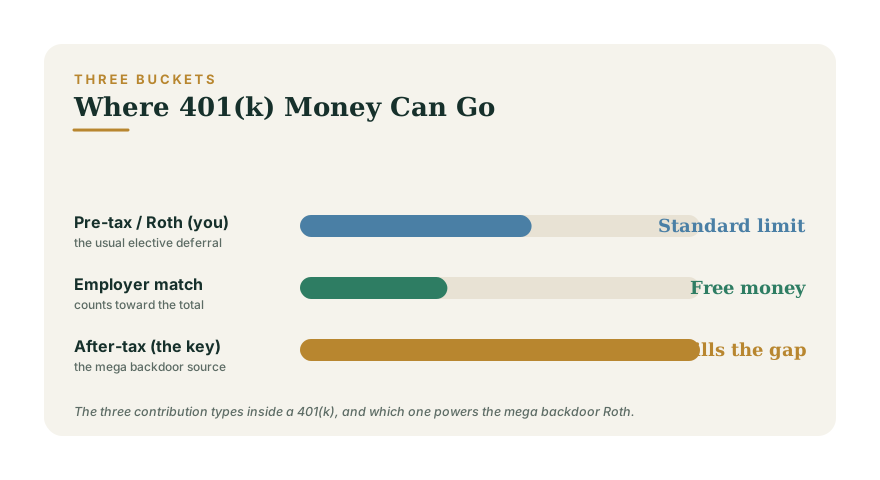
A 401(k) has two separate caps, and the gap between them is the whole game:
- The elective deferral limit is what you personally contribute from your paycheck, pre-tax or Roth. This is the well-known number, adjusted yearly by the IRS.
- The total additions limit is the maximum that can go into the account from all sources combined: your deferrals, the employer match, and after-tax contributions. It is roughly three times larger and also adjusted yearly.
Say you max your normal deferral and your employer kicks in a match. Add those together and you are usually still well short of the total additions limit. That leftover room is space you can fill with after-tax contributions, and that is the raw material for the mega backdoor Roth.
How the strategy actually works
The mechanics are two steps. First, you contribute after-tax dollars (not pre-tax, not Roth deferrals, a distinct third type) up to the total additions limit. These go in with money you have already paid income tax on. Second, you move that after-tax money into Roth before it generates much in earnings, using one of two routes:
- In-plan Roth conversion: the plan converts your after-tax balance into the Roth portion of the same 401(k).
- In-service withdrawal / rollover: the plan lets you roll the after-tax money out to a Roth IRA while you are still employed.
Either way, the after-tax contributions become Roth, where future growth is tax-free. The reason to convert quickly is that any earnings on after-tax money before conversion are taxable when moved. Convert promptly and you keep the taxable piece near zero.
What your plan must allow
This is where most people hit a wall. The mega backdoor Roth only works if your specific 401(k) plan supports two features, and many do not:
- After-tax contributions beyond the standard deferral and match. This is the rarest feature; plenty of plans simply do not offer the bucket.
- In-plan Roth conversions or in-service rollovers, ideally automatic or frequent, so the money does not sit as after-tax for long.
Without both, you are stuck. The single best thing you can do is call your plan administrator or read the summary plan description and ask two direct questions: can I make voluntary after-tax contributions, and can I convert them to Roth without leaving my job? If the answer to either is no, the strategy is off the table at your current employer.
How it differs from the regular backdoor Roth
People confuse these constantly because both have "backdoor" in the name, but they are different tools at different scales:
- The regular backdoor Roth is for people whose income is too high to contribute to a Roth IRA directly. You make a nondeductible traditional IRA contribution and convert it. The amount is capped at the modest annual IRA limit, so it is a few thousand dollars a year.
- The mega backdoor Roth happens inside a 401(k) and can move many times more, because it taps the much larger total additions limit. Hence "mega."
The two are not mutually exclusive. A high earner with the right plan can do both in the same year, layering a small backdoor Roth IRA on top of a large mega backdoor Roth from the workplace plan.
Who should actually bother
Be honest about whether this fits your life. The mega backdoor Roth makes sense if you are already maxing your normal 401(k) deferral, already maxing an IRA, already funding an HSA if eligible, and still have meaningful money left over to invest. It is a tool for people who have run out of ordinary tax-advantaged space, typically higher earners or aggressive savers. If you are not yet capturing your full employer match or building an emergency fund, those come first. There is no point optimizing the top of the pyramid while the base is hollow.
The honest caveats
A few things to keep in mind. The total additions limit includes your employer match, so a generous match actually shrinks the after-tax room available to you. The strategy ties up cash you cannot touch until retirement without penalty, so it suits people with healthy liquidity elsewhere. And tax law can change; the mega backdoor Roth has periodically been targeted in legislative proposals, so it is wise to use it while it exists rather than assume it lasts forever.
If your plan supports it and the rest of your financial base is solid, few moves build tax-free wealth as fast. To see how a much larger Roth balance reshapes your long-term picture, run the numbers in the wealth simulator.