Every investment portfolio eventually contains some positions worth less than you paid for them. Tax-loss harvesting is the discipline of using those paper losses strategically — selling them to lock in a tax loss that offsets gains elsewhere in your portfolio or reduces your ordinary income by up to $3,000 per year.
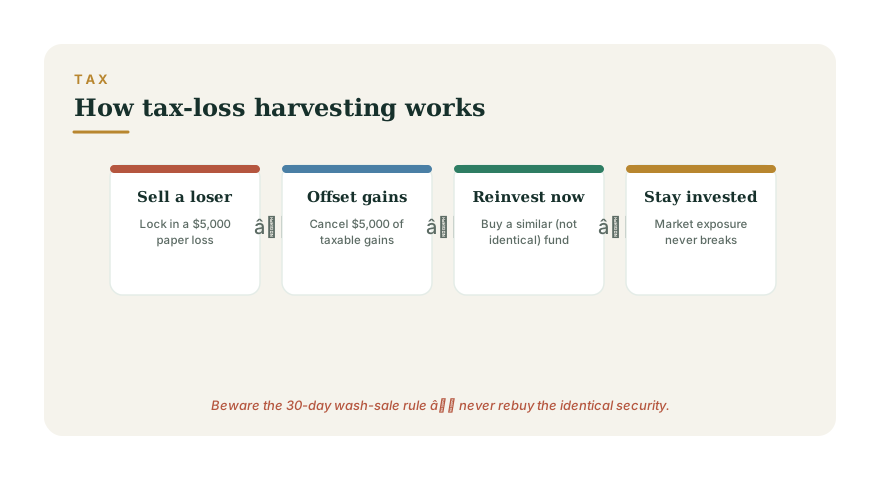
Done correctly, tax-loss harvesting reduces your tax bill without materially changing your investment exposure. You sell the losing position, immediately reinvest in a similar (but not identical) security, and end up with essentially the same portfolio — but with a tax deduction in hand.
The Basic Mechanics
Step 1: Identify positions in your taxable brokerage account with unrealized losses — positions currently worth less than their cost basis.
Step 2: Sell those positions to realize the loss.
Step 3: Immediately reinvest the proceeds in a similar investment to maintain your desired market exposure. "Similar" means economically comparable — same asset class, similar characteristics — but not "substantially identical," to avoid the wash sale rule.
Step 4: Report the loss on your tax return. Losses offset gains dollar for dollar. Net losses up to $3,000 can be deducted against ordinary income. Losses beyond $3,000 carry forward to future tax years indefinitely.
A Concrete Example
You invested $50,000 in a technology-sector ETF two years ago. It is now worth $35,000 — a $15,000 unrealized loss. You also sold some appreciated stock this year for a $20,000 capital gain.
Without harvesting: You pay tax on the full $20,000 gain. At a 15% long-term capital gains rate, that is $3,000 in federal tax.
With harvesting: You sell the tech ETF, realizing a $15,000 loss. The loss offsets $15,000 of your $20,000 gain, leaving only $5,000 taxable. Federal tax: $750. You immediately reinvest $35,000 in a similar but different ETF (perhaps a broader technology or large-cap growth fund). Your portfolio exposure is nearly identical. Your tax bill fell by $2,250.
After harvesting, your new cost basis in the replacement fund is $35,000 rather than $50,000 — you have not eliminated the tax on the $15,000 loss, just deferred it to when you eventually sell the new position. Tax-loss harvesting is a deferral strategy, not a permanent elimination. But deferring taxes for years or decades — and potentially realizing those gains in a lower-income year or at a lower rate — has real value.
The Wash Sale Rule
The wash sale rule is the most important compliance requirement in tax-loss harvesting. If you sell a security at a loss and buy the same or a "substantially identical" security within 30 days before or after the sale, the IRS disallows the loss. You cannot harvest the loss and buy the same thing back immediately.
Practically, "substantially identical" is not perfectly defined but generally includes:
- The exact same fund or security
- Different share classes of the same fund (e.g., Admiral Shares vs Investor Shares of the same Vanguard fund)
- Futures or options contracts on the same security
What is generally not substantially identical:
- A Vanguard S&P 500 ETF (VOO) sold and replaced with a Fidelity S&P 500 ETF (FSKAX) — different issuers, same index
- A large-cap growth ETF sold and replaced with a total market ETF — overlapping but different exposures
- A developed international ETF from one provider replaced with one from another
If you have the same fund in multiple accounts — a taxable account and an IRA — selling it in the taxable account and having a dividend reinvested in the IRA within the 30-day window can trigger the wash sale rule across accounts. Be aware of this if you hold the same funds in retirement accounts and taxable accounts.
When Tax-Loss Harvesting Is Most Valuable
High current-year capital gains. If you sold appreciated positions — business interests, stock options, real estate — tax-loss harvesting in the same year directly reduces the taxable gain and your tax bill.
High income years. In years when your income is high and your tax rate is elevated, harvested losses are worth more because they offset income taxed at a higher rate.
After market downturns. Market corrections create harvesting opportunities. Many positions that are temporarily down may be good long-term investments — harvesting the paper loss while staying invested in a similar position captures the tax benefit without giving up the market exposure.
The $3,000 Deduction Against Ordinary Income
If your total capital losses exceed your capital gains in a year, you can deduct up to $3,000 of the net loss against ordinary income (wages, salary, business income). Additional losses carry forward to future years, where they continue to offset gains or be deducted at $3,000 per year.
The carry-forward provision is valuable. A $30,000 loss realized in a market downturn can be deployed across 10+ years of future gains — effectively providing a recurring tax benefit for years after the original harvest.
Limitations and Caveats
Tax-loss harvesting is only relevant in taxable brokerage accounts. Inside a 401(k) or IRA, gains and losses have no current tax consequences. Do not confuse paper losses in a retirement account with harvestable losses.
Harvesting is also most valuable when your current tax rate is high. If you are in the 12% bracket, deferring a small gain through loss harvesting provides less benefit than it does for someone in the 32% bracket.
For investors using robo-advisors like Betterment or Wealthfront, automated tax-loss harvesting is built in and applied continuously. For self-directed investors, quarterly or semi-annual portfolio reviews with an eye toward harvesting opportunities are sufficient. Year-end November and December are common times to identify and execute harvesting trades before the calendar year closes.