In 1976, John Bogle launched the first index fund available to individual investors. His argument was straightforward: if most professional fund managers cannot consistently beat the market after fees, why pay them to try? Instead of hiring analysts to pick stocks, just buy all the stocks in the market and hold them. The result was Vanguard's 500 Index Fund — and it changed investing forever.
Today, index funds hold tens of trillions of dollars. The data on their performance is unambiguous. Yet many investors still avoid them, either because they seem too simple or because the financial media makes active investing sound more exciting. Understanding how index funds work cuts through both objections.
What an Index Fund Actually Is
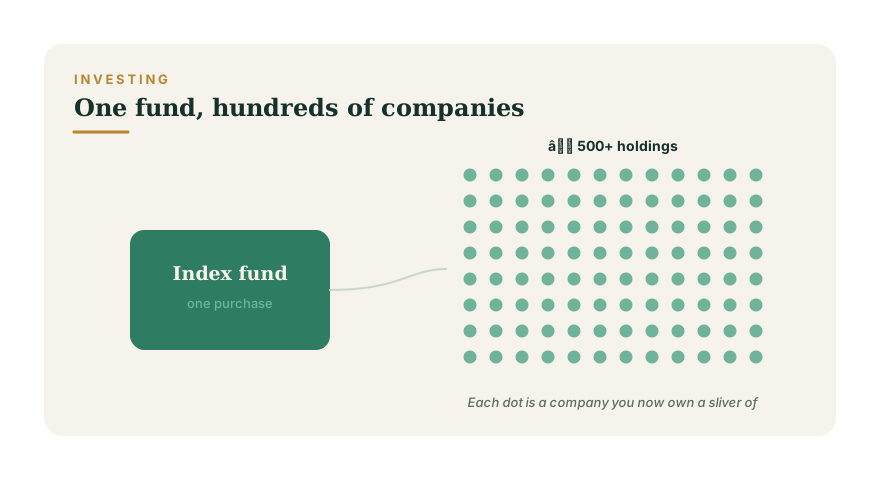
An index fund is a fund designed to replicate the performance of a market index. An index is a list of securities — usually stocks or bonds — grouped by some criteria. The S&P 500 is an index of the 500 largest publicly traded US companies. The Russell 2000 is an index of 2,000 smaller US companies. A total bond market index might include thousands of US government and corporate bonds.
An index fund does not decide which companies to buy. It simply holds all the companies in its target index, in the same proportion as the index. If Apple represents 7% of the S&P 500, a fund tracking the S&P 500 holds roughly 7% of its assets in Apple. When Apple's share price rises, Apple's weight in the index rises, and the fund automatically holds more Apple — without any human making a decision.
Why Passive Beats Active Over Time
Active fund managers research companies, meet with executives, model financial projections, and make concentrated bets on which stocks will outperform. This costs money — analyst salaries, trading costs, research subscriptions, office space. Those costs get passed to investors as the expense ratio.
A typical actively managed mutual fund charges 0.5–1.5% per year. A typical index fund charges 0.03–0.20% per year. That difference seems small until you run the math over a 30-year period.
On a $100,000 investment growing at 7% annually:
- With a 0.05% expense ratio (index fund): $749,000 after 30 years
- With a 1.0% expense ratio (typical active fund): $574,000 after 30 years
That 0.95% annual fee difference costs you $175,000 over 30 years — and that assumes the active fund matched the market's return, which most do not. Studies by S&P Dow Jones Indices consistently show that roughly 85–90% of actively managed large-cap funds underperform their benchmark index over any 15-year period after fees.
Types of Index Funds
Broad market index funds track the entire US stock market (such as funds following the CRSP US Total Market Index or similar). These are the most diversified option — you own a tiny slice of every publicly traded US company, weighted by size.
S&P 500 index funds track the 500 largest US companies. Since these companies represent about 80% of the US market's total value, S&P 500 funds capture most of the market's performance while being slightly less diversified than total market funds.
International index funds track stocks in developed markets (Europe, Japan, Australia) or emerging markets (India, China, Brazil). These provide exposure beyond the US economy.
Bond index funds track government or corporate bond markets. They provide stability and reduce the volatility of an all-stock portfolio.
Sector index funds track a specific industry — technology, healthcare, real estate, energy. These are more concentrated and volatile than broad market funds. Most investors do not need them.
Index Funds vs ETFs
You will encounter both "index mutual funds" and "index ETFs." The difference is primarily structural rather than fundamental. Index ETFs trade on stock exchanges like individual stocks throughout the day. Index mutual funds are priced once per day after market close.
For a long-term buy-and-hold investor, this distinction barely matters. Both track the same indexes. Both have similarly low expense ratios. ETFs have a slight tax efficiency advantage in taxable accounts due to their structure. Index mutual funds often allow easier dollar-cost averaging (investing a fixed dollar amount regardless of share price). Either is a sound choice.
How to Get Started
Open an account at a major low-cost brokerage — Vanguard, Fidelity, and Schwab all offer excellent index funds with expense ratios near or at zero. Your employer's 401(k) plan almost certainly offers at least one index fund option; look for funds with "index" or "S&P 500" in the name and check the expense ratio.
A simple starting allocation that serves most investors well:
- US total stock market or S&P 500 index fund: 70%
- International stock index fund: 20%
- US bond market index fund: 10%
Adjust the bond allocation based on your age and risk tolerance. A 25-year-old might hold 10% bonds; a 55-year-old approaching retirement might hold 30–40%.
Then contribute consistently, ignore market headlines, and rebalance once a year. That is the entire strategy. Its simplicity is not a weakness — it is the reason it works.