The terms "index fund" and "ETF" are often used interchangeably, but they describe different things. An index fund is an investment strategy — track a market index passively rather than picking individual securities. An ETF, or exchange-traded fund, is a fund structure — a type of investment vehicle that trades on a stock exchange throughout the day.
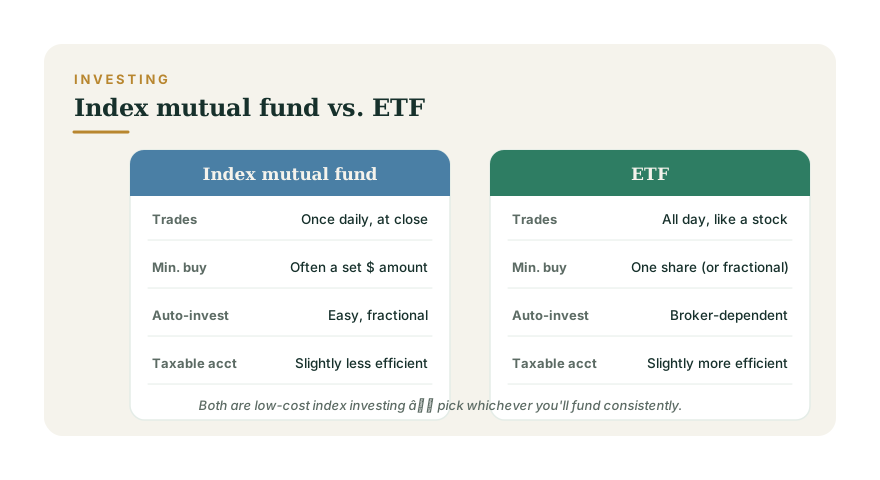
The overlap between the two is substantial: most ETFs are index funds, and many index funds are structured as ETFs. But the differences matter in specific situations, and understanding them helps you make better decisions about which to use and where.
The Structural Difference
A traditional mutual fund (including most index mutual funds) is priced once per day, after the market closes. When you submit a buy or sell order, your transaction is executed at that day's closing price — the net asset value, or NAV. You can invest any dollar amount, down to the penny.
An ETF trades on a stock exchange like an individual stock, with prices updating throughout the trading day. You buy and sell ETF shares at whatever price they are trading at that moment. Because ETFs trade in whole shares, you typically cannot invest an exact dollar amount — you buy a number of shares at the current price.
Tax Efficiency
In a taxable brokerage account (not a 401k or IRA), ETFs have a meaningful structural tax advantage over traditional mutual funds.
When investors sell shares in a mutual fund, the fund manager must sell some of the fund's underlying securities to raise cash for redemptions. If those securities have appreciated, the fund realizes capital gains — and those gains are distributed to all remaining shareholders, creating a taxable event even for investors who did not sell anything.
ETF investors, by contrast, typically sell their shares to other investors on the exchange. The fund itself rarely needs to sell underlying securities for redemptions. This "in-kind" creation and redemption mechanism allows ETFs to avoid distributing capital gains in most circumstances. Over a long period, this difference in capital gain distributions can compound into meaningful tax savings in a taxable account.
In a tax-advantaged account (401k, IRA, Roth IRA), this distinction is irrelevant. Gains inside these accounts are not taxed until withdrawal. Choose based on other factors.
Minimum Investment
Traditional index mutual funds sometimes have minimum investment requirements — often $1,000 to $3,000 for initial investments. Fidelity and Schwab have eliminated minimums on many of their funds, but minimums remain common elsewhere.
ETFs have no minimum investment requirement beyond the price of one share. A share of the Vanguard Total Stock Market ETF (VTI) costs roughly the price of a single share — often $200–$280 depending on market conditions. Many brokers now allow fractional share purchases, making ETF minimums effectively zero.
Dollar-Cost Averaging
Dollar-cost averaging (DCA) is the practice of investing a fixed dollar amount at regular intervals, regardless of market conditions. For example, investing $500 on the first of every month. This approach smooths out the impact of market timing — you buy more shares when prices are low and fewer when prices are high.
Traditional index mutual funds facilitate exact-dollar DCA effortlessly. You set up an automatic investment of $500/month, and the fund buys fractional shares at NAV. No thinking required.
With ETFs, exact-dollar DCA requires fractional share purchases, which not all brokers offer for all ETFs. If your broker supports fractional ETF shares (Fidelity and Schwab do), this advantage of mutual funds disappears. If your broker does not, you may end up with leftover cash each month.
Expense Ratios: Effectively the Same
The major index fund providers have engaged in what is essentially a price war over the past decade. Expense ratios on the most popular index ETFs and index mutual funds have converged to near-zero. Vanguard's S&P 500 ETF (VOO) charges 0.03%. Fidelity's ZERO Total Market Index Fund charges 0.00%. Schwab's total stock market index fund charges 0.03%.
For practical purposes, expense ratio differences between comparable ETFs and index mutual funds at major providers are negligible. Do not let a 0.01% difference drive your choice.
Which Should You Use?
In your 401(k): You usually do not get to choose. Most 401(k) plans offer mutual funds, not ETFs. Pick the lowest-cost index fund available in each asset class.
In an IRA or Roth IRA: ETFs are slightly better in taxable accounts due to capital gain distribution differences, but the distinction in an IRA is irrelevant since there are no annual taxes. Choose based on convenience — if your broker makes it easy to set up automatic monthly purchases of a mutual fund, that simplicity may be worth more than the structural ETF advantage.
In a taxable brokerage account: ETFs have a real, if modest, tax efficiency advantage. If you are investing in a taxable account and not doing automatic fractional dollar investments, lean toward ETFs.
The honest conclusion is that the choice between ETFs and index mutual funds matters far less than the choice to use low-cost index investing at all. Pick whichever is more convenient to contribute to consistently, and invest the mental energy you would have spent on this decision on increasing your savings rate instead.