An expense ratio is the percentage of your money a fund charges you every single year, whether it makes you money or loses it. The number is printed in a tiny font on page nine of a document nobody reads, and it usually looks harmless: 1%, maybe 0.75%. The trouble is that 1% does not get charged once. It gets charged every year, on a balance that is supposed to be growing, which means the fee compounds against you in the exact same way that returns are supposed to compound for you.
The honest truth: small percentages are not small
Here is the part the industry would rather you not internalize. The fee is not deducted from your gains. It is deducted from your balance. So in a year where the market is flat, you still pay. In a year where the market drops, you pay on the way down. And every dollar skimmed off today is a dollar that never gets to compound for the next thirty years.
Think of it this way: if your investments earn 7% a year and the fund takes 1%, you do not keep 6% and lose 1%. You lose the 1% and you lose all the future growth that 1% would have produced. Over a long career that lost growth dwarfs the headline fee.
Follow the money
Nobody walks up to you and asks for the check, which is why this fee is so effective. It is netted out of the fund's daily price before you ever see a statement. You never write a check, you never get a bill, and your balance still goes up most years, so it feels free. It is not free. On a 401(k) with 200k dollars in it, a 1% expense ratio is 2,000 dollars a year leaving your account silently. That money funds the marketing, the manager's bonus, and the broker who put you in the fund. The more assets the fund gathers, the more it collects, which is why fund families spend so heavily on advertising and shelf space rather than on lowering the fee.
Now the math
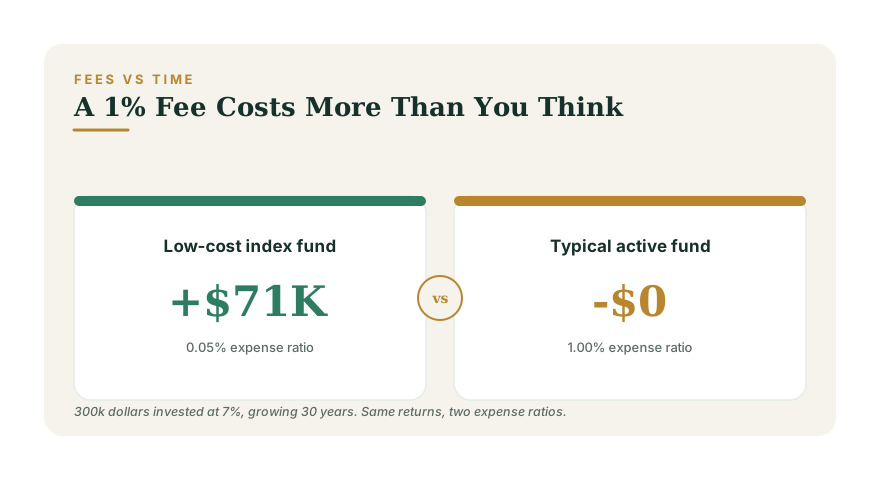
Take a starting balance of 300,000 dollars and assume it grows at a 7% gross return for 30 years, with no new contributions, so we can isolate the fee.
- At a 0.05% expense ratio (a typical total-market index fund), your net return is about 6.95%. After 30 years you have roughly 2,250,000 dollars.
- At a 1.00% expense ratio (a typical actively managed fund), your net return is about 6.00%. After 30 years you have roughly 1,720,000 dollars.
That is a gap of about 530,000 dollars on the same underlying market, the same risk, and the same starting money. The only difference is the fee. Even with a more modest starting balance, the gap routinely lands in the 200,000 to 300,000 dollar range over a career. The fee did not buy you a single dollar of extra return. It just transferred a chunk of your retirement to a fund company.
And the cruel twist is that higher fees do not buy better performance. On average, higher-cost funds underperform their cheaper peers precisely because the fee is a guaranteed headwind the manager has to overcome before you see a cent. The market hands every fund roughly the same gross return; the only thing the high-fee fund reliably does differently is take a bigger cut of it.
It also gets worse the more you save. The fee is a percentage of your balance, so a dollar amount that is trivial on a small account becomes brutal on a large one. Early in your career the gap between a cheap fund and an expensive one might be a few hundred dollars a year. By the time you have built a serious nest egg, that same 1% is skimming many thousands of dollars annually, in the very years when compounding should be doing its heaviest lifting for you instead of for the fund company.
How to protect yourself
The good news is this is one of the few investing problems with a clean, free fix. You cannot control the market, but you can control the fee, and the fee is the single most reliable predictor of long-run net return.
- Pull up every fund you own and find its net expense ratio (not just the gross). It is on the fund's fact sheet and in your 401(k) plan documents.
- Add up the weighted average across your whole portfolio. If it is above 0.30%, you are very likely overpaying.
- Watch for hidden layers: a 12b-1 marketing fee, a front-end or back-end sales load, and an advisor's separate 1% wrap fee all stack on top of the expense ratio.
- In a 401(k), pick the cheapest broad index option available, even if the menu is mediocre. The match is still worth capturing.
- In an IRA or taxable account, you have the whole market to choose from, so there is no excuse to pay a premium fee.
The honest recommendation
Favor broad, low-cost index funds with an expense ratio under 0.10%. Total-market and S&P 500 index funds from the major low-cost providers regularly run between 0.015% and 0.05%. Target-date index funds typically land between 0.08% and 0.15%, which is still excellent for a single, fully diversified, self-rebalancing holding. There is no version of paying 1% that is worth it for a standard diversified portfolio, because you are guaranteeing a large, certain cost in exchange for a manager's uncertain promise to beat the market, a promise the data says they usually break.
Spend five minutes today and look up the expense ratio on every fund you hold. If you want to see what switching to a sub-0.10% fund would do to your own numbers over the next few decades, run it through the wealth simulator, or use the broader tools and scores to pressure-test the rest of your plan. It is the rare financial move that costs nothing and pays for the rest of your life.