Cash you are saving but not investing still has a job: to earn something while staying safe and accessible. Yet most people leave it in a checking or legacy savings account paying a rate so low it is effectively zero. Two simple tools fix that without adding real risk: high-yield savings accounts and certificates of deposit.
This is about your short-term and reserve cash, not your long-term investments. Your emergency fund deserves its own treatment, covered in Emergency Fund: How Much You Need and Where to Keep It.
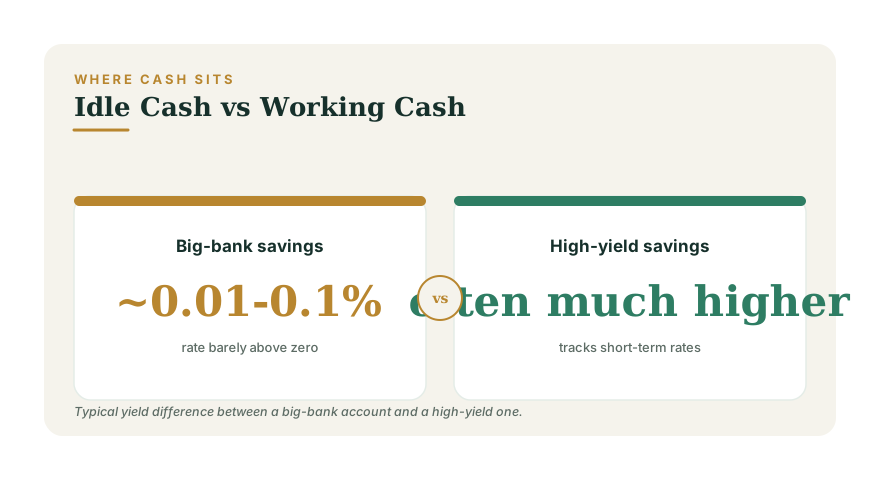
High-yield savings versus traditional
A high-yield savings account (HYSA) works exactly like an ordinary savings account, but it pays a rate that moves with short-term interest rates instead of sitting near zero. Most are offered by online banks with low overhead. Your money stays liquid: you can withdraw or transfer it within a day or two, and there is no lock-up.
The key number is the APY, the annual percentage yield, which already accounts for compounding. Compare APYs, not headline teaser rates, and watch for minimum balances or transfer limits.
What FDIC insurance means
Both HYSAs and CDs at member banks carry FDIC insurance, typically up to $250,000 per depositor, per bank, per ownership category. Credit unions offer equivalent NCUA coverage. This is what makes these accounts genuinely safe: even if the institution fails, your insured balance is protected. Confirm any online bank is FDIC-insured before depositing.
When a CD beats savings
A certificate of deposit locks your money for a fixed term, anywhere from a few months to several years, in exchange for a rate that is usually fixed for that whole term. The trade-off is access: withdraw early and you typically forfeit some interest as a penalty.
CDs make sense when:
- You have cash you genuinely will not need until a known future date.
- You want to lock in a rate because you expect rates to fall.
- You value certainty over the flexibility of a savings account.
When rates are rising or your need for the cash is uncertain, a flexible HYSA is often the better home.
Building a CD ladder
A CD ladder is a simple technique that captures higher CD rates while keeping part of your money regularly available. Instead of putting one lump sum into a single long CD, you split it across several CDs with staggered maturities.
A classic version with five rungs:
- Divide your cash into five equal parts.
- Buy CDs maturing in one, two, three, four, and five years.
- When the one-year CD matures, reinvest it into a new five-year CD.
- Repeat each year.
After the ladder is fully built, one CD matures every year, giving you annual access to a chunk of cash, while the bulk earns the higher longer-term rates. You can build shorter ladders with monthly or quarterly rungs if you want more frequent liquidity.
Putting it together
A reasonable structure for most people: keep your everyday cushion in an HYSA where it is instantly available, and ladder any longer-horizon cash, such as a planned purchase a few years out, into CDs. You earn a competitive yield, stay insured, and never have all your money locked at once. See how cash fits your wider picture at /plan.