A side hustle that starts paying real money is one of the most exciting things that can happen to your finances. At some point the question arrives: should you quit the day job and do this full-time? The dream version skips a lot of unglamorous math. A side hustle is something extra on top of a stable paycheck and benefits; a full-time business has to carry all of that weight by itself. Crossing that line works far better when you treat it as a financial decision, not just a leap of faith.
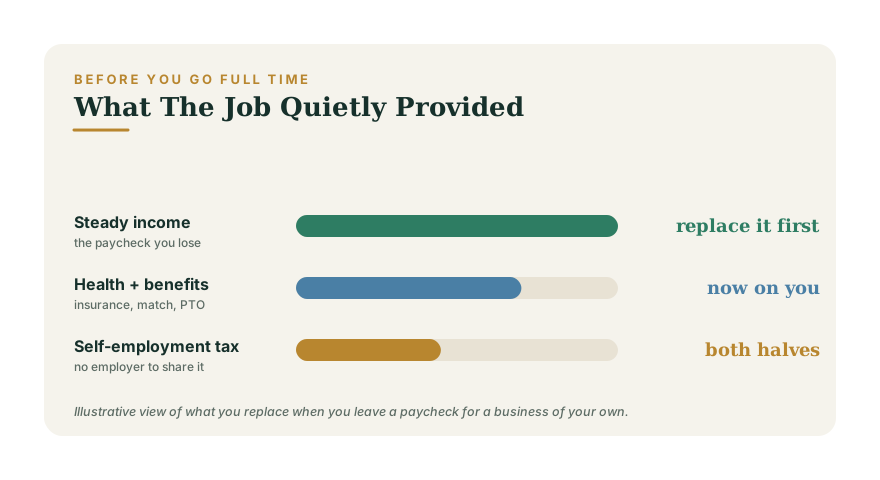
The income-replacement test
The cleanest signal that a side hustle is ready to become a business is not enthusiasm — it is whether it can reliably replace your income. A useful bar: the side hustle has consistently earned a meaningful share of your take-home pay (many people use something close to your salary, after expenses) for several months in a row, not in one lucky spike. Look at net profit after the costs of doing the work, and look at the trend: is demand steady or growing, or did it depend on a one-off client? The more your side income already looks like a dependable second salary, the less of a leap quitting becomes.
Build a real runway before you leap
Even a strong business has lumpy early income, and the safety net of a paycheck disappears the day you quit. Two cushions protect you. First, your usual emergency fund for personal surprises. Second, a separate business runway: enough cash to cover both your living expenses and the business's costs for the months it takes revenue to stabilize. Because self-employment income is unpredictable, aim higher than you would as an employee. The same affordability framework in Can You Afford to Quit? applies directly — months of runway divided by your real burn rate — with the added twist that the business itself has expenses to fund.
Structure: the boring decision that matters
As a casual side hustle you are probably a sole proprietor by default, reporting income on your personal return. As the business grows, forming an LLC can provide liability protection and a cleaner separation between business and personal money; some owners later elect a tax treatment that changes how they pay themselves. There is no one-size answer, and the right structure depends on your liability exposure and income level — this is a good moment for a short conversation with an accountant. At a minimum, open a separate business bank account early so your books are not tangled with your grocery spending.
Taxes change in ways that surprise people
The biggest financial shock for new full-timers is taxes. Two changes stand out:
- Self-employment tax — as an employee, your employer pays half of your Social Security and Medicare taxes. On your own, you pay both halves. That is a real chunk of income that used to be invisible.
- Quarterly estimated taxes — no employer withholds for you, so you generally must send the IRS estimated payments four times a year. Miss them and you face penalties and a brutal April. The mechanics are in quarterly estimated taxes explained.
The flip side is that legitimate business expenses become deductible, which softens the blow — see self-employed tax deductions. Set aside a percentage of every payment for taxes from day one so the bill is never a surprise.
The benefits you will have to replace yourself
A job quietly provides a stack of things a business owner must now buy or build alone:
- Health insurance — you will shop the ACA marketplace or use a spouse's plan; the premium is now your line item.
- Retirement — no employer match, but powerful self-directed options like a SEP-IRA or Solo 401(k) let you save a lot — see self-employed retirement accounts.
- Paid time off and sick days — every day you do not work is a day you do not earn, so build a buffer for vacations and illness.
- Disability insurance and an irregular-income budget — protecting your earning power matters even more when you are the whole company.
The broader money habits of running your own shop are covered in financial planning for freelancers.
Make the jump on numbers, not just nerve
Going full-time on a side hustle is a wonderful thing to do from a position of strength: when the income-replacement test is passed, the runway is real, the structure and tax plan are in place, and you have budgeted to replace the benefits you are giving up. Map all of it before you resign — use the Emergency Fund Calculator to size your runway and your planning hub to see how the transition reshapes your goals. Do the math first, and the leap becomes a calculated step rather than a gamble.