There is a moment in many careers when staying feels worse than the uncertainty of leaving. That feeling is real and worth taking seriously, but it is not, by itself, a financial plan. The question "should I quit?" is partly about your sanity and partly about your numbers, and the numbers part has clear answers. This is a checklist to tell whether you can actually afford to walk away — and how to leave on your own terms.
The runway math
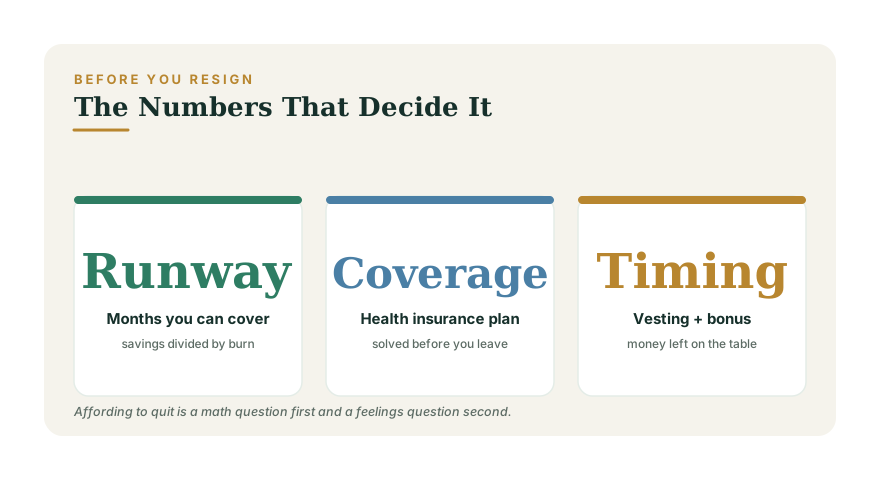
Everything starts with one calculation: how many months can you cover with no paycheck? Add up the cash you would be willing to spend — savings earmarked for this, not your retirement accounts — and divide by your true monthly expenses. That number is your runway. If your essential spending is $4,000 a month and you have $24,000 set aside, you have roughly six months before something has to change. Be conservative: use your real spending, not an optimistic version, and remember that a job search routinely takes longer than people expect. Most people are far more comfortable quitting with a runway measured in many months than in a few weeks, which is exactly why a healthy emergency fund is what buys you the freedom to leave at all.
Solve health coverage before you resign
Your employer health plan typically ends within days of your last day, and a coverage gap is precisely when an expensive surprise can undo your whole plan. Decide in advance how you will be covered: COBRA to keep your current plan at full cost, an ACA marketplace plan (leaving a job opens a special enrollment window), or a spouse's plan. Price it out before you resign, because the premium is a line item your runway has to absorb.
Check vesting and bonus timing — do not leave money on the table
Quitting a few weeks too early can cost thousands. Before you set a date, check:
- Equity vesting — if you have RSUs or options with a vesting date coming up, leaving just before it forfeits that tranche. Read your grant and the cliff carefully; see RSUs explained.
- Bonus payout dates — many companies pay annual bonuses only to employees still on the payroll on a specific date. Walking a week early can mean walking away from a whole bonus.
- 401(k) match vesting — some employer matches vest over years; leaving early can forfeit the unvested portion.
- Accrued PTO — in many states unused vacation is paid out, which adds a small one-time cushion.
None of these should trap you in a miserable job indefinitely, but if a meaningful sum vests next month, timing your exit around it is simply free money.
Quitting to something vs quitting from something
There is a real difference between leaving because you are running toward a new job, a business, or a planned break, and leaving simply to escape. Quitting to something usually means you have a destination — a signed offer, a funded sabbatical, or a side business ready to scale, as in turning a side hustle into a real business. The runway question is about bridging a known gap. Quitting from something — leaving with no plan because you cannot stand another day — is sometimes necessary for your health, but it demands a longer runway because you are funding an open-ended search. Be honest about which one you are doing; it changes how much cushion you need.
The pre-resignation checklist
- ✅ Runway of several months in dedicated savings, sized to real expenses.
- ✅ A specific health-coverage plan priced into the budget.
- ✅ Vesting, bonus, and match dates checked, with an exit timed around them.
- ✅ High-interest debt under control, not growing.
- ✅ Clarity on whether you are quitting to something or from something.
Make the call with numbers in front of you
Wanting out is a valid signal, but the decision gets easier when the math is on the table instead of in your head. Confirm how many months your savings actually buy with the Emergency Fund Calculator, sanity-check your spending in the Budget Analyzer, and use your planning hub to see how a gap in income affects your longer-term goals. If the numbers say you can afford it and you have a destination, the leap is a lot less scary than it feels.