If you have only ever had a W-2 job, taxes feel like something that happens once a year in April. That is an illusion built by payroll withholding. Every paycheck, your employer quietly skims off federal tax, Social Security, and Medicare and sends it to the government on your behalf, all year long. You never see the money, so you never feel the bill. The moment you go self-employed, that machine disappears. Nobody withholds anything, the full bill lands on you, and the IRS still expects to be paid as you earn, not just at the end. That mismatch is what blindsides new freelancers, contractors, and small-business owners.
The honest truth: the tax was always due all year
The United States runs on a pay-as-you-go tax system. A W-2 employee satisfies that requirement automatically through withholding. A self-employed person satisfies it by making estimated tax payments four times a year. The total tax owed is not higher because you pay quarterly; you are simply paying the same bill on the same schedule a salaried worker already pays, just by your own hand. The trap is that the cash flows through your checking account first, so it feels like yours. It is not. A chunk of every payment a client sends you already belongs to the government.
Who actually has to pay
The rough rule: if you expect to owe at least 1,000 dollars in federal tax for the year after subtracting any withholding and refundable credits, you are expected to make estimated payments. That sweeps in freelancers, gig workers, independent contractors, single-member LLC owners, partners, and S-corp shareholders. It also catches people with a W-2 job plus a meaningful side income, large investment gains, or big dividend and interest income that is not being withheld on. If a side hustle is throwing off real money, this is probably you.
The four due dates
The year is split into four uneven payment periods, and the deadlines do not line up neatly with calendar quarters:
- Q1: due mid-April (covers January through March).
- Q2: due mid-June (covers April and May).
- Q3: due mid-September (covers June through August).
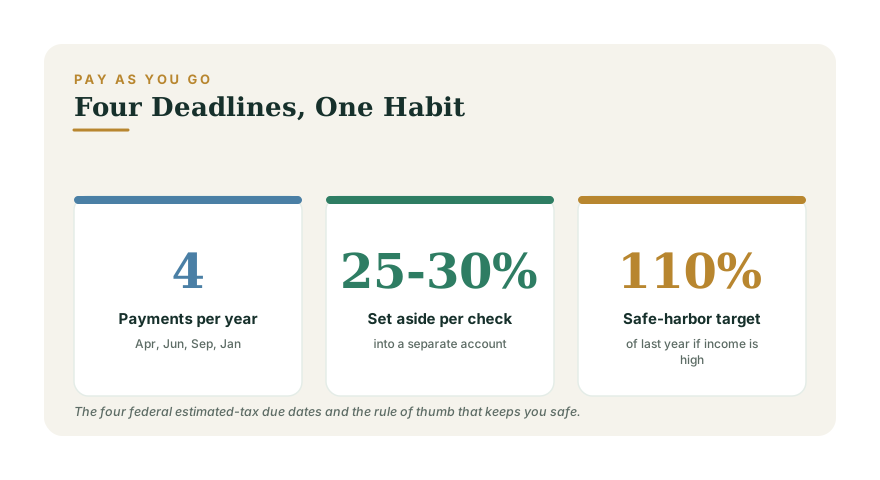
- Q4: due mid-January of the following year (covers September through December).
Most states with an income tax run their own parallel schedule, so if you live somewhere with state tax, you likely owe two sets of payments. Check your own state, because the dates and rules vary.
The safe-harbor rules that keep you out of trouble
Here is the genuinely useful part the panic articles bury. You do not have to predict your income perfectly. The IRS gives you a safe harbor: meet one of these and you avoid the underpayment penalty even if you end up owing more in April.
- Pay in at least 90% of the current year's total tax through estimated payments and withholding, or
- Pay in at least 100% of last year's total tax (this jumps to 110% if your prior-year adjusted gross income was above 150,000 dollars).
The second option is the one most people should lean on, because last year's number is a known, fixed quantity. Take last year's total federal tax, multiply by 1.00 (or 1.10 if you are a higher earner), divide by four, and pay that each quarter. Do that and you are protected regardless of how good a year you are having. You may still owe a balance in April if you earned more, but you will owe no penalty, which is the whole point.
The underpayment penalty, in plain terms
Miss the safe harbor and the IRS charges an underpayment penalty. It is not a flat fine; it works like interest, calculated on how much you underpaid and for how long, at a rate the IRS resets each quarter. In recent years that rate has sat around 7-8% annualized. It is also charged per period, so skipping the April and June payments and trying to catch up in September does not erase the penalty for those earlier months. Underpaying is, in effect, taking a high-interest loan from the government that you did not ask for and cannot deduct.
The one habit that solves all of this
Forget complex projections. The single behavior that fixes estimated taxes is to set aside 25-30% of every payment the moment it lands. When a client pays you 4,000 dollars, immediately move roughly 1,000-1,200 dollars into a separate account you do not touch. Remember that the self-employed also owe self-employment tax (Social Security and Medicare, around 15.3% on net earnings) on top of income tax, which is exactly why a flat 25-30% is a saner default than the income-tax rate alone. Higher earners or those in high-tax states should skew toward the top of that range or beyond.
Run a quick example. Suppose your business nets 80,000 dollars. Between federal income tax, self-employment tax, and a typical state, your total bill might land somewhere around 20,000-24,000 dollars. If you set aside 28% as you go, you bank about 22,400 dollars over the year, the money is sitting there each quarter, and writing the check is painless. If you set aside nothing, that same 22,000-dollar bill arrives all at once in April, usually right when you have already spent it.
Your quarterly checklist
- Open a separate savings account used only for taxes, and never spend from it.
- Transfer 25-30% of every payment into it the day it arrives.
- Compute your safe-harbor number from last year's total tax (100% or 110%) and divide by four.
- Mark the four federal due dates on your calendar, plus your state's dates if applicable.
- Pay electronically and keep the confirmation for each quarter.
- Reconcile at year end and top up Q4 if you had a big year.
The honest recommendation
Do not try to nail your tax to the dollar each quarter; you will either drive yourself crazy or skip it entirely. Instead, automate the boring version: a dedicated account, a fixed 28% set-aside, and the prior-year safe harbor as your payment target. That combination protects you from the penalty, smooths the cash-flow shock, and means April becomes a settling-up exercise instead of an emergency. The goal is not perfection, it is to never be surprised.
If you want to sanity-check how much of your income should be heading into that tax account and how the rest fits your goals, build it into your numbers on the plan, see where you stand on your scores, or read more in our articles library. The freelancers who sleep well in April are simply the ones who treated tax money as never theirs to begin with.