Leaving a traditional job often feels like losing access to retirement savings. No HR department, no payroll deferral, no employer match. In reality, the self-employed have some of the most generous tax-advantaged accounts available, and they can frequently shelter far more than a salaried worker with a standard 401(k). The two heavyweights are the SEP-IRA and the solo 401(k). Picking between them is mostly a question of how much you earn, how much you want to save, and how much administration you can tolerate.
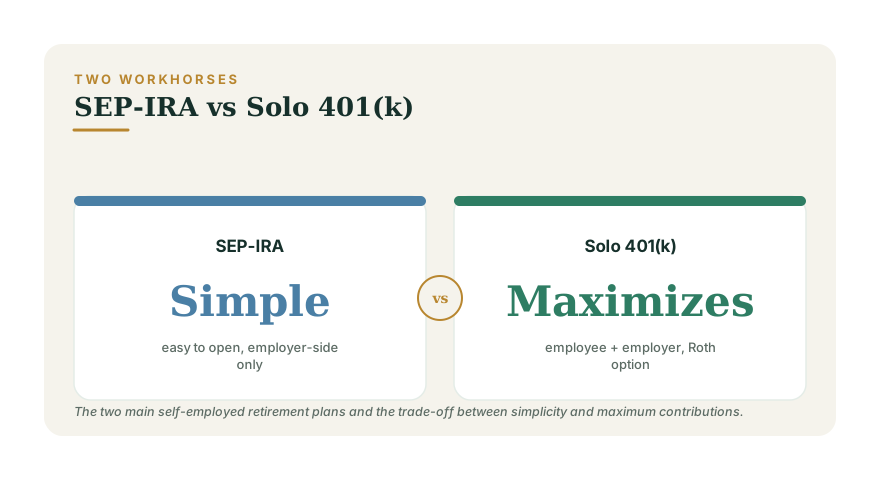
The SEP-IRA: maximum simplicity
A SEP-IRA (Simplified Employee Pension) is the no-fuss option. You open one at any major brokerage in minutes, there is almost no annual paperwork, and you can fund it right up until your tax filing deadline, extensions included. That last point is a genuine perk: you can look at your finished tax picture and decide how much to contribute after the year is over.
The catch is that all SEP contributions come from the employer side only. As a self-employed person you are the employer, and you can contribute roughly up to 25% of your net self-employment income (the math works out closer to about 20% of net once the self-employment-tax adjustment is applied), capped at the annual dollar limit the IRS sets and adjusts each year. There is no separate employee contribution, which becomes its main limitation for moderate earners.
The solo 401(k): two ways to contribute
A solo 401(k) (also called an individual or one-participant 401(k)) is designed for a business owner with no employees other than a spouse. Its superpower is that you wear two hats and contribute from both:
- As the employee, you can defer up to the standard elective deferral limit (the same cap a corporate 401(k) uses, adjusted yearly), and this slice is a flat dollar amount regardless of how high your income is.
- As the employer, you can add roughly the same 25%-of-compensation profit-sharing contribution a SEP allows.
Stack those two together and a solo 401(k) almost always lets you contribute more than a SEP at the same income, especially at lower and middle income levels. The employee deferral lets you save aggressively even when your business income is modest, where a percentage-only SEP would fall short.
The Roth advantage of the solo 401(k)
Here is a frequently overlooked edge: many solo 401(k) plans offer a Roth option for the employee deferral. You contribute after-tax dollars and the growth comes out tax-free in retirement. A SEP-IRA is traditional pre-tax money only. If you expect to be in a similar or higher tax bracket later, or simply want tax diversification, the Roth solo 401(k) is a meaningful advantage the SEP cannot match. Some plans now also allow Roth treatment on the employer side, though availability varies by provider.
When each plan wins
The decision usually sorts itself out along these lines:
- Choose a SEP-IRA if you value dead-simple setup, you have variable income and want to decide the amount after year-end, or your income is high enough that the percentage-based contribution already maxes you out.
- Choose a solo 401(k) if you want to contribute the most possible at low-to-moderate income, you want a Roth option, or you might want to take a loan from the plan (allowed in many solo 401(k)s, never in a SEP).
One practical note: a SEP-IRA balance can interfere with the regular backdoor Roth strategy because of how the IRS pro-rata rule treats pre-tax IRA money. Solo 401(k) balances do not. If backdoor Roth contributions matter to you, that alone can tip the scales toward the solo 401(k).
A word on the SIMPLE IRA
There is a third option worth a mention: the SIMPLE IRA. It is built for small businesses with employees rather than solo operators, sits between a SEP and a full 401(k) in complexity, and has lower contribution limits than either the SEP or solo 401(k) at higher incomes. For a one-person business focused on maximizing savings, it is rarely the best fit, but it can make sense if you have a few employees and want a low-cost plan with some matching.
The honest takeaway
For most self-employed people with no employees, the solo 401(k) is the stronger default: it allows larger contributions at typical income levels, offers a Roth choice, and plays nicely with other strategies. The SEP-IRA wins on pure simplicity and last-minute flexibility. Whichever you pick, the contribution itself is one of the largest tax deductions available to the self-employed, so coordinate it with the rest of your write-offs in our guide to self-employed tax deductions and the wider articles library.