Self-employed individuals, freelancers, and small business owners face a tax reality that W-2 employees do not: you pay both the employee and employer portions of Social Security and Medicare taxes. The self-employment tax rate is 15.3% on the first $176,100 of net self-employment income in 2025 (the Social Security portion) plus 2.9% on all net income above that (Medicare portion), with a 0.9% Additional Medicare Tax applying above $200,000 for single filers.
The silver lining is a significantly broader menu of deductions. Expenses that W-2 employees cannot deduct are often fully deductible for self-employed individuals. Knowing what qualifies — and how to document it properly — can reduce your tax bill by thousands of dollars per year.
The Self-Employment Tax Deduction
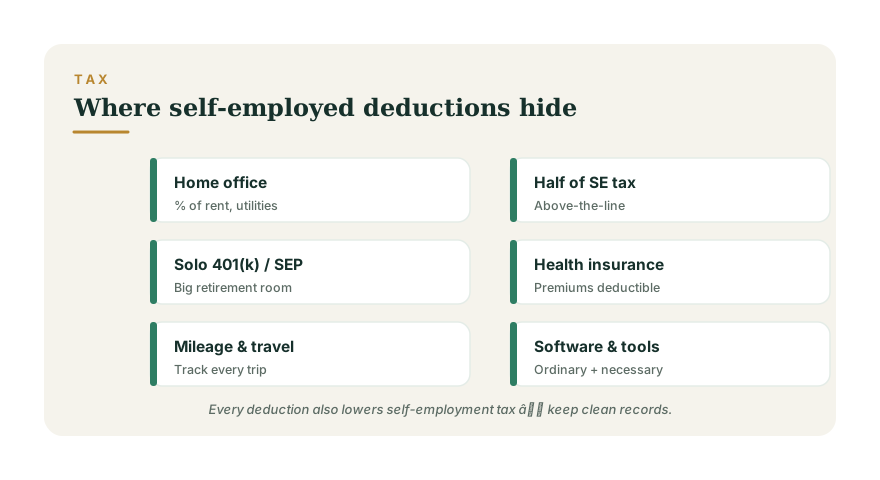
Before getting to business expenses, note that you can deduct 50% of your self-employment tax from your adjusted gross income (not just as an itemized deduction). If you paid $14,000 in self-employment tax, you can deduct $7,000 from your gross income — reducing your federal income tax without itemizing. This deduction is automatic and appears on Schedule SE.
Home Office Deduction
If you use part of your home regularly and exclusively for business, you can deduct that portion of your home expenses. "Regularly and exclusively" means a dedicated space — a guest room you also use for personal guests does not qualify.
Two methods:
Simplified method: Deduct $5 per square foot of your home office, up to 300 square feet, for a maximum deduction of $1,500. Easy to calculate; no depreciation recapture on home sale.
Regular method: Calculate the percentage of your home used for business (office square footage ÷ total home square footage). Apply that percentage to your actual home expenses — rent or mortgage interest, utilities, insurance, repairs, and depreciation. More complex but often results in a larger deduction.
Important: The home office deduction cannot exceed your net business income (it cannot create a loss that offsets other income for home office purposes).
Business Use of Your Vehicle
If you use your personal vehicle for business purposes — visiting clients, attending business meetings, picking up supplies — you can deduct the business portion of vehicle expenses.
Standard mileage rate: In 2025, deduct 70 cents per business mile driven. This is the simplest method and most commonly used by sole proprietors.
Actual expense method: Track and deduct the actual costs of operating your vehicle (gas, insurance, repairs, depreciation) multiplied by the business use percentage. Better for expensive vehicles or high-mileage business use.
Commuting miles (home to a regular office) are never deductible. Keep a mileage log — date, destination, business purpose, miles — for every business trip. The IRS scrutinises vehicle deductions and requires contemporaneous records.
Health Insurance Premiums
Self-employed individuals can deduct 100% of health, dental, and vision insurance premiums paid for themselves and their families — above the line, directly from gross income. This is one of the most valuable deductions available to the self-employed. The deduction is limited to your net self-employment income and cannot be claimed in months you were eligible for employer-sponsored health insurance through a spouse's employer.
Retirement Contributions
Self-employed individuals can contribute to — and deduct — retirement accounts on a scale that far exceeds W-2 employee options.
SEP-IRA: Contribute up to 25% of net self-employment income (effectively 20% of gross self-employment income after the SE deduction adjustment), up to $70,000 in 2025. Simple to open, no per-employee administrative burden if you have no employees. The entire contribution is deductible from gross income.
Solo 401(k): If you have no employees other than yourself (and possibly a spouse), a Solo 401(k) allows up to $70,000 in total contributions in 2025 ($77,500 if 50+). This consists of an employee contribution of up to $23,500 (the standard 401k limit) plus an employer contribution of up to 25% of net self-employment income. For high-earning self-employed individuals, the Solo 401(k) allows larger contributions at equivalent income levels than a SEP-IRA.
Qualified Business Income Deduction (QBI)
Under current tax law, many self-employed individuals qualify for a 20% deduction of qualified business income — up to 20% of your net self-employment income, subject to income limits and restrictions for certain service businesses. In 2025, this deduction phases out for "specified service trades or businesses" (doctors, lawyers, consultants, financial advisors) above $197,300 (single) or $394,600 (married).
For self-employed people whose income falls below the phase-out thresholds, this deduction is enormous — effectively reducing the marginal rate on business income by 20%.
Other Common Business Deductions
Professional services: Fees paid to accountants, attorneys, and business consultants for business-related purposes.
Software and subscriptions: Business software, cloud services, industry publications, project management tools, and professional association dues.
Education and training: Courses, books, seminars, and workshops that maintain or improve skills required in your current trade or business. (Note: costs to qualify for a new career are generally not deductible.)
Marketing and advertising: Website hosting, domain registration, advertising spend, business cards, and promotional materials.
Phone and internet: The business-use percentage of your phone and home internet bills. Keep records of your estimated business use percentage.
Equipment and supplies: Computers, monitors, desks, cameras, and other equipment used for business. Under Section 179, you can deduct the full cost of qualifying business equipment in the year of purchase rather than depreciating it over years.
Business travel: Airfare, hotels, and 50% of meals while away from home for business purposes. Business entertainment (tickets, golf, etc.) is generally no longer deductible under current tax law.
Record-Keeping Requirements
Every deduction requires documentation. The IRS may disallow deductions without adequate records. Best practices:
- Keep all receipts (digital or physical) for business expenses
- Maintain separate business bank accounts and credit cards — never mix personal and business expenses
- Note the business purpose on receipts at the time of the expense
- For vehicle use, keep a contemporaneous mileage log
- For home office, photograph the space and measure square footage
Accounting software (QuickBooks, FreshBooks, Wave, or similar) makes tracking dramatically easier and reduces the work of preparing your tax return. If your self-employment income is more than a side gig, working with a CPA who specializes in self-employed clients pays for itself many times over in legitimate deductions identified and IRS-audit risk reduced.