When you do not have health coverage through an employer — because you are self-employed, between jobs, or work somewhere that does not offer it — the Affordable Care Act (ACA) marketplace is where you buy your own plan. It can feel overwhelming the first time, but the structure is simpler than it looks once you understand two things: the metal tiers and the subsidies.
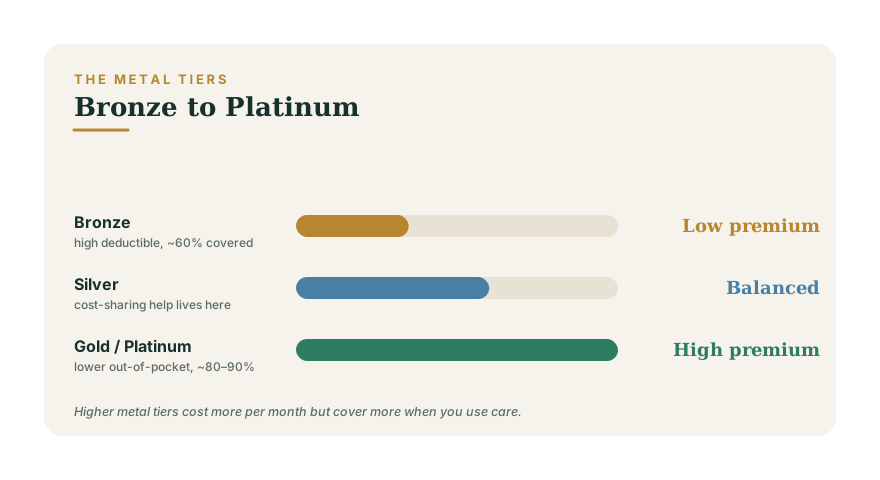
The metal tiers, in plain English
Every marketplace plan is sorted into a metal tier: Bronze, Silver, Gold, and Platinum. The tier does not describe the quality of the doctors — it describes how the cost of care is split between you and the insurer. Bronze plans cover roughly 60% of typical costs, Silver about 70%, Gold about 80%, and Platinum about 90%.
The trade-off is the usual one in insurance: a lower metal tier means a lower monthly premium but a higher deductible and more out of pocket when you actually use care. A higher tier flips that. If this premium-versus-deductible balance is new to you, the mechanics are explained in How Health Insurance Actually Works.
Premium subsidies and why Silver is special
Most marketplace shoppers qualify for a premium tax credit — a subsidy that lowers your monthly premium based on your estimated income for the year. The lower your income relative to the cost of coverage in your area, the larger the credit. You can take it in advance (applied to each month's bill) or claim it when you file your taxes.
There is also a second, separate help called cost-sharing reductions (CSRs), which shrink your deductible and copays — but these only attach to Silver plans, and only at lower incomes. That is why a Silver plan is often the smartest pick for a modest income: a subsidized Silver plan can end up covering more than a Gold plan at a similar price.
The income cliff to watch
Subsidies are tied to your estimated annual income, which creates a real planning trap for self-employed and gig workers whose income swings. If you under-estimate and earn more than expected, you may have to pay back part of the advance credit at tax time. Historically there was a hard "cliff" at 400% of the federal poverty level where subsidies vanished entirely; recent law softened it so the credit phases out more gradually, but the basic lesson stands: estimate your income carefully and update the marketplace when it changes.
This matters for tax planning too. A pre-tax contribution to a retirement account or HSA lowers the income figure that drives your subsidy, sometimes meaningfully. See Health and Disability Insurance When You're Self-Employed for how these pieces fit together.
Enrollment windows and special enrollment
You normally can only buy or change a marketplace plan during the annual open enrollment window in the fall. Outside that window, you need a special enrollment period (SEP), which is triggered by a qualifying life event:
- Losing other coverage — including leaving a job or aging off a parent's plan.
- Getting married or divorced.
- Having or adopting a child.
- Moving to a new area with different plans.
An SEP usually gives you about 60 days to act, so if you just lost job-based coverage, do not wait. This is one of the most common situations after a layoff — covered alongside other steps in Money Moves After a Job Loss.
Picking a plan when you are self-employed or between jobs
Beyond the metal tier, two practical checks decide whether a plan actually works for you:
- The network. Marketplace plans are often HMOs or narrow-network EPOs. Confirm your doctors and a nearby hospital are in-network before you enroll, because out-of-network care can be brutally expensive. See In-Network vs Out-of-Network: Why It Matters.
- Your prescriptions. Check the plan's drug formulary so your regular medications are covered at a reasonable tier.
If you are healthy and mainly want protection against a catastrophe, a subsidized Bronze plan paired with a Health Savings Account can be efficient. If you expect regular care or have a chronic condition, the lower out-of-pocket costs of a Silver-with-CSR or Gold plan usually win.
Comparing plans on total cost, not premium
The single most common marketplace mistake is choosing the plan with the lowest monthly premium and stopping there. Premium is only one of four numbers that decide what a plan really costs you:
- Premium — what you pay every month regardless of whether you use care.
- Deductible — what you pay yourself before the plan starts sharing costs.
- Coinsurance and copays — your share after the deductible is met.
- Out-of-pocket maximum — the most you can lose in a year, after which the plan pays everything.
A cheap Bronze plan can quietly cost more than a Silver plan in any year you actually get sick, because the low premium hides a punishing deductible. The honest way to compare is to estimate a realistic year of care for each plan: premium times twelve, plus what you would likely pay out of pocket, capped at the out-of-pocket max. Do that for two or three finalists and the right answer usually becomes obvious.
Don't forget the HSA angle
If you are leaning toward a high-deductible Bronze plan, check whether it is HSA-eligible. A Health Savings Account lets you set aside money tax-free for the deductible you are taking on, which softens the main downside of a high-deductible plan and adds a long-term tax shelter on top. It is one of the few accounts with a triple tax advantage; the case for it is in Health and Disability Insurance When You're Self-Employed.
Put a number on it
Premiums, subsidies, and deductibles all interact, so estimate the full year's cost — not just the monthly premium — before you choose. Run your expected income and care needs through the Insurance Calculator to compare plans on total cost, and use the Financial Wellness assessment to make sure the premium fits the rest of your budget.