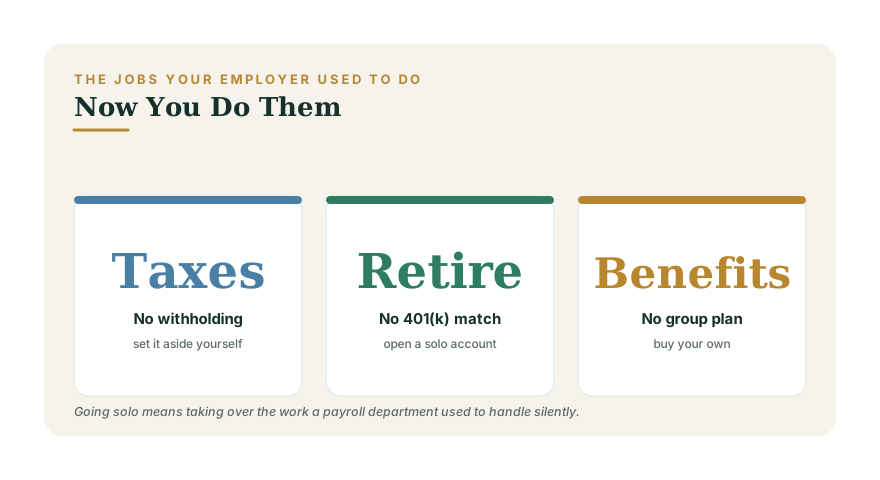
Going freelance or full-time gig work is a kind of promotion you never asked for: overnight, you become your own payroll department, benefits administrator, and tax accountant. The income can be great, but the structure that a regular job quietly provided — steady paychecks, automatic tax withholding, a retirement match, subsidized health insurance — is now yours to rebuild from scratch. The good news is that each piece is manageable once you name it.
Smooth the income before you do anything else
The hardest part of freelance money is not that you earn less — many people earn more — it is that the income arrives in unpredictable lumps. A great month and a dead month can sit right next to each other, and budgeting around either one will burn you. The fix is to stop spending from your income and start spending from a buffer.
Set up a separate "income holding" account where every client payment lands. From there, pay yourself a fixed, modest monthly "salary" into your checking account — based on a conservative average of your slow months, not your good ones. In strong months the holding account builds a cushion; in lean months it covers the gap. This turns a jagged income into a steady paycheck you can actually plan around. The full mechanics are in Budgeting on an Irregular Income.
Set aside for taxes — nobody is doing it for you
This is the trap that catches new freelancers hardest. With no employer withholding, the entire tax bill — federal income tax, state tax, and self-employment tax (the full 15.3% for Social Security and Medicare, since you now pay both halves) — comes due, and the IRS expects it in four installments during the year, not just in April.
The simple defense: every time a payment lands, move a fixed percentage straight into a separate tax savings account and pretend it was never yours. A common starting estimate is 25–30%, adjusted for your bracket and state. Then pay quarterly estimated taxes so you avoid underpayment penalties. And learn what you can deduct — home office, equipment, health premiums, mileage — because as a business owner those write-downs are real money. Start with Self-Employed Tax Deductions You're Probably Missing.
Build your own retirement match
You lost the employer 401(k) match, but you gained access to retirement accounts with far higher contribution ceilings. A SEP-IRA or a Solo 401(k) lets a self-employed person shelter a large share of profit from tax — often well beyond what a salaried 401(k) allows — because you contribute as both the "employee" and the "employer." A Solo 401(k) can even include a Roth side and a loan provision.
The discipline that an automatic payroll deduction used to provide now has to come from you: pick an account, set a recurring contribution, and treat it like a non-negotiable bill. Which account fits your income and paperwork tolerance is laid out in Self-Employed Retirement Accounts Compared, and you can model what consistent contributions grow into with the Retirement Planner.
Buy the benefits you used to get for free
Health insurance is the big one. Without a group plan, most freelancers buy coverage through the ACA marketplace, where income-based subsidies can make it far cheaper than the sticker price suggests. If you choose a high-deductible plan, you unlock an HSA — a rare triple-tax-advantaged account that doubles as stealth retirement savings.
Two more are easy to forget. Disability insurance matters even more for you than for an employee, because there is no sick leave or short-term disability behind you — your income stops the day you cannot work. And an emergency fund should be larger than the standard advice: aim for the higher end, six months or more, because your income itself is variable.
Separate the business from the person
Even a solo operator benefits from drawing a clean line between business money and personal money. A dedicated business checking account makes bookkeeping, deductions, and tax time vastly simpler, and it gives you an honest view of what the work actually earns after expenses. Track income and costs as you go rather than reconstructing the year in a panic each spring — a simple spreadsheet or inexpensive accounting app is enough at the start. This habit also protects you in an audit and makes it obvious whether a slow stretch is a real income problem or just lumpy timing.
Build a small "business runway" too: enough cash to cover a few months of work expenses and your own salary if a major client disappears. Freelance income concentration is a hidden risk — if one client is most of your revenue, a single email can halve your income overnight. Spreading work across several clients is itself a form of financial planning.
Put the structure on autopilot
The whole freelance system comes down to splitting every dollar the moment it arrives — a slice to taxes, a slice to retirement, a slice to your salary, a slice to the buffer — so the discipline lives in the setup, not in your willpower each month. Once those automatic transfers are running, freelancing stops feeling financially chaotic, and the great months quietly fund the lean ones instead of vanishing. Map your full picture, including the self-employed pieces, at the self-employed hub and pressure-test it on the planning hub.