If you work for the federal government or serve in the uniformed services, you have access to the Thrift Savings Plan, or TSP. It is the government's version of a 401(k), and by one important measure — cost — it is arguably the best large retirement plan in the country. Understanding its handful of funds and its matching rules can be worth a great deal over a federal career.
Why the TSP is special: cost
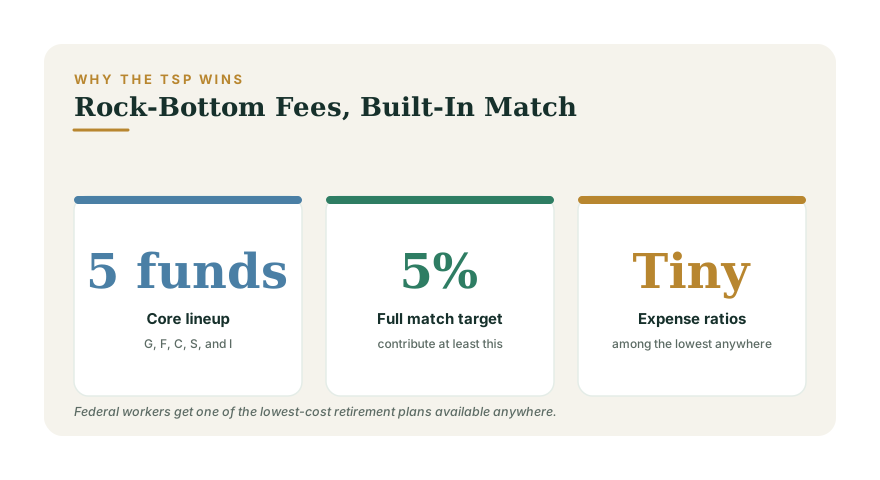
Most of a retirement plan's quality comes down to fees, and the TSP's are famously low — among the cheapest of any plan, anywhere. While a typical 401(k) fund might charge 0.5% to 1% a year (and some 403(b) annuities far more), TSP funds historically cost a tiny fraction of that. Because fees compound against you over decades, that gap alone can mean a meaningfully larger balance at retirement. The reason this matters so much is spelled out in how expense ratios destroy wealth.
The five core funds
The TSP keeps things refreshingly simple. There are five core index funds, each a single letter:
- G Fund — government securities. Effectively no risk of losing principal; the safe, slow-growth anchor.
- F Fund — a broad U.S. bond index. More yield than the G Fund, with some price movement.
- C Fund — large U.S. companies, tracking an S&P 500-style index. The core growth engine.
- S Fund — small and mid-size U.S. companies. Adds the rest of the U.S. market.
- I Fund — international developed-market stocks. Diversifies you outside the U.S.
That is genuinely all you need to build a complete portfolio. A common do-it-yourself mix is mostly C, S, and I for growth (the stock side), with G and F for stability (the bond side), shifting gradually toward the safer funds as you age — the same logic as asset allocation by age.
The Lifecycle (L) funds
If picking your own mix sounds like work, the Lifecycle (L) funds do it for you. You choose the one named for roughly when you will need the money (an L 2050, an L 2060, and so on), and it holds a blend of the five core funds that automatically grows more conservative as the target date nears. It is the TSP's version of a target-date fund — a fully diversified, hands-off, one-decision option. For most federal workers, picking the right L fund and contributing steadily is a perfectly sound strategy. If you would rather build your own, see how to pick funds in your 401(k); the principles carry straight over.
The match — don't leave it behind
Federal employees under the modern FERS system get an employer match, and it is generous. The government automatically contributes an amount equal to 1% of your pay whether or not you save anything, and then matches your own contributions up to a total of 5% of pay. Translation: if you contribute 5% of your salary, you receive the full match — an immediate, guaranteed return you cannot beat elsewhere. Contributing less than 5% means walking away from free money. The first rule of the TSP is simple: contribute at least 5%.
How the TSP fits with FERS
The TSP is one leg of a three-legged retirement stool for FERS employees:
- The FERS pension — a defined-benefit annuity based on your years of service and salary. A real pension, increasingly rare in the private sector.
- Social Security — federal workers under FERS pay into and collect Social Security like everyone else.
- The TSP — your personal savings, which you control and which can grow well beyond the other two.
The pension and Social Security provide a guaranteed income floor; the TSP is the part you build and steer yourself, and the part most able to grow your wealth. Because two of your three legs are guaranteed income, you may be comfortable holding a healthy share of stocks in the TSP. The TSP also offers a Roth option, so you can choose between pre-tax and tax-free growth — the decision in Roth 401(k) vs Traditional 401(k) applies directly.
Bottom line
The TSP is a gift: ultra-low fees, a clean fund lineup, hands-off L funds, and a strong match. The whole game is to contribute at least 5%, pick a sensible allocation (an L fund is fine), and leave it alone for decades. See how your projected pension, Social Security, and TSP add up with the Retirement Planner, and gauge whether you are on pace with the Retirement Readiness assessment.