If you teach, work at a hospital, staff a charity, or hold a government job, the retirement plan on your benefits menu might not say 401(k). It may say 403(b) or 457. These plans do the same essential job as a 401(k) — let you save for retirement with a tax advantage straight out of your paycheck — but each has its own quirks, and a couple of those quirks are worth knowing.
Who has a 403(b)
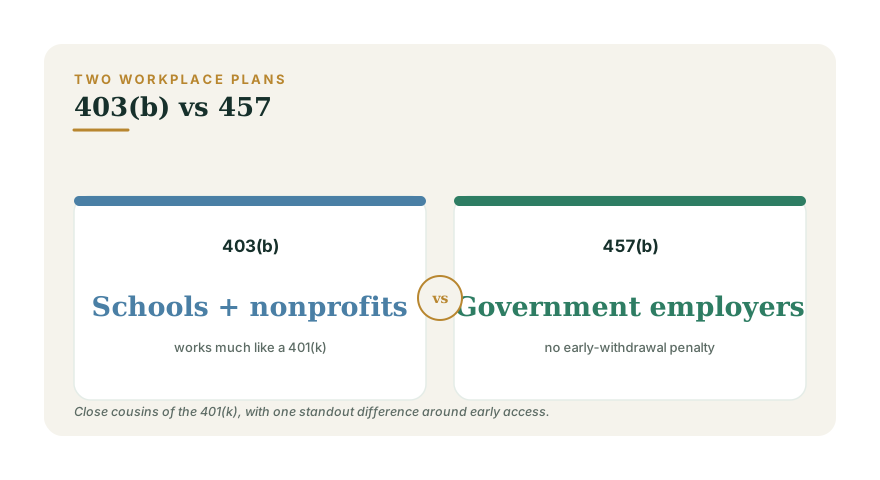
The 403(b) is the nonprofit world's version of the 401(k). You find it at public schools and universities, hospitals, churches, and tax-exempt organizations. Teachers and healthcare workers are the classic examples. Functionally it behaves almost exactly like a 401(k): you contribute pre-tax (or Roth) dollars from each paycheck, the money grows tax-deferred, and many employers offer a match. The annual contribution limit is the same as a 401(k), and some long-tenured employees qualify for a modest extra "service" catch-up on top of the standard age-based catch-up.
Who has a 457
The 457(b) is typically offered to state and local government employees — and sometimes to senior staff at certain nonprofits. It also looks a lot like a 401(k) on the surface: pre-tax or Roth contributions, tax-deferred growth, the same general contribution limit. What makes the governmental 457 special is hidden in the rules around getting your money out.
The 457 early-access advantage
Here is the feature that makes the 457 quietly powerful: with most retirement accounts, taking money out before age 59 and a half triggers a 10% early-withdrawal penalty. A governmental 457 has no such penalty. Once you leave that employer, you can access the money at any age without the 10% hit — you still owe ordinary income tax, but the penalty is gone.
For anyone aiming to stop working before their late 50s, that is a meaningful edge. It can serve as a bridge that funds the early years of retirement before other accounts unlock. If early retirement is on your radar, it pairs naturally with the ideas in the Roth conversion ladder for early retirement. Note that this penalty-free feature applies to governmental 457 plans; non-governmental 457(b) plans (offered by some nonprofits) carry extra risk because the assets are not fully protected from the employer's creditors.
How they compare to a 401(k)
For day-to-day purposes, treat all three as the same animal: a tax-advantaged box you fill from your paycheck. A few differences are worth filing away:
- Matching. 401(k) and 403(b) matches are common. 457 plans match less often, though some governments do.
- Stacking limits. If your employer offers both a 403(b) and a 457, you may be able to contribute the full limit to each, effectively doubling your tax-advantaged space. This is a rare and valuable opportunity for public-sector workers.
- Early access. The governmental 457's penalty-free withdrawals after separation are the standout difference.
The order in which you fund these still follows the usual logic — grab any match first, then weigh tax-advantaged space against an IRA. The reasoning is the same as in 401(k) vs IRA: which comes first.
The fee problem you have to watch
Here is where 403(b) plans, in particular, earn a bad reputation. Many — especially in K-12 school districts — are dominated by insurance companies selling high-cost annuity products dressed up as retirement accounts. It is common to see total annual costs well above 1%, and sometimes surrender charges that lock your money in for years. Over a career, fees like that can quietly erase a large slice of your nest egg. The math on why is laid out in how expense ratios destroy wealth.
Before you commit, dig into the lineup. Ask your benefits office for the full list of providers — these plans often have several — and look for low-cost index funds with expense ratios near 0.1% or lower. If your plan offers a custodial (mutual-fund) account alongside the annuity options, that is usually the cheaper path. Decline products with surrender charges unless you fully understand the trade-off.
Pre-tax or Roth?
Like 401(k)s, many 403(b) and 457 plans now offer a Roth option. The choice between paying tax now versus later comes down to your current versus expected future tax bracket — the same decision covered in Roth 401(k) vs Traditional 401(k). You can split contributions between both if you are unsure.
Putting it to work
The headline: a 403(b) or 457 is a perfectly good retirement vehicle — sometimes a great one, thanks to the 457's early-access feature and the chance to stack both plans. The catch is fees, so audit your fund choices carefully. Once you know what you can contribute, model how it grows over your career with the Retirement Planner, and check whether your overall savings rate is on track with the Retirement Readiness assessment.