Many employer plans now let you choose how your 401(k) contributions are taxed: the traditional route, which gives you a tax break today, or the Roth route, which gives you tax-free money in retirement. It is one of the more consequential checkboxes in your benefits portal, and the logic behind it is simpler than it looks.
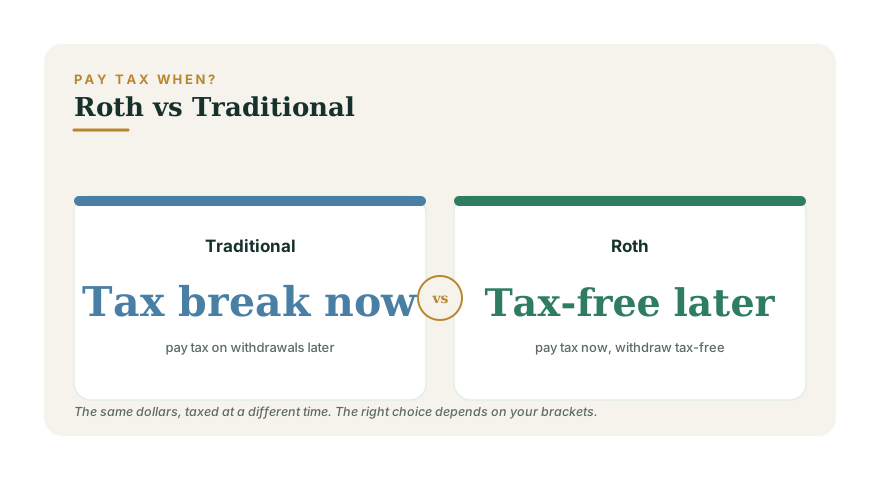
The core trade: now vs later
With a traditional 401(k), your contributions are made with pre-tax dollars. They lower your taxable income today, so you get an immediate tax break. The catch comes later: every dollar you withdraw in retirement — contributions and growth alike — is taxed as ordinary income.
With a Roth 401(k), it is the mirror image. You contribute with after-tax dollars, so there is no tax break today. But the money grows tax-free, and in retirement, qualified withdrawals come out completely tax-free — every dollar of it, including decades of growth. You are choosing when to pay the tax: now, at today's rate, or later, at whatever your rate turns out to be.
How to choose: compare your brackets
The decision hinges on one comparison: is your tax rate likely to be higher now or higher in retirement? (To follow the bracket logic here, it helps to first understand how tax brackets really work.)
- Lean Roth if your tax rate is likely lower now than it will be later. That describes many younger workers and anyone early in their career: you are in a modest bracket today and expect to earn — and be taxed — more down the road. Paying the tax now, at a low rate, locks in tax-free growth.
- Lean traditional if you are in your peak earning years and expect a lower bracket in retirement. The deduction is most valuable when your current rate is high, and you defer the tax to a time when you may pay less on it.
Two things complicate the clean version of this story. First, nobody knows future tax rates — many people expect rates to be higher across the board years from now, which tilts toward Roth. Second, the Roth has a subtle bonus: a Roth contribution effectively shelters more money, because you are paying the tax with outside dollars rather than letting it eat into the account.
You don't have to pick just one
If the choice feels like a coin flip, here is the freeing part: you can split your contributions between traditional and Roth. Many people put part in each, which hedges against an uncertain future and gives you both taxable and tax-free buckets to draw from in retirement. Having both is genuinely useful, because it lets you manage your taxable income year by year once you stop working — pulling from the traditional account up to a target, then topping up tax-free from the Roth.
That flexibility matters more than people realize. Controlling your taxable income in retirement affects how much of your Social Security gets taxed and which Medicare premium tier you land in. A Roth bucket is a powerful lever for keeping reported income down.
The match is always pre-tax
One detail trips people up: even if you contribute to a Roth 401(k), your employer's matching contributions have traditionally gone into the pre-tax (traditional) side and will be taxed when withdrawn. So most people with a Roth 401(k) end up with a mix anyway — Roth from their own contributions, traditional from the match. That is fine, and arguably a feature: you get a bit of both automatically. (Some plans now allow Roth matching as well; check your plan's specifics.)
A few practical notes
- Same contribution limit. The annual cap applies to your combined traditional and Roth 401(k) contributions, not to each separately.
- No income limit. Unlike a Roth IRA, the Roth 401(k) has no income cap, so high earners can use it directly.
- It travels. When you leave a job, a Roth 401(k) can roll into a Roth IRA, which has no required minimum distributions during your lifetime.
- This applies beyond 401(k)s. The same Roth-vs-traditional choice shows up in 403(b), 457, and TSP plans — see 403(b) and 457 plans explained.
Making the call
If you are early-career or in a low bracket, the Roth is usually the stronger bet. If you are at peak earnings and expect a lower retirement bracket, the traditional deduction is attractive. When in doubt, split the difference. To pressure-test the numbers for your own situation, run the comparison through the Roth vs Traditional calculator, then fold the result into your broader retirement plan.