You enroll in your 401(k), feel good about it, and then hit the fund menu — a list of two dozen options with cryptic names, and no obvious instruction on what to pick. Many people freeze here, leave the money in a default cash-like option, or pick randomly. None of that is necessary. For most people, choosing 401(k) funds well comes down to a few simple principles.
Read the menu before you choose
Your 401(k) offers a fixed list of funds chosen by your employer's plan. They usually fall into a few groups: target-date funds (often named for a retirement year like "2055"), broad index funds (total stock market, international, bond), more specialized or actively managed stock funds, and a stable-value or money-market option. Your job is not to understand all of them — it is to recognize which are the cheap, diversified building blocks and which are the expensive distractions.
For each fund you are considering, find two numbers on its fact sheet: what it invests in, and its expense ratio. Learning to skim that document quickly is a high-value skill; see how to read a fund fact sheet. Those two pieces of information are enough to make a good decision.
The simplest sensible choice: a target-date fund
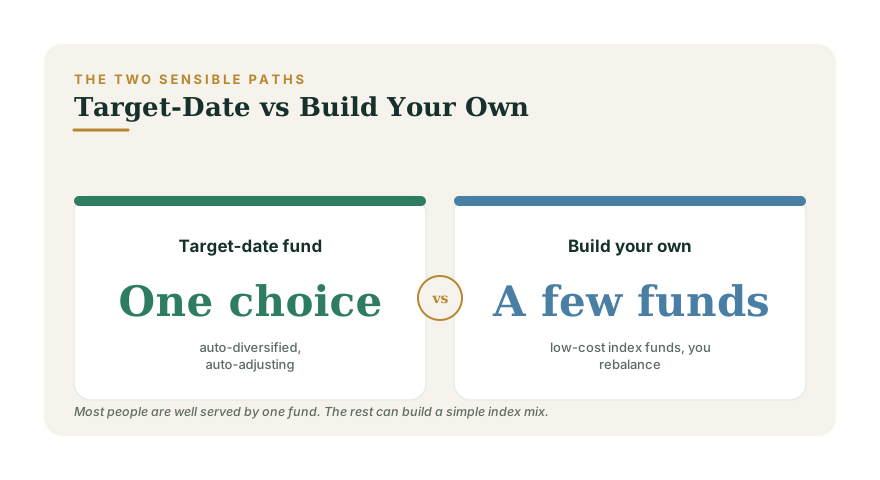
If you want one decision and done, a target-date fund matched to roughly when you will retire is hard to beat. You pick the year closest to your expected retirement, put your contributions there, and the fund does the rest: it holds a diversified mix of stocks and bonds, rebalances itself, and gradually shifts toward more conservative holdings as the date approaches. It is a complete, hands-off portfolio in a single fund.
The one thing to check is the expense ratio. Most index-based target-date funds are inexpensive; some are not. If yours is cheap and broadly diversified, you can genuinely stop here — it is a perfectly respectable lifetime choice for the bulk of investors.
Building your own: a few index funds
If you prefer more control or your plan's target-date option is pricey, you can assemble a simple portfolio from the index funds on the menu. A classic, durable approach is a small handful of broad index funds — a total U.S. stock fund, an international stock fund, and a bond fund — held in proportions that suit your age and risk tolerance. This is the three-fund portfolio idea, and most 401(k) menus contain the pieces to build it.
The trade-off is that you take on two small jobs the target-date fund handled for you: choosing your stock-to-bond split, and rebalancing occasionally to keep it on track. Neither is hard, but if you would not actually do them, the target-date fund is the better honest choice. The fuller comparison is in target-date funds vs a custom portfolio.
Watch the expense ratios — relentlessly
The expense ratio is the percentage of your money a fund charges every year, and inside a 401(k) it is the single biggest controllable drag on your returns. A fund charging 1% versus one charging 0.05% does not sound like much, but over a career that difference can quietly consume a large slice of your final balance. Whenever two funds invest in similar things, the cheaper one almost always wins over the long run.
So the rule is simple: among the broadly diversified options, favor the lowest-cost index funds available on your menu. Be skeptical of expensive actively managed funds promising to beat the market; most do not, especially after their higher fees. If you suspect your plan's options are all costly, that is a real issue worth raising with your employer — but you can still pick the least-bad option and capture the match in the meantime.
Avoid the common 401(k) mistakes
A few errors cost people more than fund selection itself: leaving contributions in a default cash option earning almost nothing, not contributing enough to get the full employer match, or chasing last year's hot fund. Sidestepping these matters more than fine-tuning your allocation; the list is in 401(k) mistakes that cost you.
Put it together
For most people the whole decision is this: contribute enough to get the full match, then either choose a low-cost target-date fund or build a simple index mix, keep your eye on expense ratios, and review once a year. That is it — no need to master the entire menu. To pressure-test your choices and see how today's contributions translate into a retirement number, run them through the Retirement Planner.