A Roth conversion is the act of moving money from a pre-tax retirement account — Traditional IRA, 401(k), 403(b), or similar — into a Roth IRA. The converted amount is added to your taxable income in the year of conversion. In exchange, that money grows tax-free in the Roth account and can be withdrawn tax-free in retirement, with no required minimum distributions during your lifetime.
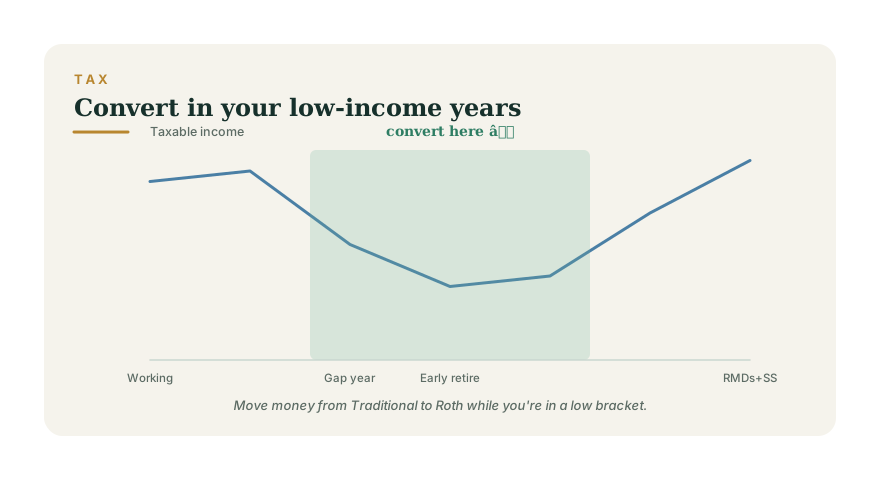
Done at the right time and in the right amounts, Roth conversions can dramatically reduce your lifetime tax burden. Done carelessly — too much, too fast, in high-income years — they can generate avoidable tax bills. The difference between a well-executed conversion strategy and a poorly timed one can easily exceed $100,000 in lifetime taxes for someone with significant pre-tax savings.
The Core Logic: Lower Taxes Now vs Later
A Roth conversion makes financial sense when the tax rate you pay today on the conversion is lower than the tax rate you would have paid on those funds later as ordinary income or RMDs.
This creates a natural window of opportunity for people who:
- Have retired early and have income below their peak-career level
- Are in the window between retirement and RMD start age (73)
- Have a year with unusually low income (career gap, business loss, large deductions)
- Have significant pre-tax balances that will generate large, unavoidable RMDs in their 70s and 80s
The RMD Problem: Why Conversions Often Matter More Than People Realize
The most overlooked reason to consider Roth conversions is RMD management. Required Minimum Distributions begin at 73, and they are calculated as a percentage of your traditional account balances. A person with $2 million in Traditional IRA accounts at 73 must take approximately $75,000 in RMDs in year one — whether they need it or not. That $75,000 is added to any other income (Social Security, pension, investment dividends), potentially pushing the retiree into higher tax brackets and triggering Medicare surcharges.
By converting $30,000–$50,000 per year in the years between retirement and RMD start age — paying tax at a lower bracket — you reduce the pre-tax balance subject to future RMDs. The tax you pay during conversion is often significantly less than the tax you would eventually pay on those same dollars as RMDs in your 70s.
Bracket Filling: The Core Strategy
The most practical Roth conversion approach is "bracket filling" — converting enough pre-tax funds each year to use up your available lower tax bracket space without crossing into the next bracket.
In 2025, the 22% federal bracket for single filers covers income from $47,150 to $100,525. If your total income (Social Security, investment income, part-time work) for the year is $60,000, you have roughly $40,000 of unused 22% bracket space. You could convert up to $40,000 of Traditional IRA funds, paying 22% tax on that amount, and stay within the 22% bracket.
The same approach works for married filers with correspondingly wider bracket ranges.
This strategy requires estimating your total income for the year before making conversion decisions — ideally in October or November, when you have a clear picture of your year's income but still have time to execute before December 31.
How Much to Convert Each Year
There is no universal answer — the right conversion amount depends on your current income, the size of your pre-tax balances, your expected future income, and your projections for future tax rates. A few considerations:
Convert up to (but not over) the next bracket boundary. Crossing into a higher tax bracket with conversion income increases the marginal cost of each additional dollar converted. Be precise about where bracket boundaries fall for your filing status.
Mind the Medicare surcharges. IRMAA (Income-Related Monthly Adjustment Amount) adds surcharges to Medicare Part B and D premiums for higher-income beneficiaries. The 2025 thresholds begin at $106,000 for individuals and $212,000 for married filers. A large conversion that crosses an IRMAA threshold can add $1,000–$7,000 per year in Medicare premiums — assessed on the income from two years prior. Factor this into your conversion sizing.
Consider state taxes. If you live in a high-income-tax state (California, New York, New Jersey), Roth conversions can be expensive. Some retirees strategically delay large conversions until they relocate to a lower-tax state — though this is a complex planning decision with many trade-offs.
Paying Conversion Tax from Non-Retirement Funds
The value of a Roth conversion is maximized when you pay the tax bill from outside the IRA — using taxable savings or income — rather than by withholding from the converted amount. If you convert $50,000 and withhold $10,000 for taxes, only $40,000 enters the Roth. If you pay the $10,000 tax from a bank account, the full $50,000 is in the Roth earning tax-free returns.
The withheld amount also counts as a distribution (if taken before 59½, it may trigger a penalty) and forgoes decades of tax-free compounding. Whenever possible, convert without withholding and pay the resulting tax bill from other funds.
The Break-Even Analysis
A useful sanity check for any conversion is the break-even calculation: how many years until the tax-free compounding in the Roth recovers the tax you paid upfront?
A rough rule: at a 7% annual return and assuming a future RMD tax rate higher than your current conversion tax rate, most Roth conversions break even in 10–15 years. If you are in your 50s or early 60s and have a long retirement ahead, conversions made now have 25–40 years to compound — well beyond any reasonable break-even period.
When Roth Conversions Are Less Compelling
Not everyone should rush to convert. Conversions are less attractive when your current tax rate is equal to or higher than your expected retirement rate; when you have short life expectancy or expect to spend down your portfolio quickly; when you plan to leave retirement assets to charity (which can claim the charitable deduction and reduces the tax impact of inheriting pre-tax accounts); or when converting would require taking money from the IRA itself to pay the taxes.
Roth conversion planning benefits enormously from detailed modeling. Use the Roth Conversion Analyzer tool to input your specific balance, income projections, and timeline. The right answer for your situation may be different from the right answer for someone with a similar income but different account structure or retirement plans.