Choosing where to open your investing account can feel like a momentous decision, as if picking the wrong company will cost you years of returns. It will not. For the vast majority of long-term investors, the largest brokerages — Fidelity, Vanguard, and Schwab among them — are all genuinely solid choices. The differences between them are real but small, and none of them is a trap.
What matters far more than which logo is on your account is that you open one, fund it regularly, and buy low-cost diversified funds. Still, it helps to know what to actually compare so you can pick with confidence and move on.
Fees: mostly a solved problem
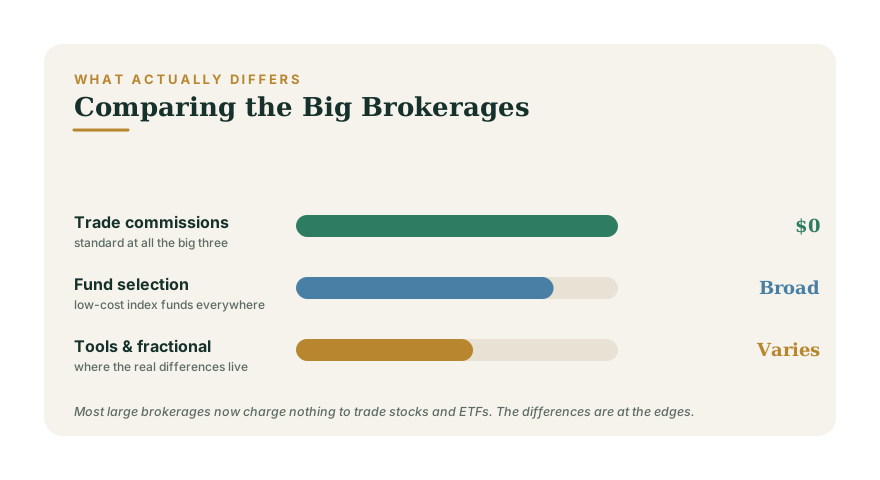
A decade ago, brokerages competed on trade commissions. Today the major firms charge nothing to buy and sell stocks and exchange-traded funds, so commissions are rarely a deciding factor. The fees that still matter are the ones buried inside the funds you buy — the expense ratios — not the cost of placing a trade. A high expense ratio quietly drains returns year after year, which is why it deserves more attention than the headline commission; the math is laid out in how expense ratios destroy wealth.
Watch instead for the small print: account maintenance fees (most large brokerages have none), fees to transfer your account out, and the rates paid on uninvested cash. Some brokers automatically sweep idle cash into a money-market fund paying a competitive yield; others leave it earning almost nothing. Over time that gap adds up.
Fund selection: can you buy what you want cheaply?
The single most useful question is whether the brokerage gives you easy, cheap access to broad index funds. All three of the big providers do. You can build a complete portfolio of total-market and international index funds at any of them, often with no transaction fee and very low expense ratios. If you already know you want a simple, durable mix like the three-fund portfolio, every major brokerage can hold it.
There are minor wrinkles. Each firm tends to push its own house funds, which are usually excellent and low-cost. You can typically buy another company's index ETFs commission-free as well, so you are not locked in. Unless you have an exotic need, fund selection should not be the thing that decides it.
Tools, service, and the overall experience
This is where personal preference actually shows up. Consider how the website and mobile app feel, how good the research and planning tools are, and whether you can reach a human when you need one. Some brokerages have extensive branch networks and strong phone support; others lean more digital. If you value walking into a branch, that narrows the field; if you live in the app, judge the app.
For a beginner, the most valuable feature is often the least flashy: clear statements, painless automatic investing, and a clean interface that does not tempt you into day-trading. A brokerage that makes it easy to set up recurring contributions and hard to do something reckless is doing its job.
Fractional shares and automation
If you are investing modest amounts, check whether the brokerage offers fractional shares — the ability to buy a slice of a share rather than a whole one. This lets you put an exact dollar amount to work even if a single share costs hundreds of dollars, and it makes automatic investing far smoother. Support varies: some brokers offer fractional buying on a wide range of stocks and ETFs, others only on their own mutual funds. If recurring small investments are central to your plan, weight this feature heavily.
Don't overthink it
Here is the honest summary: pick any of the large, reputable, low-cost brokerages and you will be fine. The differences are at the margins, and you can always transfer to another firm later if your needs change — moving an account is more paperwork than peril. The far bigger risk is letting the choice become an excuse to delay starting.
If you are still deciding what a brokerage account even is and how it fits alongside your 401(k) and IRA, start with what a brokerage account actually is. When you are ready to translate this into an actual portfolio, the Portfolio Builder can help you sketch a sensible mix you can buy at whichever brokerage you choose.