You do not need a complicated portfolio to build serious wealth. In fact, one of the most respected approaches among long-term investors uses just three low-cost index funds. It is cheap, takes minutes to manage, and over time it quietly outperforms the large majority of professional money managers. The whole idea is to own nearly everything and then get out of your own way.
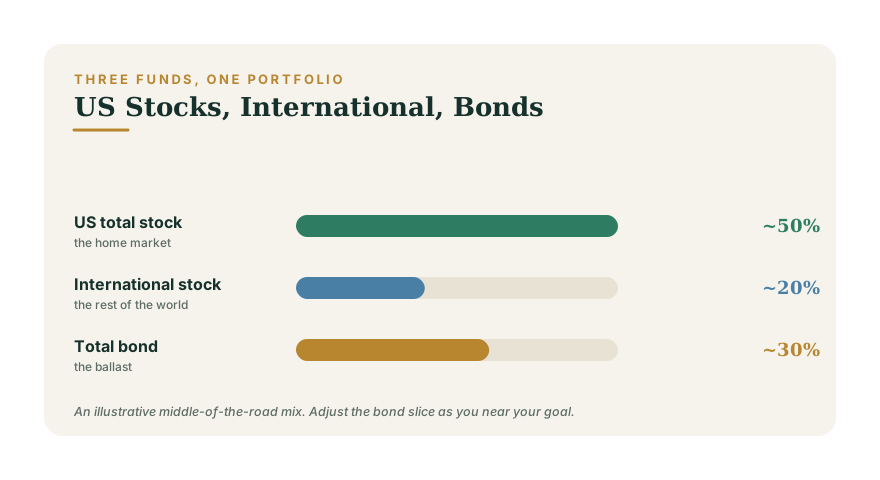
The three funds, and what each does
The portfolio is built from three broad index funds, each covering a huge slice of the investable world:
- A US total stock market fund — owns essentially every publicly traded American company, from the giants to the small caps. This is your engine of long-term growth.
- An international (total ex-US) stock fund — owns companies in the rest of the world, both developed and emerging markets. This spreads your bet beyond a single country's economy.
- A total bond market fund — owns a broad mix of US bonds. Bonds are the ballast: they cushion the ride when stocks fall and reduce how much your portfolio swings.
That is it. With three holdings you own thousands of companies and bonds across the globe. If the terms are new, start with the beginner's guide to index funds.
Why simplicity actually wins
It is tempting to think more funds, more strategy, and more activity must produce better results. The evidence points the other way. A simple, broadly diversified, low-cost portfolio wins for a few concrete reasons:
- Low costs compound in your favor. Index funds charge a tiny fraction of what active funds do, and every dollar not lost to fees stays invested and growing. Over decades, the fee gap alone can be worth a small fortune.
- You can't be fooled by complexity. A portfolio you fully understand is one you will actually hold through a downturn. Complicated portfolios invite tinkering, and tinkering tends to lose.
- Broad diversification removes single-bet risk. When you own everything, no single company, sector, or fad can sink you.
- It is nearly maintenance-free. Three funds are easy to rebalance once a year and easy to ignore the rest of the time — which, for investors, is a feature.
The reason this beats the pros is structural: most active managers fail to outperform a simple index after fees, year after year. You are not trying to be clever; you are refusing to pay for cleverness that rarely shows up.
Sample weights by age
There is no single correct split — it depends on your timeline and how much volatility you can stomach. The two levers are how much you put in stocks versus bonds, and how you divide stocks between US and international. A rough, illustrative framework:
- In your 20s and 30s: heavily weighted to stocks — perhaps 80–90% stocks, 10–20% bonds. Time is on your side, so you can ride out declines for the higher long-run return.
- In your 40s and 50s: gradually adding bonds — maybe 60–75% stocks. You are protecting gains while still growing.
- Near and in retirement: a more balanced mix — often 40–60% stocks — to reduce the damage a crash could do just as you start withdrawing.
Within the stock portion, a common choice is to put roughly 20–40% of stocks into international. For a deeper framework on shifting the mix over time, see asset allocation by age, and for why the foreign slice matters at all, read why diversify beyond the US.
Which accounts to hold it in
The three-fund portfolio works in any account, but a little thought about placement can save on taxes. The general order of operations: fund tax-advantaged accounts first — capture any employer 401(k) match, then use an IRA, then more 401(k). Inside those accounts, buying and rebalancing triggers no taxes, so they are the ideal home for the bond fund, which throws off regularly taxed interest. A taxable brokerage account is fine for the stock funds once your tax-advantaged space is full. The key point is that the same three funds can simply be spread across whatever accounts you have, treated as one combined portfolio.
Getting started
You can implement the whole thing in an afternoon: open the accounts, pick your stock/bond split, choose low-cost total-market index funds, and set up automatic monthly contributions. Then rebalance once a year and otherwise leave it alone. To pick weights that match your timeline and temperament, explore the model portfolios tool, and use the portfolio builder to turn your target into a concrete plan you can fund every month.