"How much do I need to retire?" is the most common money question there is, and the honest answer is that it depends — mostly on how much you plan to spend. A retiree who lives on $40,000 a year and one who needs $120,000 are solving two completely different problems, even at the same age. So the right way to find your number is not to copy someone else's, but to build it from your own planned spending.
Start with spending, not a round number
Forget the headline figures you see in magazines. The foundation of any retirement estimate is your annual spending in retirement. Many people spend somewhat less than they did while working — the mortgage may be gone, the kids independent, commuting and payroll taxes behind them — while others spend more in the early "go-go" years on travel and hobbies. Build a realistic monthly budget for the life you actually want, then annualize it. That spending number is the engine of the whole calculation.
Subtract your guaranteed income
Your portfolio does not have to cover all of that spending. Subtract any income that arrives no matter what: Social Security, a pension, an annuity, rental income. What remains — the gap between your spending and your guaranteed income — is the part your savings must fund. This is the number that actually drives how big a nest egg you need, and it is often far smaller than people assume. When you claim Social Security matters a great deal here; the trade-offs are in Social Security Claiming Strategies.
The 25x rule of thumb
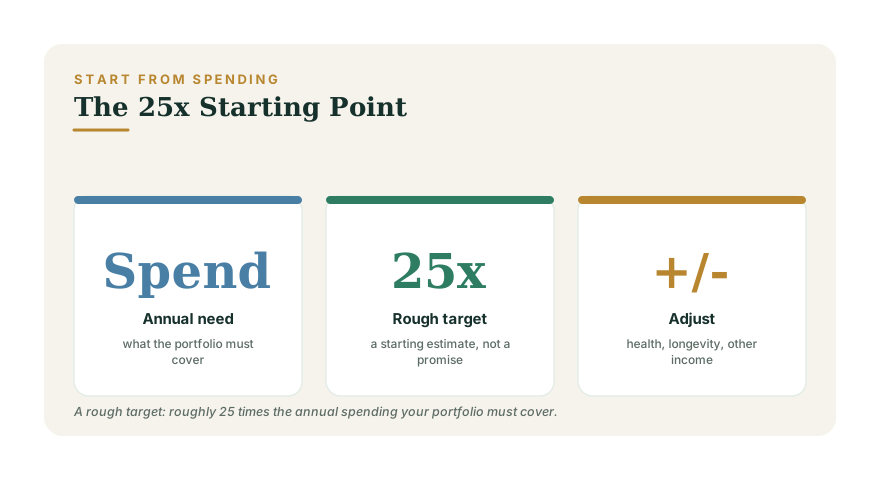
Once you know the annual amount your portfolio must provide, a widely used shortcut is to multiply it by 25. Need $40,000 a year from the portfolio? A rough target is $1,000,000. This 25x figure is just the inverse of a 4% initial withdrawal rate — take out 4% in year one, and 25 times your spending is what supports it. It is a starting estimate, not a guarantee; where it comes from and where it breaks down is covered in The 4% Rule: Where It Comes From and Its Limits.
Why a single number is only a starting point
The 25x figure quietly assumes a roughly 30-year retirement and average market history. Several things can push your real number higher or lower:
- Longevity. Retiring at 55 instead of 67 can mean funding 40 years, not 30 — a longer horizon needs a larger cushion or a lower withdrawal rate.
- Sequence of returns. A market crash in your first few retirement years does far more damage than the same crash later. More on this in Sequence-of-Returns Risk.
- Inflation. Your number must grow over time; what covers your life today will not in 20 years.
- Taxes. A dollar in a traditional 401(k) is worth less than a dollar in a Roth, because the IRS takes a cut on the way out.
Healthcare is the wild card
Healthcare is the expense most people underestimate. If you retire before 65, you must bridge to Medicare on your own, which can be expensive. Even after 65, Medicare has premiums, deductibles, and gaps, and long-term care is a real possibility that Medicare largely does not cover. A serious estimate sets aside a dedicated allowance for medical costs that rises faster than general inflation. The landscape is laid out in Healthcare Costs in Retirement.
Turn the estimate into a plan
The point of a number is to tell you whether you are on track and what to change if you are not — save more, work a couple of years longer, or trim planned spending. Rather than guess, model it: the Retirement Planner lets you enter your spending, savings, and timeline and see whether the math holds. If financial independence is your aim, What Is Your FI Number? walks through the same logic. Run your numbers, then revisit them yearly — your retirement target is a moving estimate you refine, not a fixed line you cross once.