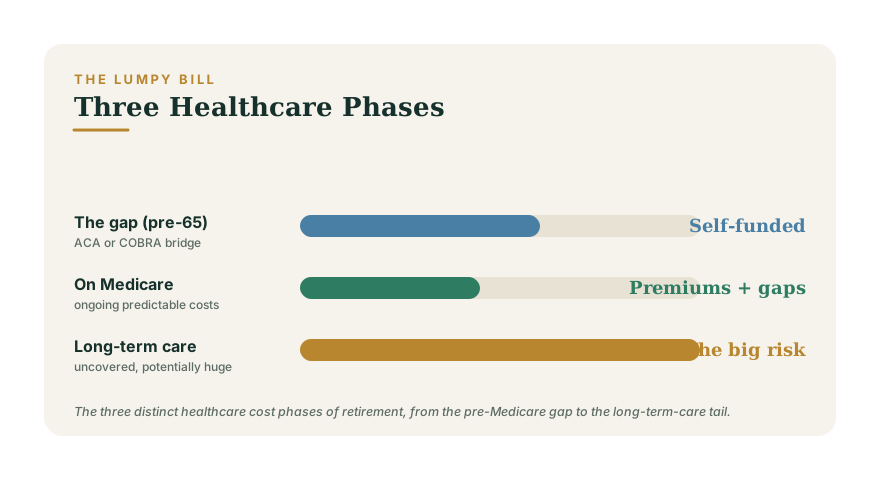
Ask most people what could blow up their retirement and they will say a market crash. The more reliable answer is healthcare. It is the cost category that is large, unpredictable, and arrives in lumps right when income is fixed. A frequently cited estimate puts the lifetime out-of-pocket healthcare bill for a retired couple at well into the hundreds of thousands of dollars, and that figure typically excludes the single largest risk of all: long-term care. Planning for it is less about hitting a precise number and more about preparing for three very different phases.
The lifetime estimate, in context
The big scary number that makes headlines, often quoted as roughly a few hundred thousand dollars per couple over retirement, is real but easy to misread. It is a lifetime total spread across decades, not a bill due on day one. It also assumes you are on Medicare, so it mostly captures premiums, deductibles, copays, and the things Medicare does not cover. Treat it as a planning anchor, not a savings target you must hit before retiring. The more useful exercise is to break the cost into its phases and prepare for each.
Phase one: the gap before Medicare
If you retire before 65, you fall into the most dangerous and most overlooked phase. You are too young for Medicare and no longer covered by an employer, so you must bridge the gap yourself. The main options:
- ACA marketplace coverage: you can buy an individual plan on the marketplace, and because premium subsidies are based on income, a retiree who controls taxable income (drawing from savings, Roth, or cash) can sometimes qualify for substantial help. This makes income planning and healthcare planning the same conversation.
- COBRA: you can often continue your former employer's plan for a limited stretch, but you pay the full premium plus an administrative fee, which is usually expensive. It is best as a short bridge, not a multi-year solution.
- A spouse's plan if one is still working with coverage.
This pre-65 gap can be the single most expensive period of your retirement on a monthly basis, which is exactly why early-retirement plans live or die on how they handle it.
Phase two: life on Medicare
At 65 Medicare takes over the heavy lifting, but it is not free. You will pay Part B premiums, likely a Part D drug premium, and either a Medigap premium or Medicare Advantage out-of-pocket costs. Higher earners pay the IRMAA surcharge on top. These costs are relatively predictable year to year, which makes them straightforward to build into a budget, but they rise with age and with healthcare inflation, so they deserve a dedicated line in your plan rather than a vague allowance.
Phase three: the long-term care wildcard
This is the exposure that can genuinely wreck a financial plan, and Medicare does not cover it. Long-term care means the extended help with daily living, an in-home aide, assisted living, or a nursing home, that many people eventually need. The costs are large: a year in a nursing home can run into six figures, and stays can last years. The risk is uneven, most people need some care and a minority need a lot, which makes it hard to self-insure with certainty. The main ways to handle it:
- Self-fund from a dedicated slice of your portfolio if your assets are large enough to absorb a multi-year stay.
- Long-term care insurance or hybrid life-insurance policies that include a care benefit, which spread the risk but come with rising premiums and complexity.
- Medicaid, the safety net, which covers long-term care only after you have spent down most assets.
There is no clean answer here, but the worst plan is no plan, assuming you will simply never need it.
The HSA as a purpose-built funding tool
If you have access to a high-deductible health plan during your working years, the Health Savings Account is arguably the best vehicle ever created for retirement healthcare. Contributions are deductible, growth is tax-free, and withdrawals for qualified medical expenses are tax-free, a rare triple advantage. Money you do not spend rolls over indefinitely and can be invested for decades. The savviest savers treat the HSA not as a spending account but as a dedicated medical-expense war chest for retirement, paying current bills out of pocket and letting the balance compound. After 65 it becomes even more flexible, functioning like a traditional account for non-medical withdrawals.
The honest plan
You cannot predict your exact healthcare bill, but you can prepare structurally: a strategy for the pre-65 gap, a realistic premium budget on Medicare, an explicit decision about long-term care, and an HSA funded aggressively while you are still working. Fold those four pieces into your numbers on the plan, and read our deeper dive on the HSA triple tax advantage to make the most of that account.