Financial independence sounds abstract until you give it a number. That number is the size of the portfolio that can support your lifestyle without a paycheck. Once you know it, financial independence stops being a vague aspiration and becomes a target you can measure progress against, the same way you track any other goal.
This piece focuses on calculating the number. For the broader philosophy and the honest critiques of the early-retirement movement, see The FIRE Movement Explained: Lean, Fat, and Coast FIRE and Early Retirement: Where the FIRE Math Gets Oversimplified.
The 25x rule
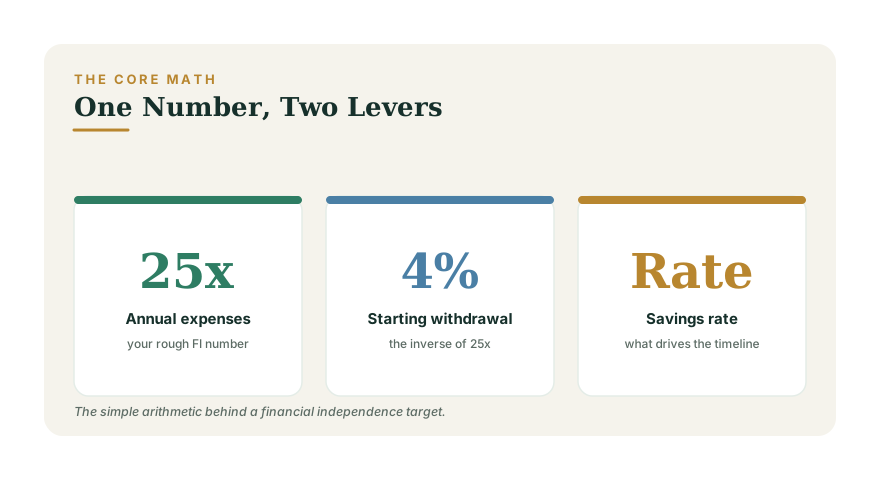
The simplest estimate is this: take your expected annual expenses in retirement and multiply by 25. If you expect to spend about $40,000 a year, your rough financial independence number is around $1 million. Spend $80,000? You need roughly $2 million. The figure scales directly with your spending, which is why controlling expenses does double duty: it frees up money to invest and lowers the target you are aiming at.
Note that the number is driven by spending, not income. Two people earning the same salary can have very different financial independence numbers depending on how they live.
The 4% rule and its critiques
Where does 25x come from? It is the inverse of the 4% rule, a guideline drawn from historical research suggesting that withdrawing about 4% of a portfolio in the first year, then adjusting for inflation, has typically lasted around 30 years. Multiplying expenses by 25 is just another way of saying you withdraw 4% of 25x.
It is a starting estimate, not a law. Reasonable critiques include:
- It was based on specific historical market and bond conditions that may not repeat.
- A 30-year horizon may be too short for someone retiring in their 40s, arguing for a more conservative rate.
- Poor returns in the first years of retirement, known as sequence-of-returns risk, can strain even a careful plan.
Many planners treat a withdrawal rate somewhere in the 3% to 4% range as a sensible band, with flexibility to spend less in down markets.
What actually drives the timeline
The biggest lever on how soon you reach the number is not your investment returns; it is your savings rate, the share of take-home pay you keep. A higher savings rate works on both ends at once: it pours more into the portfolio and trains you to live on less, which shrinks the target. Someone saving half their income reaches financial independence dramatically faster than someone saving a tenth of it, even with identical returns.
Coast, lean, and fat variations
The single number comes in flavors. Lean financial independence targets a frugal lifestyle and a smaller portfolio. Fat aims for a generous lifestyle and a larger one. Coast means you have invested enough early that, even without adding another dollar, growth alone should carry you to a traditional retirement, so you only need to cover current expenses from here. Pick the version that fits the life you actually want.
Run your own numbers
Start with one honest figure: your real annual spending. Multiply by 25 for a baseline target, then stress-test it against different savings rates and time horizons rather than trusting a single estimate. Model your own path and watch how the savings rate moves the finish line at /tools/wealth-simulator.