If you read anything about retirement, you will run into the "4% rule." It is the closest thing personal finance has to a household name for spending down a portfolio. Like most rules of thumb, it is genuinely useful and routinely misunderstood. Knowing where it came from explains both its strength and its limits.
Where it came from
The rule traces to research in the 1990s, most famously the Trinity study, named for the university where three professors ran it. They asked a simple question: how much could a retiree withdraw from a stock-and-bond portfolio each year without running out of money over a 30-year retirement, across every historical period they could test? Their answer was that an initial withdrawal of about 4%, adjusted for inflation thereafter, survived almost all of those historical 30-year windows. That "safe withdrawal rate" became the 4% rule.
How the rule actually works
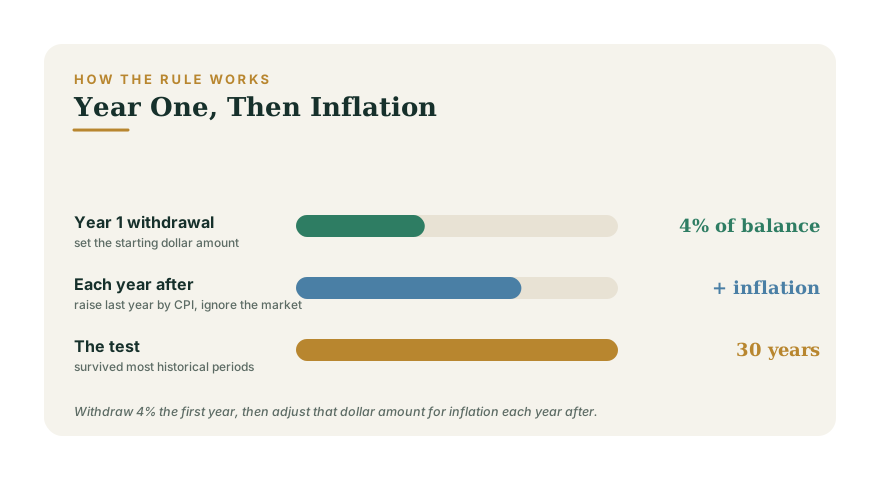
The mechanics are precise, and people get them wrong constantly. It is not "take out 4% of your balance every year." It is:
- Year one: withdraw 4% of your starting portfolio. On $1,000,000, that is $40,000.
- Every year after: take last year's dollar amount and increase it by inflation. If inflation was 3%, year two is $41,200 — regardless of what the market did.
That inflation adjustment is the whole point: it keeps your spending power roughly constant. The flip side, also the point, is the 25x relationship — 4% is one twenty-fifth, so a portfolio of 25 times your first-year spending is what the rule assumes you start with. That connection is explored in How Much Do You Actually Need to Retire?
The criticisms
The rule has aged into a starting point rather than gospel, for good reasons:
- It was built on US history. A century of strong US stock returns may not repeat, and starting from high valuations or low bond yields can lower the safe rate.
- It ignores sequence risk. The rule's danger years are early ones; a crash right after you retire, combined with steady withdrawals, can permanently damage a portfolio. This is the single biggest threat, covered in Sequence-of-Returns Risk.
- It assumes rigid spending. No real retiree spends the exact same inflation-adjusted amount through a market crash. Humans naturally cut back, and the rule gives no credit for that flexibility.
- It assumes 30 years. Early retirees planning for 40-plus years need a more conservative rate.
Modern variations that fix the blind spots
The response to these criticisms is not to abandon the rule but to add flexibility:
- Guardrails. Set an upper and lower band around your withdrawal rate. If markets soar and your rate drifts low, give yourself a raise; if markets fall and your rate climbs too high, trim spending. Small, rules-based adjustments dramatically improve durability.
- Flexible spending. Plan to spend more in good market years and pull back in bad ones, especially on discretionary items like travel.
- Lower starting rates. Cautious retirees, or those with very long horizons, start nearer 3–3.5% for a wider margin of safety.
Use it as a compass, not a contract
The 4% rule's real value is as a quick sanity check: multiply your desired spending by 25 and you have a rough savings target. Treat it as the start of the conversation, not the end of it. Pair it with a flexible withdrawal plan — see How to Turn a Nest Egg Into a Monthly Paycheck — and test your own numbers against history with the Retirement Planner before you rely on any single rate.